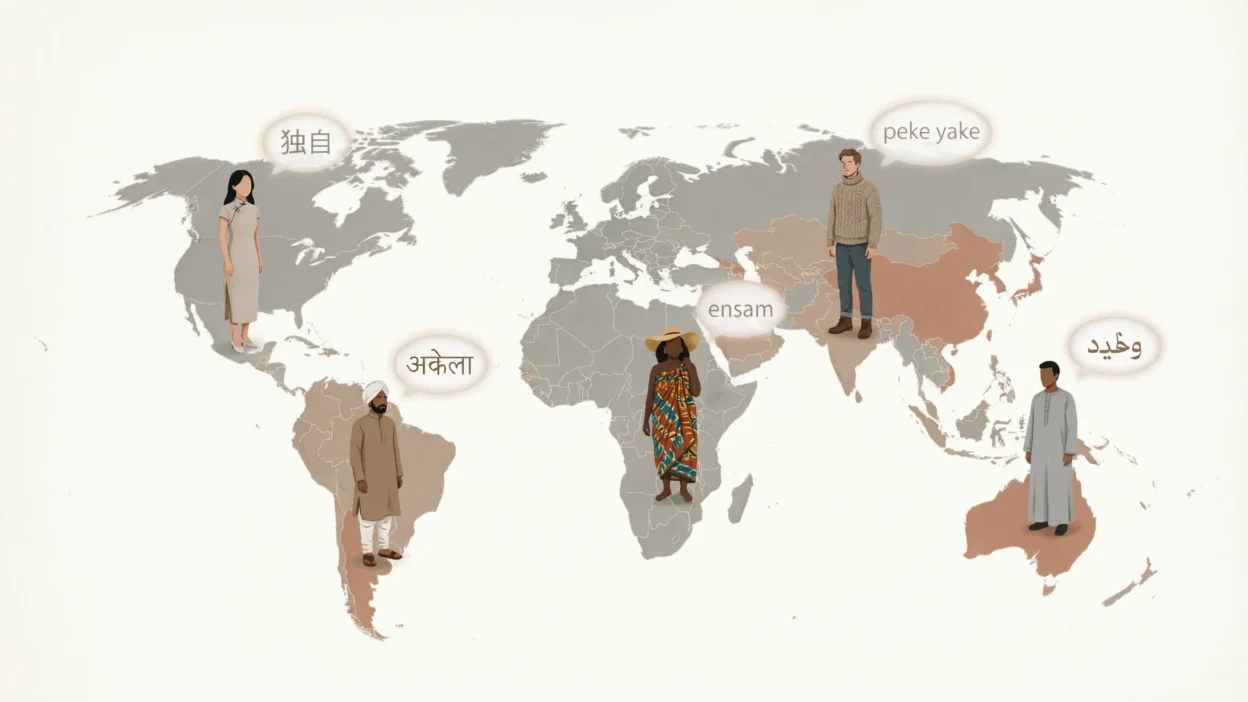
Understanding how to express alone in different languages is useful for travelers, language learners, writers, and anyone curious about global communication. Whether you want to describe being by yourself, feeling independent, or simply standing solo, this single word appears in everyday conversations across cultures.
In this guide, you’ll discover how to say alone in different languages, complete with pronunciation and real-life example sentences. This article is designed to match informational search intent and help you quickly find accurate, human-friendly translations of alone around the world.
“Alone” in Different Languages (70 Languages)
The table below shows alone in all languages with pronunciation, a short example sentence, and the English meaning of that sentence. It’s clean, simple, and optimized for easy reading on mobile and desktop.
| Language | Pronunciation | Example |
| English | uh-lohn | I am alone at home. (I am by myself at home.) |
| Spanish | so-lo | Estoy solo hoy. (I am alone today.) |
| French | suh-luh | Je suis seul ici. (I am alone here.) |
| German | ah-lahn | Ich bin allein. (I am alone.) |
| Italian | soh-lo | Sono solo ora. (I am alone now.) |
| Portuguese | soh-lo | Estou sozinho. (I am alone.) |
| Dutch | uh-lain | Ik ben alleen. (I am alone.) |
| Russian | ah-deen | Ya adin. (I am alone.) |
| Arabic | wah-heed | Ana waheed. (I am alone.) |
| Hindi | uh-keh-la | Main akela hoon. (I am alone.) |
| Urdu | uh-kay-la | Main akela hoon. (I am alone.) |
| Bengali | eh-ka | Ami eka. (I am alone.) |
| Punjabi | uh-kay-la | Main akela aan. (I am alone.) |
| Chinese (Mandarin) | duhn | Wo yi ge ren. (I am alone.) |
| Japanese | hi-to-ri | Watashi wa hitori desu. (I am alone.) |
| Korean | hon-ja | Naneun honja-ya. (I am alone.) |
| Thai | khon-dee-ow | Chan yuu khon-dee-ow. (I am alone.) |
| Vietnamese | moht meen | Toi o mot minh. (I am alone.) |
| Indonesian | sen-dee-ree | Saya sendiri. (I am alone.) |
| Malay | sen-dee-ree-an | Saya sendirian. (I am alone.) |
| Filipino | ma-ga-ee-sa | Mag-isa ako. (I am alone.) |
| Swahili | pee-key-ya-key | Niko peke yangu. (I am alone.) |
| Zulu | nguh-duh-wah | Ngodwa lapha. (I am alone here.) |
| Yoruba | nik-un | Mo wa nikan. (I am alone.) |
| Hausa | ka-deye | Ina kadai. (I am alone.) |
| Turkish | yah-niz | Yalnızım. (I am alone.) |
| Greek | mo-nos | Eimai monos. (I am alone.) |
| Polish | sah-mot-nee | Jestem sam. (I am alone.) |
| Czech | sahm | Jsem sám. (I am alone.) |
| Slovak | sahm | Som sám. (I am alone.) |
| Hungarian | eh-jay-doohl | Egyedül vagyok. (I am alone.) |
| Romanian | sing-goor | Sunt singur. (I am alone.) |
| Bulgarian | sam | Az sam sam. (I am alone.) |
| Serbian | sahm | Ja sam sam. (I am alone.) |
| Croatian | sahm | Ja sam sam. (I am alone.) |
| Slovenian | sahm | Sem sam. (I am alone.) |
| Finnish | yook-sin | Olen yksin. (I am alone.) |
| Swedish | en-sahm | Jag är ensam. (I am alone.) |
| Norwegian | ah-leh-nay | Jeg er alene. (I am alone.) |
| Danish | ah-leh-nuh | Jeg er alene. (I am alone.) |
| Icelandic | eyn | Ég er einn. (I am alone.) |
| Irish | uhn-aw-nuh | Tá mé i m’aonar. (I am alone.) |
| Welsh | pee-nahf | Rwyf ar ben fy hun. (I am alone.) |
| Hebrew | leh-vahd | Ani levado. (I am alone.) |
| Persian | tahn-hah | Man tanha hastam. (I am alone.) |
| Pashto | yah-wah-zay | Za yawazay yum. (I am alone.) |
| Sinhala | than-ee | Mama thani. (I am alone.) |
| Tamil | than-ee-yah | Naan thaniya irukken. (I am alone.) |
| Telugu | on-teh-ree | Nenu onteri. (I am alone.) |
| Kannada | ob-ba-ne | Naanu obbane. (I am alone.) |
| Malayalam | ott-ah-kum | Njan ottakkum. (I am alone.) |
| Marathi | ekh-tah | Me ekta aahe. (I am alone.) |
| Nepali | eh-klo | Ma eklo chu. (I am alone.) |
| Burmese | ti-ta | Nga tee-ta de. (I am alone.) |
| Khmer | moi-nee | Khnhom nov moi. (I am alone.) |
| Lao | deo-diaw | Koi yoo deo-diaw. (I am alone.) |
| Mongolian | gan-tsa-rah | Bi gantsara. (I am alone.) |
| Kazakh | zhal-gyz | Men zhalgyzbin. (I am alone.) |
| Uzbek | yah-lghiz | Men yolg’izman. (I am alone.) |
| Georgian | mar-to | Me marto var. (I am alone.) |
Why Learn “Alone” in All Languages
Learning alone translations helps you:
- Communicate basic emotions clearly
- Understand movies, songs, and books
- Travel confidently
- Expand cultural awareness
It’s one of the most practical words for daily conversation.
How to Say Alone in Different Languages Correctly
The meaning of “alone” can vary slightly:
- Being physically by yourself
- Feeling lonely or emotionally isolated
- Doing something independently
Context matters when using alone in different languages, so example sentences are key.
Alone Around the World: Cultural Usage Tips
In some cultures, saying “alone” sounds neutral. In others, it can feel emotional or dramatic. Always pay attention to tone, setting, and social norms when using this word globally.
Conclusion
Learning how to say alone in different languages gives you a simple but powerful communication tool. With these 70 translations, pronunciations, and examples, you can express independence or solitude clearly anywhere in the world.
FAQs
1. What does “alone” mean in different languages?
It usually means being by yourself, though emotional meaning can change by culture.
2. How can I learn alone in all languages easily?
Start with common languages, practice example sentences, and focus on pronunciation.
3. Is “alone” always negative in meaning?
No. In many languages, it simply means being independent or solo.
4. Are there multiple words for alone in some languages?
Yes. Some languages have different words for physical solitude and emotional loneliness.
5. Why is learning basic words like alone important?
They help with daily communication, travel, and cultural understanding.