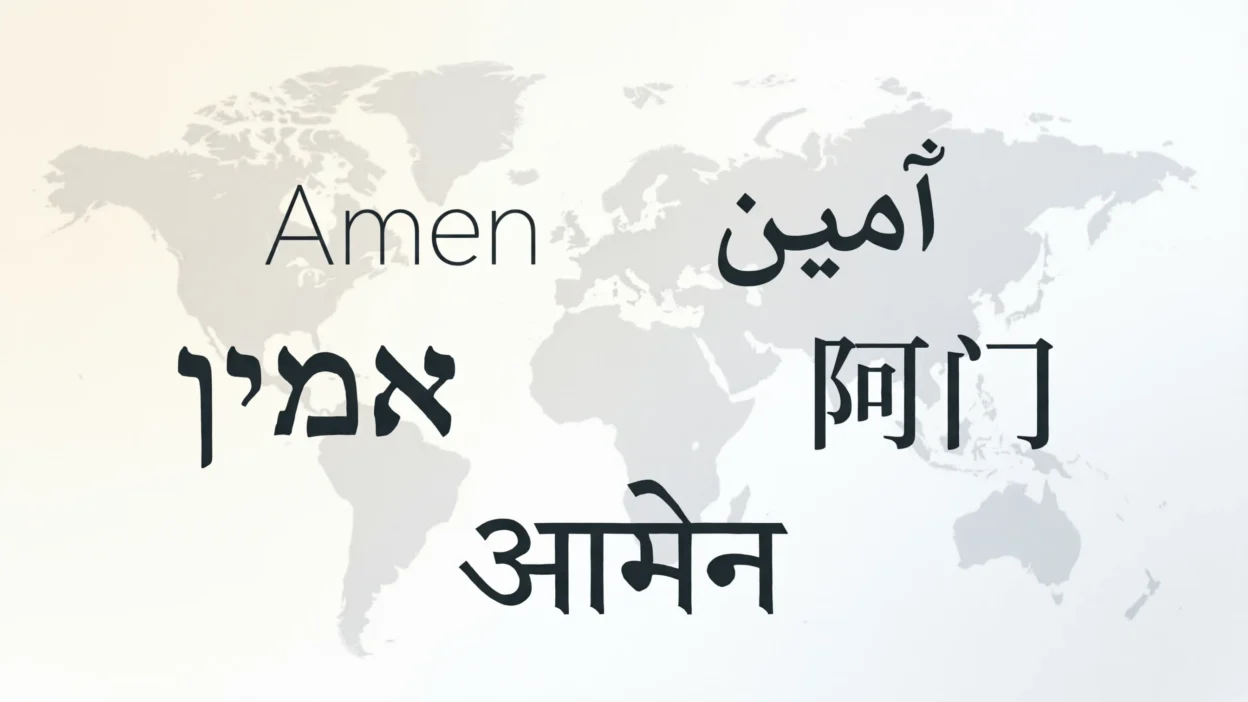
“Amen” is one of the most widely spoken spiritual words on Earth. People search for amen in different languages to understand how this powerful word is used, pronounced, and understood across cultures and religions. Whether you’re learning languages, studying religion, or simply curious, this guide gives you clear, real world answers.
In this article, you’ll discover amen in all languages, learn how to say amen in different languages, and see practical examples showing how people use it in daily life. Everything is simple, human friendly, and optimized for quick understanding.
Amen Translations Around the World in 70 Languages
| Language | Pronunciation | Example |
| English | ah-men | We ended the prayer with amen – The prayer finished with agreement |
| Arabic | aa-meen | He said ameen after the dua – He agreed with the prayer |
| Hebrew | ah-men | The congregation answered amen – People agreed together |
| Latin | ah-men | The priest concluded with amen – The prayer was closed |
| Greek | a-men | They replied amen in church – They confirmed the prayer |
| French | ah-men | Ils ont dit amen à la fin – They agreed at the end |
| Spanish | ah-men | Todos dijeron amén – Everyone agreed |
| Portuguese | ah-men | A oração terminou com amém – The prayer ended |
| Italian | ah-men | Disse amen in chiesa – He agreed in church |
| German | ah-men | Alle sagten amen – Everyone agreed |
| Dutch | ah-men | Ze zeiden amen samen – They agreed together |
| Swedish | ah-men | Bönen slutade med amen – The prayer ended |
| Norwegian | ah-men | Han svarte amen – He agreed |
| Danish | ah-men | De sagde amen – They agreed |
| Finnish | ah-men | Hän sanoi amen – He confirmed it |
| Russian | a-myén | Oni skazali amin – They agreed |
| Ukrainian | ah-meen | Vony skazaly amin – They confirmed |
| Polish | ah-men | Powiedzieli amen – They agreed |
| Czech | ah-men | Řekli amen – They agreed |
| Slovak | ah-men | Povedali amen – They confirmed |
| Hungarian | ah-men | A végén amen – Amen at the end |
| Romanian | ah-men | Au spus amin – They agreed |
| Bulgarian | ah-meen | Kazaha amin – They agreed |
| Serbian | ah-meen | Rekli su amin – They confirmed |
| Croatian | ah-meen | Rekli su amen – They agreed |
| Bosnian | ah-meen | Rekli amin – They agreed |
| Turkish | ah-meen | Duadan sonra amin – After the prayer |
| Persian | aa-min | Ba amin tamoom shod – It ended in agreement |
| Urdu | aa-meen | Sab ne ameen kaha – Everyone agreed |
| Hindi | aa-meen | Sab ne ameen bola – Everyone agreed |
| Bengali | aa-min | Ora amin bollo – They agreed |
| Punjabi | aa-meen | Ameen kaha gaya – Amen was said |
| Tamil | aa-men | Prarthanai amen endru mudinthathu – Prayer ended |
| Telugu | aa-men | Prarthana amen tho mugisindi – Prayer ended |
| Malayalam | aa-men | Amen ennu paranju – Said amen |
| Kannada | aa-men | Amen endru helidaru – They agreed |
| Marathi | aa-meen | Ameen mhanale – They agreed |
| Gujarati | aa-meen | Ameen kahyu – They confirmed |
| Sinhala | aa-men | Amen kiyala iwara una – Ended in agreement |
| Nepali | aa-meen | Ameen bhaniyo – Amen was said |
| Thai | aa-men | Prarthana amen – Prayer agreement |
| Vietnamese | a-men | Mọi người nói amen – Everyone agreed |
| Indonesian | a-men | Doa diakhiri amin – Prayer ended |
| Malay | a-men | Doa ditutup amin – Prayer closed |
| Filipino | a-men | Sinabi nila amen – They agreed |
| Japanese | a-men | Amen to itta – Said amen |
| Korean | a-men | Amen imnida – It is agreed |
| Chinese (Mandarin) | a-men | Tamen shuo amen – They agreed |
| Cantonese | a-men | Keuih dei gong amen – They agreed |
| Tibetan | a-men | Amen zer ba – Agreed |
| Mongolian | a-men | Amen gej helew – Said amen |
| Swahili | aa-men | Walisema amina – They agreed |
| Hausa | aa-min | Sun ce amin – They agreed |
| Yoruba | aa-men | Wọn sọ amin – They agreed |
| Igbo | aa-men | Ha kwuru amen – They agreed |
| Zulu | aa-men | Bathi amen – They agreed |
| Afrikaans | ah-men | Hulle sê amen – They agree |
Why “Amen” Sounds Similar in All Languages
One reason amen around the world sounds almost the same is its ancient origin. The word comes from Semitic languages and means truth, certainty, or so be it. Because of its sacred meaning, many cultures preserved its original sound instead of translating it fully.
When and How Amen Is Used Globally
People use amen in prayers, religious gatherings, and even everyday speech. Across cultures, saying amen shows agreement, hope, or confirmation. Understanding how to say amen in different languages helps you connect respectfully in multicultural settings.
Amen in All Languages: Cultural Significance
Despite language differences, amen carries the same emotional weight everywhere. It represents unity, faith, and agreement. This consistency makes amen translations unique compared to most words.
Conclusion
Amen is a timeless word spoken across continents, cultures, and languages. Learning amen in different languages helps you appreciate its shared meaning and deep global significance. No matter where you are, amen always brings people together.
FAQs About Amen in Different Languages
1. Is amen the same word in all languages?
Yes, most languages keep the original form with slight pronunciation changes.
2. What does amen mean in English?
It means “so be it,” “truly,” or “I agree.”
3. Is amen used outside religion?
Yes, some people use it casually to strongly agree with a statement.
4. Why do Muslims say ameen instead of amen?
Ameen is the Arabic pronunciation used after supplications.
5. How old is the word amen?
It dates back thousands of years to ancient Semitic languages.