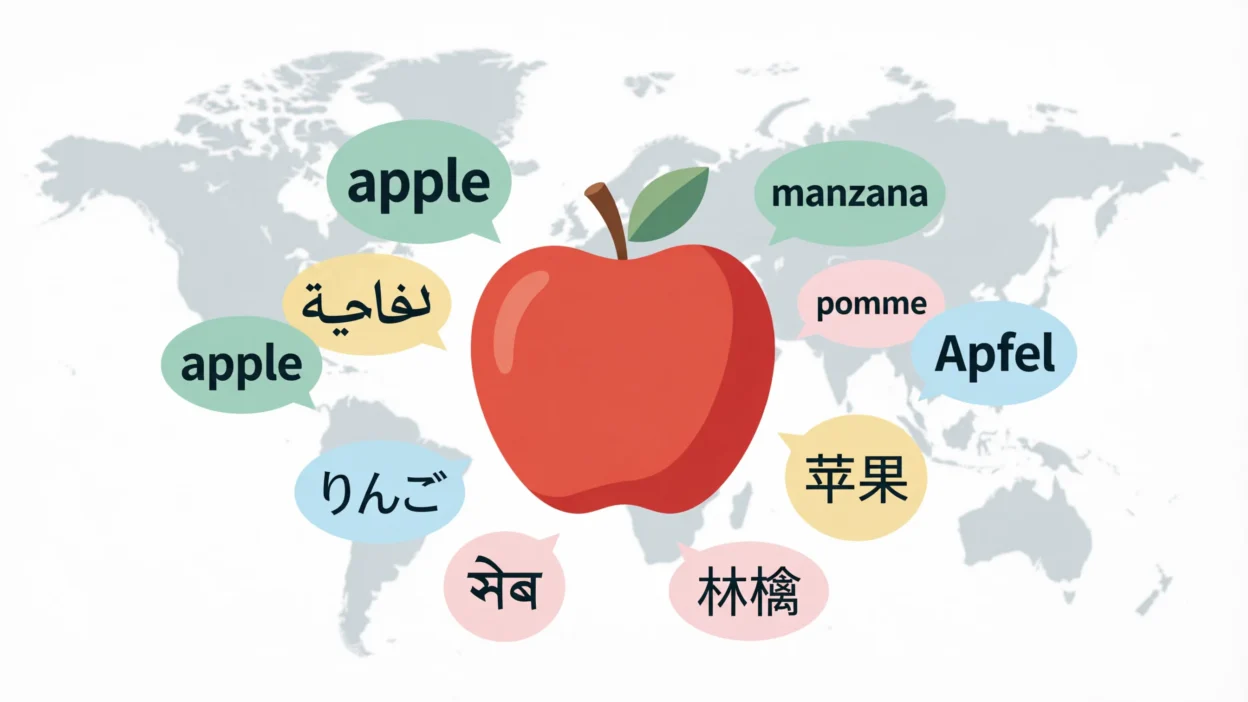
Apples are one of the most common fruits on the planet, and the word for “apple” exists in every culture and language. If you’re learning a new language, traveling, teaching vocabulary, or creating multilingual content, understanding apple in different languages is surprisingly useful.
This guide is designed for informational search intent. You’ll find accurate translations, simple pronunciations, and real-life example sentences — all in one clean table. It’s optimized for readers who want apple in all languages, clear usage examples, and quick learning without distractions.
Apple in Different Languages
| Language | Pronunciation | Example |
| English | ap-uhl | I eat an apple every day. (Meaning: I eat an apple every day.) |
| Spanish | mahn-sah-nah | Como una manzana al día. (Meaning: I eat an apple a day.) |
| French | pom | Je mange une pomme. (Meaning: I eat an apple.) |
| German | ah-pfel | Ich esse einen Apfel. (Meaning: I eat an apple.) |
| Italian | meh-lah | Mangio una mela. (Meaning: I eat an apple.) |
| Portuguese | mah-sah | Eu como uma maçã. (Meaning: I eat an apple.) |
| Dutch | ah-pel | Ik eet een appel. (Meaning: I eat an apple.) |
| Swedish | eh-pleh | Jag äter ett äpple. (Meaning: I eat an apple.) |
| Norwegian | eh-pleh | Jeg spiser et eple. (Meaning: I eat an apple.) |
| Danish | eh-bleh | Jeg spiser et æble. (Meaning: I eat an apple.) |
| Finnish | oh-meh-nah | Syön omenan. (Meaning: I eat an apple.) |
| Russian | yah-bla-kah | Ya yem yabloko. (Meaning: I eat an apple.) |
| Ukrainian | yah-bloo-koh | Ya yidu yabluko. (Meaning: I eat an apple.) |
| Polish | yahb-ko | Jem jabłko. (Meaning: I eat an apple.) |
| Czech | yahb-loh | Jím jablko. (Meaning: I eat an apple.) |
| Slovak | yahb-loh | Jem jablko. (Meaning: I eat an apple.) |
| Hungarian | ahl-mah | Eszem egy almát. (Meaning: I eat an apple.) |
| Romanian | muhr | Mănânc un măr. (Meaning: I eat an apple.) |
| Bulgarian | yah-bul-kah | Yadem yabalka. (Meaning: I eat an apple.) |
| Serbian | yah-boo-kah | Jedem jabuku. (Meaning: I eat an apple.) |
| Croatian | yah-boo-kah | Jedem jabuku. (Meaning: I eat an apple.) |
| Slovenian | yah-bol-koh | Jem jabolko. (Meaning: I eat an apple.) |
| Greek | mee-lo | Tróo éna mílo. (Meaning: I eat an apple.) |
| Turkish | el-mah | Bir elma yerim. (Meaning: I eat an apple.) |
| Arabic | tuf-fah | Ana aakul tuffah. (Meaning: I eat an apple.) |
| Hebrew | tah-poo-ah | Ani ochel tapuach. (Meaning: I eat an apple.) |
| Persian | seeb | Man sib mikhoram. (Meaning: I eat an apple.) |
| Hindi | seyb | Main seb khata hoon. (Meaning: I eat an apple.) |
| Urdu | seyb | Main seb khata hoon. (Meaning: I eat an apple.) |
| Bengali | ah-pel | Ami apel khai. (Meaning: I eat an apple.) |
| Punjabi | seyb | Main seb khanda haan. (Meaning: I eat an apple.) |
| Gujarati | suh-fur-jan | Hu safarjan khaau chhu. (Meaning: I eat an apple.) |
| Marathi | suh-fur-chund | Mi safarchand khato. (Meaning: I eat an apple.) |
| Tamil | aap-pil | Naan apple saapdugiren. (Meaning: I eat an apple.) |
| Telugu | aap-pil | Nenu apple tinnanu. (Meaning: I eat an apple.) |
| Kannada | seh-boo | Naanu sebu tintini. (Meaning: I eat an apple.) |
| Malayalam | aap-pil | Njaan apple kazhikkunnu. (Meaning: I eat an apple.) |
| Sinhala | a-pel | Mama apel kanawa. (Meaning: I eat an apple.) |
| Nepali | syau | Ma syau khanchu. (Meaning: I eat an apple.) |
| Mandarin Chinese | ping-gwoh | Wǒ chī píngguǒ. (Meaning: I eat an apple.) |
| Cantonese | ping-gwoh | Ngo sik ping gwo. (Meaning: I eat an apple.) |
| Japanese | rin-go | Ringo o tabemasu. (Meaning: I eat an apple.) |
| Korean | sah-gwa | Sagwa-reul meokseoyo. (Meaning: I eat an apple.) |
| Thai | ae-pel | Chan kin aepple. (Meaning: I eat an apple.) |
| Vietnamese | tao | Tôi ăn táo. (Meaning: I eat an apple.) |
| Indonesian | a-pel | Saya makan apel. (Meaning: I eat an apple.) |
| Malay | e-pal | Saya makan epal. (Meaning: I eat an apple.) |
| Filipino | man-sa-nas | Kumakain ako ng mansanas. (Meaning: I eat an apple.) |
| Swahili | tu-fah-ha | Nakula tufaha. (Meaning: I eat an apple.) |
| Zulu | a-poo-la | Ngidla i-apula. (Meaning: I eat an apple.) |
| Afrikaans | a-pel | Ek eet ’n appel. (Meaning: I eat an apple.) |
| Hausa | tuf-fa | Ina cin tuffa. (Meaning: I eat an apple.) |
| Yoruba | a-poo-loo | Mo n je àpùlù. (Meaning: I eat an apple.) |
| Igbo | a-pool | Ana m eri apụl. (Meaning: I eat an apple.) |
| Amharic | tuf-fa | Tuffa belija. (Meaning: I eat an apple.) |
| Somali | tu-faax | Waxaan cunaa tufaax. (Meaning: I eat an apple.) |
| Amazigh (Berber) | ta-fust | Tettɣiɣ tafust. (Meaning: I eat an apple.) |
| Latin | mah-lum | Malum edo. (Meaning: I eat an apple.) |
| Esperanto | po-mo | Mi manĝas pomon. (Meaning: I eat an apple.) |
| Icelandic | eh-plee | Ég borða epli. (Meaning: I eat an apple.) |
| Irish | ool | Ithim úll. (Meaning: I eat an apple.) |
| Scottish Gaelic | oo-val | Bidh mi ag ithe ubhal. (Meaning: I eat an apple.) |
| Welsh | a-val | Dw i’n bwyta afal. (Meaning: I eat an apple.) |
| Breton | a-val | Me a zebro aval. (Meaning: I eat an apple.) |
| Basque | sah-gar | Sagar bat jaten dut. (Meaning: I eat an apple.) |
| Catalan | po-mah | Menjo una poma. (Meaning: I eat an apple.) |
| Galician | ma-tha | Como unha mazá. (Meaning: I eat an apple.) |
| Albanian | mol-leh | Unë ha një mollë. (Meaning: I eat an apple.) |
| Armenian | khn-zor | Yes khndzor em utum. (Meaning: I eat an apple.) |
| Georgian | vash-lee | Me vashls vcham. (Meaning: I eat an apple.) |
Why Learning “Apple” in Different Languages Is Useful
Learning apple translations helps beginners build vocabulary fast. Food words are often the first step in conversations, classrooms, and travel situations. This is why “apple in different languages” appears so often in language learning searches.
How to Say Apple Around the World
From pomme in French to ringo in Japanese, apple vocabulary shows how languages evolve across cultures. Understanding apple around the world also improves pronunciation skills and cultural awareness.
Conclusion
Knowing apple in different languages is a small skill with big value. Whether you’re learning languages, teaching students, or creating global content, these translations and examples give you a solid foundation in everyday vocabulary.
FAQs About Apple in Different Languages
1. What is the most common translation of apple worldwide?
Many languages use similar sounds, such as “apel,” “appel,” or “apfel.”
2. How do you say apple in different languages easily?
Start with European languages first, then move to Asian and African languages.
3. Is apple one of the first words learned in new languages?
Yes, food words like apple are commonly taught to beginners.
4. Are apple translations always exact?
Mostly yes, though pronunciation and usage vary slightly by region.
5. Why is “apple in different languages” a popular search?
It’s useful for education, travel, language learning, and global communication.