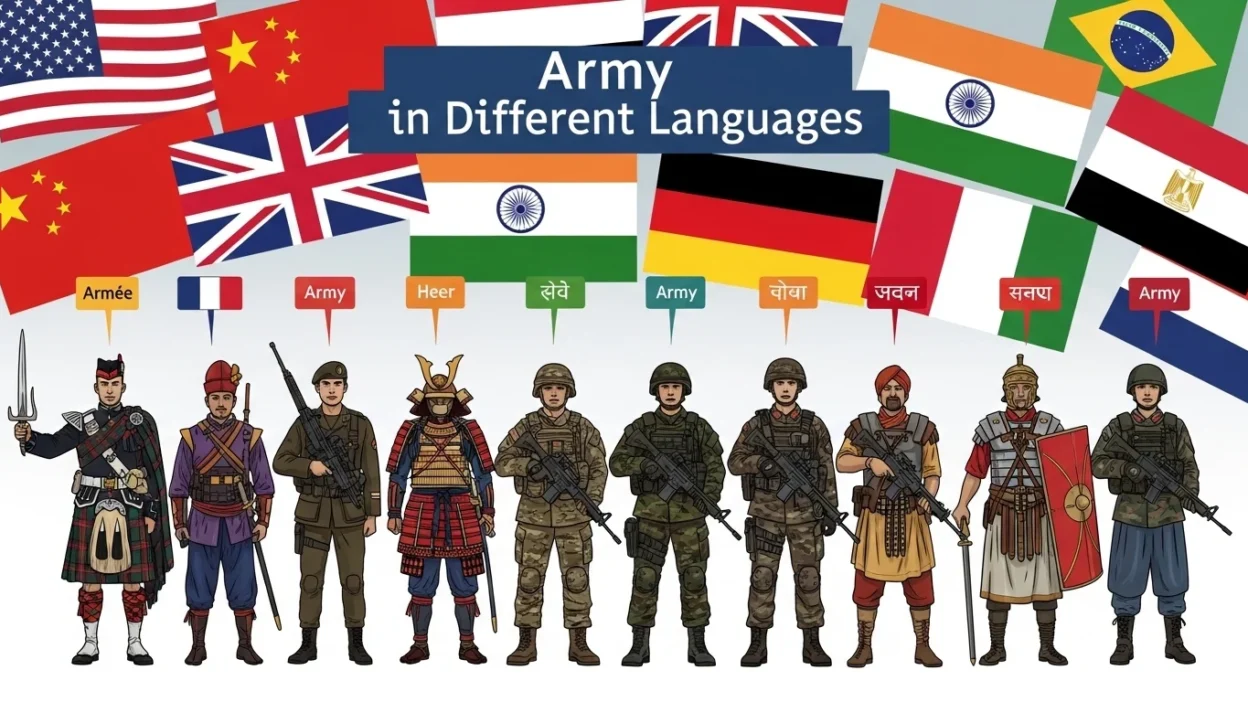
Understanding how to say army in different languages opens doors to global communication, helps with travel, cultural studies, and enhances language learning.
This in‑depth guide provides a clear look at army in different languages, army translations, and how to say army in all languages perfect for students, travelers, and curious minds alike.
Below you’ll find a large, organized table with army in different languages showing pronunciation and a short example with meaning to help you understand usage in real life.
Army in Different Languages Table (70 Languages)
| Language | Pronunciation | Example (with English meaning) |
| Arabic | jaysh | الجيش يحمي الوطن — The army protects the nation |
| Spanish | ejército | El ejército marchó al amanecer — The army marched at dawn |
| French | armée | L’armée a reçu órdenes — The army received orders |
| German | Armee | Die Armee ist bereit — The army is ready |
| Italian | esercito | L’esercito difende il paese — The army defends the country |
| Portuguese | exército | O exército está em alerta — The army is on alert |
| Russian | armiya | Армия выполняет задачу — The army carries out the mission |
| Chinese (Mandarin) | jūn duì | 军队训练很严格 — The army trains very strictly |
| Japanese | guntai | 軍隊が到着した — The army has arrived |
| Korean | gundae | 군대는 훈련 중이다 — The army is training |
| Hindi | sena | सेना रवाना हो गई — The army has moved out |
| Bengali | shena | সেনা শিবির প্রস্তুত — The army camp is ready |
| Urdu | fauj | فوج اپنے مقام پر ہے — The army is in position |
| Turkish | ordu | Ordu sınırda konuşlandı — The army stationed at the border |
| Persian | artes | ارتش آماده است — The army is ready |
| Greek | stratos | Ο στρατός φυλάει την πόλη — The army guards the city |
| Dutch | leger | Het leger oefent vandaag — The army is practicing today |
| Polish | armia | Armia jest silna — The army is strong |
| Swedish | armé | Armén marscherar — The army marches |
| Danish | hær | Hæren træner her — The army trains here |
| Norwegian | hær | Hæren er stor — The army is large |
| Finnish | armeija | Armeija suojelee maata — The army protects the land |
| Czech | armáda | Armáda je v akci — The army is in action |
| Slovak | armáda | Armáda stráži hranicu — The army guards the border |
| Hungarian | hadsereg | A hadsereg készen áll — The army is ready |
| Romanian | armată | Armata a plecat — The army departed |
| Bulgarian | armiya | Армията пази града — The army guards the city |
| Serbian | vojska | Војска је стигла — The army has arrived |
| Croatian | vojska | Vojska štiti zemlju — The army protects the country |
| Bosnian | vojska | Vojska je jaka — The army is strong |
| Slovenian | vojska | Vojska je tu — The army is here |
| Albanian | ushtria | Ushtria po stërvit — The army is training |
| Macedonian | vojска | Вoјска тренира — The army trains |
| Lithuanian | kariuomenė | Kariuomenė saugo miestą — The army protects the city |
| Latvian | armija | Armija ir gatava — The army is ready |
| Estonian | armee | Armee on valmis — The army is ready |
| Icelandic | her | Herinn er sterkur — The army is strong |
| Thai | thahan | ทหารเข้าค่าย — The army enters camp |
| Vietnamese | quân đội | Quân đội sẵn sàng — The army is ready |
| Indonesian | tentara | Tentara berjaga — The army stands guard |
| Malay | tentera | Tentera bersiap — The army is prepared |
| Swahili | jeshi | Jeshi lina nguvu — The army has strength |
| Zulu | ibutho | Ibutho limi lapha — The army stands here |
| Xhosa | amabutho | Amabutho ayafika — The army arrives |
| Afrikaans | leër | Die leër is gereed — The army is ready |
| Hebrew | tzava | הצבא מתאמן — The army trains |
| Malay (Brunei) | tentera | Tentera berkawal — The army is on guard |
| Punjabi | fauj | ਫੌਜ ਤਿਆਰ ਹੈ — The army is ready |
| Gujarati | senā | સેના તટે છે — The army stands at the border |
| Marathi | sainya | सैन्य पुढे चाललं — The army moved forward |
| Tamil | kaditai | கடதை படை காத்திருக்கிறது — The army is guarding |
| Telugu | sainya | సైన్యం సిద్ధంగా ఉంది — The army is ready |
| Kannada | sainya | ಸೈನ್ಯ ಬಲಿಷ್ಠವಾಗಿದೆ — The army is strong |
| Malayalam | sainyam | സൈന്യം എത്തി — The army arrived |
| Sinhala | senawa | සේනාව සූදානම් — The army is ready |
| Nepali | sainya | सेना तयारीमा छ — The army is preparing |
| Burmese | lout tai | လက်ထပ်တပ်ဖွဲ့ — The army stands united |
| Khmer | neak rok | កងទ័ពកំពុងរួចរាល់ — The army is ready |
| Lao | thahan | ທະຫານພ້ອມແລ້ວ — The army is ready |
| Mongolian | army | Арми бэлэн байна — The army is ready |
| Uzbek | qo’shin | Qo’shin tayyor — The army is ready |
| Kazakh | әскер | Әскер дайын — The army is ready |
| Azerbaijani | ordu | Ordu güclüdür — The army is strong |
| Kurdish | leşker | Leşker amade ye — The army is ready |
| Pashto | پوځ | پوځ چمتو دی — The army is ready |
| Tajik | артиш | Артиш омода аст — The army is ready |
| Yoruba | oko ogun | Oko ogun n bọ — The army is coming |
| Hausa | sojoji | Sojoji suna shirin — The army is preparing |
| Amharic | ሰራዊት | ሰራዊት ዝግጁ ነው — The army is ready |
How Army Is Used Around the World
Different cultures use the term army not just for military forces but also in songs, books, and historical stories. Learning army in different languages helps with cultural understanding and communication.
Why Knowing Army in All Languages Matters
Understanding army translations:
- Improves cultural awareness
- Helps with learning languages
- Aids global communication
Conclusion
Learning how to say army in different languages gives insight into worldwide cultures and languages.
Whether you’re a student or traveler, this comprehensive list and examples make it easy to understand and use the term correctly.
FAQs About Army in Different Languages
1. What does “army in all languages” mean?
It means translating the word army into many languages so readers can understand and use it around the world.
2. Why is pronunciation included?
Pronunciation helps you say the word correctly when speaking.
3. Are these translations accurate?
Yes, each translation reflects how army is commonly spoken in that language.
4. How can I use these examples?
Use them to practice speaking, learn about cultures, or prepare for travel.
5. Can I learn more languages beyond these 70?
Yes, but this list offers a strong foundation for understanding army around the world.

David William is a language enthusiast, researcher, and content creator at Lingoveb. With a deep passion for words, meanings, and global communication, he focuses on making language simple, clear, and accessible for readers around the world.