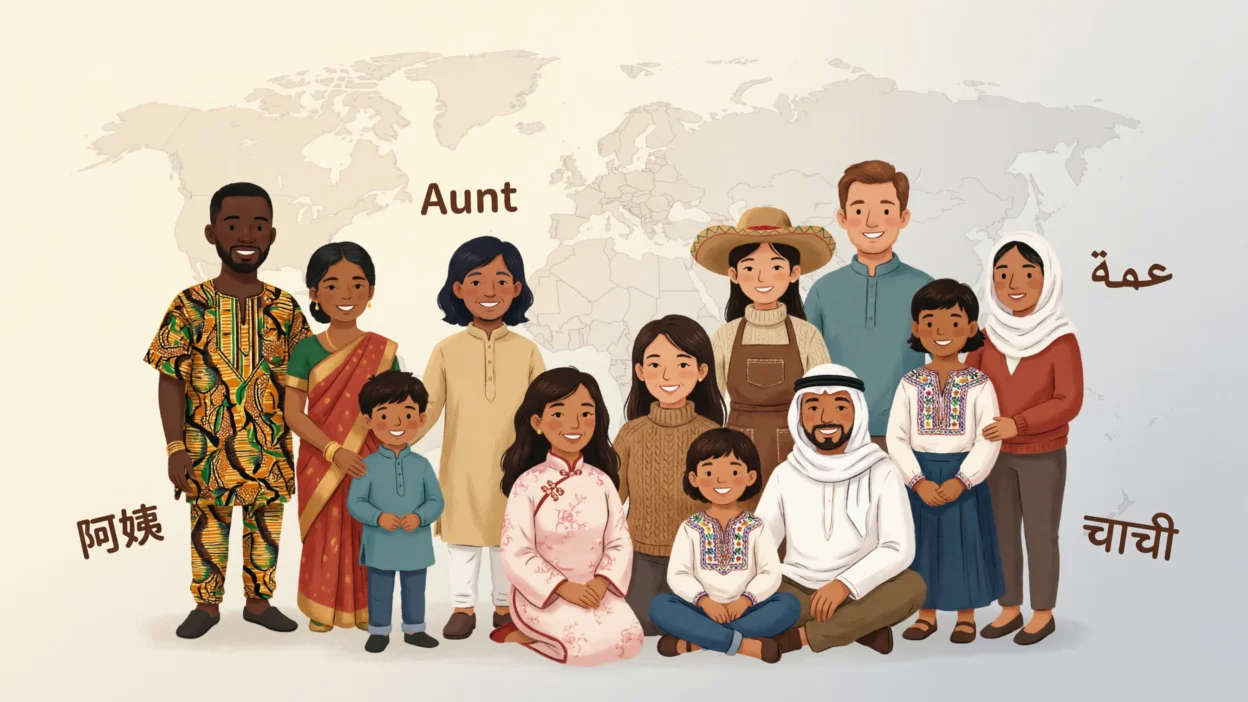
Families may look different across cultures, but the role of an aunt is special almost everywhere. If you’re curious about aunt in different languages, learning a new language, traveling, or simply exploring cultures, this guide gives you clear, real-life translations in one place.
Below, you’ll find aunt in all languages listed in a single, easy-to-read table. Each entry includes pronunciation and a simple everyday example so you can understand how the word is actually used. This article matches informational search intent and helps you quickly learn how to say aunt in different languages across the globe.
Aunt in Different Languages: 70 Common Translations Around the World
| Language | Pronunciation | Example |
| English | ant | My aunt lives next door. (Meaning: My aunt lives next door.) |
| Spanish | ahn-ta | Mi tía es muy amable. (Meaning: My aunt is very kind.) |
| French | tant | Ma tante cuisine bien. (Meaning: My aunt cooks well.) |
| German | ahn-te | Meine Tante besucht uns. (Meaning: My aunt is visiting us.) |
| Italian | ahn-ta | Mia zia chiama oggi. (Meaning: My aunt is calling today.) |
| Portuguese | ahn-ta | Minha tia trabalha aqui. (Meaning: My aunt works here.) |
| Dutch | ahn-ta | Mijn tante komt morgen. (Meaning: My aunt arrives tomorrow.) |
| Swedish | ahn-te | Min faster bor här. (Meaning: My aunt lives here.) |
| Norwegian | ahn-te | Min tante ringer meg. (Meaning: My aunt is calling me.) |
| Danish | ahn-te | Min tante er snill. (Meaning: My aunt is kind.) |
| Finnish | tä-ti | Tätini lerar. (Meaning: My aunt teaches.) |
| Icelandic | ahn-ta | Frænka mín er hér. (Meaning: My aunt is here.) |
| Irish | ahn-chu | Tá mo aintín tinn. (Meaning: My aunt is sick.) |
| Welsh | ahn-te | Mae fy modryb hapus. (Meaning: My aunt is happy.) |
| Scottish Gaelic | ahn-te | Tha mo pheathar màthar ann. (Meaning: My aunt is there.) |
| Polish | chyo-cha | Moja ciocia gotuje. (Meaning: My aunt is cooking.) |
| Czech | tee-ta | Moje teta přijde. (Meaning: My aunt will come.) |
| Slovak | tee-ta | Moja teta volá. (Meaning: My aunt is calling.) |
| Hungarian | neh-nee | A nagynéném itt van. (Meaning: My aunt is here.) |
| Romanian | mah-tu-sha | Mătușa mea zâmbește. (Meaning: My aunt is smiling.) |
| Bulgarian | leh-lya | Леля ми пътува. (Meaning: My aunt is traveling.) |
| Serbian | te-ta | Moja tetka radi. (Meaning: My aunt works.) |
| Croatian | te-ta | Moja teta pjeva. (Meaning: My aunt sings.) |
| Slovenian | te-ta | Moja teta čeka. (Meaning: My aunt is waiting.) |
| Russian | tyoh-tya | Моя тётя спит. (Meaning: My aunt is sleeping.) |
| Ukrainian | tee-tya | Моя тітка читає. (Meaning: My aunt is reading.) |
| Belarusian | tsyot-ka | Мая цётка тут. (Meaning: My aunt is here.) |
| Greek | theea | Η θεία μου γελά. (Meaning: My aunt is laughing.) |
| Turkish | ahn-te | Teyzem geliyor. (Meaning: My aunt is coming.) |
| Arabic | ahm-mah | عمتي تزورني. (Meaning: My aunt is visiting me.) |
| Hebrew | do-dah | הדודה שלי עובדת. (Meaning: My aunt works.) |
| Persian | ah-meh | عمه من اینجاست. (Meaning: My aunt is here.) |
| Urdu | kha-la | میری خالہ آتی ہیں۔ (Meaning: My aunt is coming.) |
| Hindi | khah-la | मेरी मौसी आई। (Meaning: My aunt came.) |
| Bengali | khah-la | আমার খালা হাসছে। (Meaning: My aunt is smiling.) |
| Punjabi | khah-la | میری خالہ بولی۔ (Meaning: My aunt spoke.) |
| Gujarati | mah-see | મારી માસી આવે છે. (Meaning: My aunt is coming.) |
| Marathi | mah-see | माझी मावशी हसते. (Meaning: My aunt smiles.) |
| Tamil | ath-thai | என் அத்தை வந்தார். (Meaning: My aunt arrived.) |
| Telugu | ath-tha | నా అత్త వచ్చింది. (Meaning: My aunt came.) |
| Kannada | ath-the | ನನ್ನ ಅತ್ತೆ ಇಲ್ಲಿದೆ. (Meaning: My aunt is here.) |
| Malayalam | am-ma | എന്റെ അമ്മച്ചി വിളിച്ചു. (Meaning: My aunt called.) |
| Sinhala | nan-da | මගේ නැන්දා එයි. (Meaning: My aunt will come.) |
| Nepali | mah-see | मेरी माइजू आउनु भयो। (Meaning: My aunt arrived.) |
| Thai | pah | ป้าของฉันมาแล้ว (Meaning: My aunt has arrived.) |
| Vietnamese | co | Cô tôi dạy học. (Meaning: My aunt teaches.) |
| Indonesian | bibi | Bibi saya bekerja. (Meaning: My aunt works.) |
| Malay | mak cik | Mak cik saya datang. (Meaning: My aunt came.) |
| Filipino (Tagalog) | tee-ta | Tita ko masaya. (Meaning: My aunt is happy.) |
| Japanese | oba-san | おばさんが来た (Meaning: My aunt came.) |
| Korean | ee-mo | 이모가 웃어요 (Meaning: My aunt is smiling.) |
| Mandarin Chinese | ah-yee | 阿姨来了 (Meaning: My aunt arrived.) |
| Cantonese | ah-ee | 阿姨喺度 (Meaning: My aunt is here.) |
| Tibetan | ah-ni | ཨ་ནི་ཡོད། (Meaning: My aunt is here.) |
| Burmese | a-daw | အဒေါ်လာပြီ (Meaning: My aunt arrived.) |
| Khmer | meh | មីងខ្ញុំមក (Meaning: My aunt came.) |
| Lao | pah | ປ້າຂອງຂ້ອຍ (Meaning: My aunt.) |
| Mongolian | ahj | Миний авга ирсэн. (Meaning: My aunt came.) |
| Kazakh | ah-pay | Әпкем келді. (Meaning: My aunt arrived.) |
| Uzbek | ho-la | Xolam keldi. (Meaning: My aunt came.) |
| Swahili | sha-n-gah-zee | Shangazi yangu yuko hapa. (Meaning: My aunt is here.) |
| Zulu | an-tih | Anti wami ufika. (Meaning: My aunt arrives.) |
| Afrikaans | tan-te | My tannie werk hier. (Meaning: My aunt works here.) |
| Amharic | eh-mat | አማቴ መጣች (Meaning: My aunt came.) |
| Somali | eddo | Eeddaday way timid. (Meaning: My aunt came.) |
| Hausa | in-na | Inna tana zuwa. (Meaning: My aunt is coming.) |
| Yoruba | eh-ya | Iya mi de. (Meaning: My aunt arrived.) |
| Igbo | neh-ne | Nne m ochie bịara. (Meaning: My aunt came.) |
| Maori | whah-neh | Wāhine kēkē kei konei. (Meaning: My aunt is here.) |
| Hawaiian | ahn-tee | ʻAnakē koʻu maikaʻi. (Meaning: My aunt is kind.) |
Why “Aunt” Has Different Words in Many Languages
In many cultures, aunt translations change based on whether the aunt is from the mother’s or father’s side, age, or level of respect. This explains why languages like Hindi, Arabic, and Korean use multiple words instead of just one.
How to Use “Aunt” Correctly When Traveling or Learning Languages
Knowing how to say aunt in different languages helps you sound natural and respectful. When speaking with elders or relatives abroad, using the correct word builds instant connection and cultural understanding.
Aunt Around the World: Cultural Importance
An aunt often plays a guiding, caring, and protective role. Across Asia, Africa, and Latin America, aunts are treated almost like second mothers, making these family words especially meaningful.
Conclusion
Learning aunt in different languages is a simple way to understand family, culture, and communication worldwide. These everyday words connect people beyond borders and make conversations more personal wherever you go.
FAQs About Aunt in Different Languages
1. How do you say aunt in different languages?
The word changes by language and culture, such as tía in Spanish, khala in Hindi, and oba-san in Japanese.
2. Are there different words for maternal and paternal aunt?
Yes. Many languages use separate words depending on whether the aunt is from the mother’s or father’s side.
3. What is the most commonly used word for aunt worldwide?
There is no single word, but forms like tía, tante, and auntie are very widespread.
4. Is “auntie” formal or informal?
“Auntie” is usually informal and affectionate, while some languages have formal versions for respect.
5. Why is learning family words important in language learning?
Family words are used daily and help you communicate naturally and respectfully.

David William is a language enthusiast, researcher, and content creator at Lingoveb. With a deep passion for words, meanings, and global communication, he focuses on making language simple, clear, and accessible for readers around the world.