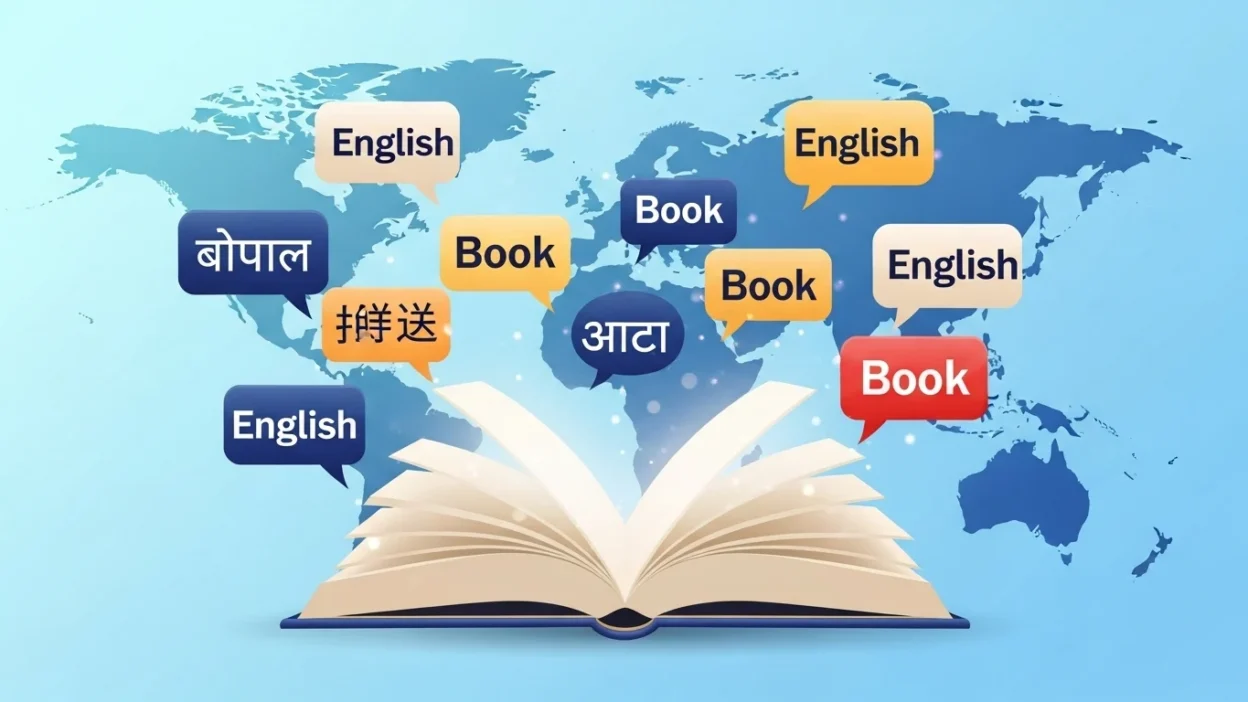
Books connect cultures, ideas, and people across the globe. But have you ever wondered how to say “book” in different languages? Whether you’re learning a new language, traveling, or simply curious, knowing book in different languages can help you communicate better and understand global cultures more deeply.
In this guide, you’ll discover how to say “book” in 70 languages, along with pronunciation and real life examples. This makes it easier to remember and actually use these translations in everyday situations.
Book in All Languages (70 Translations Table)
| Language | Pronunciation | Example |
| English | book | I bought a new book yesterday. (English: I bought a new book yesterday.) |
| Spanish | libro | Compré un libro nuevo. (English: I bought a new book.) |
| French | livre | J’ai acheté un livre. (English: I bought a book.) |
| German | Buch | Ich habe ein Buch gekauft. (English: I bought a book.) |
| Italian | libro | Ho comprato un libro. (English: I bought a book.) |
| Portuguese | livro | Comprei um livro. (English: I bought a book.) |
| Dutch | boek | Ik heb een boek gekocht. (English: I bought a book.) |
| Russian | kniga | Ya kupil knigu. (English: I bought a book.) |
| Chinese (Mandarin) | shū | Wǒ mǎile yī běn shū. (English: I bought a book.) |
| Japanese | hon | Watashi wa hon o kaimashita. (English: I bought a book.) |
| Korean | chaek | Naneun chaek-eul sasda. (English: I bought a book.) |
| Arabic | kitab | Ishtaraytu kitaban. (English: I bought a book.) |
| Hindi | pustak | Maine ek pustak kharidi. (English: I bought a book.) |
| Urdu | kitaab | Maine ek kitaab khareedi. (English: I bought a book.) |
| Turkish | kitap | Bir kitap aldım. (English: I bought a book.) |
| Greek | vivlio | Agorasa ena vivlio. (English: I bought a book.) |
| Polish | książka | Kupiłem książkę. (English: I bought a book.) |
| Swedish | bok | Jag köpte en bok. (English: I bought a book.) |
| Norwegian | bok | Jeg kjøpte en bok. (English: I bought a book.) |
| Danish | bog | Jeg købte en bog. (English: I bought a book.) |
| Finnish | kirja | Ostin kirjan. (English: I bought a book.) |
| Czech | kniha | Koupil jsem knihu. (English: I bought a book.) |
| Slovak | kniha | Kúpil som knihu. (English: I bought a book.) |
| Hungarian | könyv | Vettem egy könyvet. (English: I bought a book.) |
| Romanian | carte | Am cumpărat o carte. (English: I bought a book.) |
| Bulgarian | kniga | Kupih kniga. (English: I bought a book.) |
| Ukrainian | knyha | Ya kupyv knyhu. (English: I bought a book.) |
| Hebrew | sefer | Kaniti sefer. (English: I bought a book.) |
| Persian | ketab | Man ketab kharidam. (English: I bought a book.) |
| Thai | nangsue | Chan sue nangsue. (English: I bought a book.) |
| Vietnamese | sách | Tôi mua một cuốn sách. (English: I bought a book.) |
| Indonesian | buku | Saya membeli buku. (English: I bought a book.) |
| Malay | buku | Saya beli buku. (English: I bought a book.) |
| Filipino | aklat | Bumili ako ng aklat. (English: I bought a book.) |
| Swahili | kitabu | Nilinunua kitabu. (English: I bought a book.) |
| Zulu | incwadi | Ngithenge incwadi. (English: I bought a book.) |
| Afrikaans | boek | Ek het ‘n boek gekoop. (English: I bought a book.) |
| Amharic | metshaf | Metshaf gezah. (English: I bought a book.) |
| Somali | buug | Waxaan iibsaday buug. (English: I bought a book.) |
| Yoruba | iwe | Mo ra iwe kan. (English: I bought a book.) |
| Igbo | akwukwo | Azurula m akwukwo. (English: I bought a book.) |
| Hausa | littafi | Na sayi littafi. (English: I bought a book.) |
| Bengali | boi | Ami boi kinechi. (English: I bought a book.) |
| Tamil | puthagam | Naan puthagam vaanginen. (English: I bought a book.) |
| Telugu | pustakam | Nenu pustakam konnanu. (English: I bought a book.) |
| Kannada | pustaka | Naanu pustaka kondenu. (English: I bought a book.) |
| Malayalam | pusthakam | Njan pusthakam vanghi. (English: I bought a book.) |
| Marathi | pustak | Mi pustak ghetle. (English: I bought a book.) |
| Gujarati | pustak | Mane pustak lidhu. (English: I bought a book.) |
| Punjabi | kitaab | Main kitaab khareedi. (English: I bought a book.) |
| Nepali | kitab | Maile kitab kine. (English: I bought a book.) |
| Sinhala | potha | Mama potha gatta. (English: I bought a book.) |
| Khmer | sievphov | Khnhom tinn sievphov. (English: I bought a book.) |
| Lao | nangsue | Khoy sue nangsue. (English: I bought a book.) |
| Burmese | sar-oke | Kya naw sar-oke we de. (English: I bought a book.) |
| Mongolian | nom | Bi nom avsan. (English: I bought a book.) |
| Kazakh | kitap | Men kitap satyp aldym. (English: I bought a book.) |
| Uzbek | kitob | Men kitob sotib oldim. (English: I bought a book.) |
| Azerbaijani | kitab | Mən kitab aldım. (English: I bought a book.) |
| Georgian | tsigni | Me tsigni viqide. (English: I bought a book.) |
| Armenian | girk | Yes girk gnetsi. (English: I bought a book.) |
| Albanian | liber | Bleva një libër. (English: I bought a book.) |
| Croatian | knjiga | Kupio sam knjigu. (English: I bought a book.) |
| Serbian | knjiga | Kupio sam knjigu. (English: I bought a book.) |
| Slovenian | knjiga | Kupil sem knjigo. (English: I bought a book.) |
| Estonian | raamat | Ostsin raamatu. (English: I bought a book.) |
| Latvian | grāmata | Es nopirku grāmatu. (English: I bought a book.) |
| Lithuanian | knyga | Nusipirkau knygą. (English: I bought a book.) |
How to Say Book in Different Languages
Learning how to say book in different languages is a great starting point for language learners. The word “book” is simple, practical, and commonly used in daily conversations, schools, and travel situations.
Many languages share similar roots. For example, “kitab” appears in Arabic, Urdu, Persian, and several Central Asian languages. Meanwhile, European languages often use variations like “libro” or “livre.”
Book Translations Around the World
Understanding book translations around the world reveals cultural connections between languages. Words evolve through history, trade, and migration.
For example:
- Latin influenced many European terms like libro and livre
- Arabic influenced South Asian and African languages with kitab
- Slavic languages share forms like kniga or knyha
This shows how language families are interconnected.
Why Learn Book in All Languages?
Knowing book in all languages can be useful for:
- Traveling and shopping for books abroad
- Learning new languages faster
- Improving vocabulary retention
- Understanding cultural similarities
- Enhancing communication skills
It’s also a fun way to explore global diversity through a single word.
Conclusion
Learning book in different languages is more than just memorizing words it’s a gateway to understanding cultures and communication worldwide.
From libro to kitab to hon, each translation tells a story about language evolution and human connection.
Start with these 70 languages and expand your vocabulary step by step.
FAQs
1. How do you say book in different languages?
You can say “book” as libro (Spanish), livre (French), kitab (Arabic/Urdu), hon (Japanese), and many more depending on the language.
2. What is the most common word for book worldwide?
“Kitab” is widely used across Arabic, Urdu, Persian, and several Asian languages, making it one of the most распространён (widely used) roots.
3. Why are book translations similar in some languages?
Languages share historical roots and influences, such as Latin in Europe and Arabic in Asia and Africa.
4. Is learning simple words like book useful in language learning?
Yes, basic words like “book” are essential for building vocabulary and starting conversations.
5. How can I remember book in multiple languages?
Use repetition, real life examples, and grouping similar languages together for easier learning.

Marak Robort is a content writer and researcher with a strong interest in language, meanings, and digital information. His work focuses on presenting clear, easy-to-understand explanations that help readers quickly grasp complex ideas.