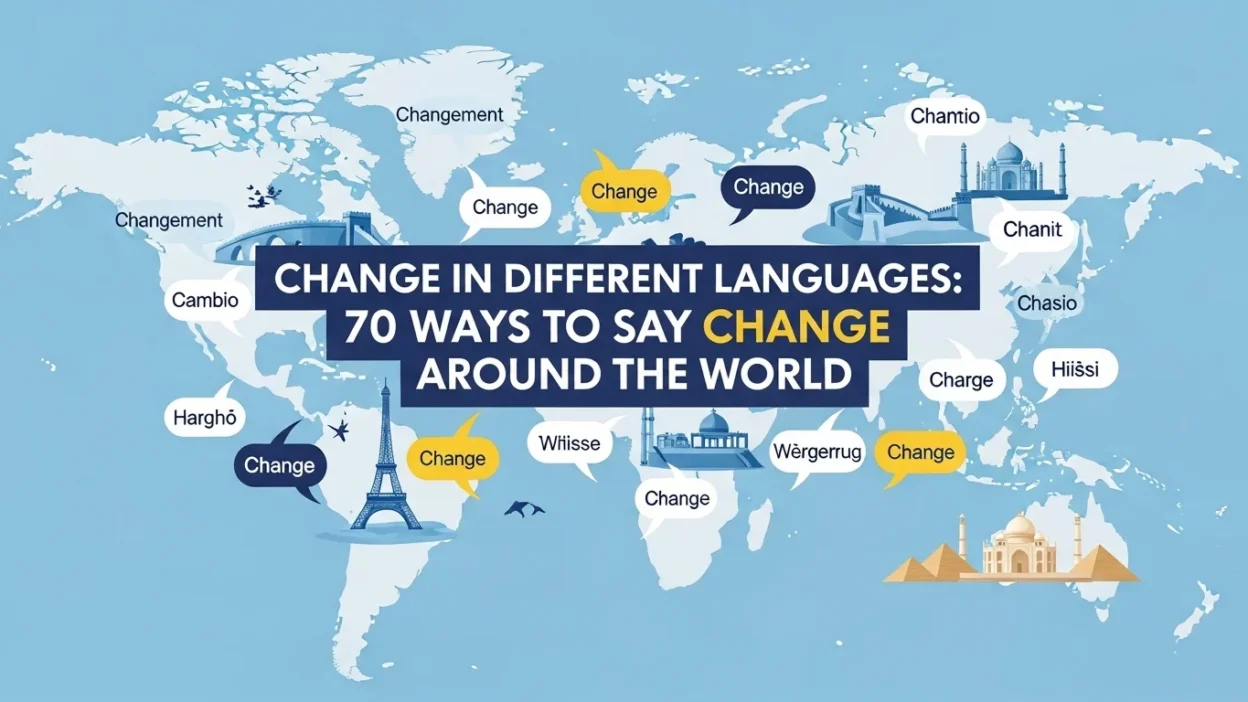
Language connects people across cultures, and learning how to say change in different languages can open doors in travel, business, education, and daily conversations. Whether you’re curious about cultural expressions, studying linguistics, or simply want to expand your vocabulary, understanding how to say “change” around the world is both practical and fascinating.
In this guide, you’ll discover change in all languages through a carefully organized table of 70 major and widely spoken languages. You’ll also see pronunciation guidance and real-life example sentences with English meanings. If you’ve ever wondered how to say change in different languages or searched for reliable change translations, this resource is for you.
Change in All Languages (70 Languages Table)
| Language | Pronunciation | Example |
| English | cheynj | Change is necessary for growth. (English meaning: Change is necessary for growth.) |
| Spanish | kam-byo | El cambio es importante en la vida. (English meaning: Change is important in life.) |
| French | shahnzh | Le changement est parfois difficile. (English meaning: Change is sometimes difficult.) |
| German | ahn-de-roong | Veränderung bringt neue Chancen. (English meaning: Change brings new opportunities.) |
| Italian | kahm-byoh | Il cambiamento è positivo. (English meaning: Change is positive.) |
| Portuguese | kahm-byoo | A mudança faz parte da vida. (English meaning: Change is part of life.) |
| Dutch | ver-an-de-ring | Verandering is goed voor je. (English meaning: Change is good for you.) |
| Russian | iz-me-nyen-ye | Изменение приносит надежду. (English meaning: Change brings hope.) |
| Chinese (Mandarin) | byan-hwah | 改变是可能的。 (English meaning: Change is possible.) |
| Japanese | hen-kah | 変化は自然です。 (English meaning: Change is natural.) |
| Korean | byon-hwa | 변화는 필요합니다. (English meaning: Change is necessary.) |
| Arabic | tagh-yeer | التغيير مهم للحياة. (English meaning: Change is important for life.) |
| Hindi | pa-ri-var-tan | परिवर्तन जीवन का हिस्सा है। (English meaning: Change is part of life.) |
| Bengali | po-ri-bor-ton | পরিবর্তন ভালো। (English meaning: Change is good.) |
| Urdu | tab-dee-lee | تبدیلی ضروری ہے۔ (English meaning: Change is necessary.) |
| Turkish | deh-gi-shim | Değişim hayatın bir parçasıdır. (English meaning: Change is part of life.) |
| Greek | all-ah-yee | Η αλλαγή φέρνει ελπίδα. (English meaning: Change brings hope.) |
| Polish | zmy-ah-na | Zmiana jest potrzebna. (English meaning: Change is needed.) |
| Swedish | fo-ran-dring | Förändring är bra. (English meaning: Change is good.) |
| Norwegian | for-an-dring | Forandring gir styrke. (English meaning: Change gives strength.) |
| Danish | for-an-dring | Forandring er vigtig. (English meaning: Change is important.) |
| Finnish | moo-tos | Muutos on välttämätön. (English meaning: Change is essential.) |
| Czech | zmyeh-na | Změna je součást života. (English meaning: Change is part of life.) |
| Slovak | zmeh-na | Zmena prináša rast. (English meaning: Change brings growth.) |
| Hungarian | val-toh-zash | A változás jó. (English meaning: Change is good.) |
| Romanian | skhim-bah-re | Schimbarea este dificilă. (English meaning: Change is difficult.) |
| Bulgarian | pro-mya-na | Промяната носи надежда. (English meaning: Change brings hope.) |
| Serbian | pro-me-na | Promena je stalna. (English meaning: Change is constant.) |
| Croatian | pro-mye-na | Promjena je važna. (English meaning: Change is important.) |
| Slovenian | spre-me-mba | Sprememba je dobra. (English meaning: Change is good.) |
| Ukrainian | zmi-na | Зміна приносить можливості. (English meaning: Change brings opportunities.) |
| Hebrew | shi-noo-ee | שינוי הוא חלק מהחיים. (English meaning: Change is part of life.) |
| Persian | tagh-yeer | تغییر لازم است. (English meaning: Change is necessary.) |
| Thai | plian | การเปลี่ยนแปลงดีเสมอ. (English meaning: Change is always good.) |
| Vietnamese | thay-doi | Thay đổi là cần thiết. (English meaning: Change is necessary.) |
| Indonesian | pe-ru-ba-han | Perubahan membawa harapan. (English meaning: Change brings hope.) |
| Malay | pe-ru-ba-han | Perubahan adalah penting. (English meaning: Change is important.) |
| Filipino | pag-ba-ba-go | Ang pagbabago ay mabuti. (English meaning: Change is good.) |
| Swahili | ma-ba-di-li-ko | Mabadiliko ni muhimu. (English meaning: Change is important.) |
| Zulu | ushintsho | Ushintsho luyadingeka. (English meaning: Change is necessary.) |
| Afrikaans | fer-an-de-ring | Verandering is goed. (English meaning: Change is good.) |
| Icelandic | brey-ting | Breyting er nauðsynleg. (English meaning: Change is necessary.) |
| Irish | ar-oo | Tá athrú tábhachtach. (English meaning: Change is important.) |
| Welsh | new-id | Mae newid yn dda. (English meaning: Change is good.) |
| Scottish Gaelic | at-roo | Tha atharrachadh math. (English meaning: Change is good.) |
| Latvian | mai-na | Pārmaiņas ir labas. (English meaning: Change is good.) |
| Lithuanian | poky-tis | Pokytis yra svarbus. (English meaning: Change is important.) |
| Estonian | muu-tus | Muutus on vajalik. (English meaning: Change is necessary.) |
| Albanian | ndry-shim | Ndryshimi është i mirë. (English meaning: Change is good.) |
| Macedonian | pro-me-na | Промената е важна. (English meaning: Change is important.) |
| Georgian | ts-vo-le-ba | ცვლილება საჭიროა. (English meaning: Change is necessary.) |
| Armenian | po-po-khoo-tyoon | Փոփոխությունը լավ է։ (English meaning: Change is good.) |
| Nepali | pa-ri-var-tan | परिवर्तन आवश्यक छ। (English meaning: Change is necessary.) |
| Sinhala | ve-na-s | වෙනස හොඳයි. (English meaning: Change is good.) |
| Tamil | ma-ru-thal | மாற்றம் அவசியம். (English meaning: Change is necessary.) |
| Telugu | ma-rpu | మార్పు మంచిది. (English meaning: Change is good.) |
| Kannada | bad-la-va-ne | ಬದಲಾವಣೆ ಅಗತ್ಯ. (English meaning: Change is necessary.) |
| Malayalam | ma-tam | മാറ്റം നല്ലതാണ്. (English meaning: Change is good.) |
| Gujarati | pa-ri-var-tan | પરિવર્તન સારું છે. (English meaning: Change is good.) |
| Marathi | ba-dal | बदल महत्त्वाचा आहे. (English meaning: Change is important.) |
| Punjabi | ta-bde-li | ਤਬਦੀਲੀ ਚੰਗੀ ਹੈ। (English meaning: Change is good.) |
| Mongolian | oor-chlol-t | Өөрчлөлт сайн. (English meaning: Change is good.) |
| Khmer | plah-bdoo | ការផ្លាស់ប្តូរល្អ។ (English meaning: Change is good.) |
| Lao | plian-paeng | ການປ່ຽນແປງດີ. (English meaning: Change is good.) |
| Burmese | pyawng-le | ပြောင်းလဲမှုကောင်းသည်။ (English meaning: Change is good.) |
| Haitian Creole | shanj-man | Chanjman enpòtan. (English meaning: Change is important.) |
| Malagasy | fi-o-va-na | Ny fiovana dia tsara. (English meaning: Change is good.) |
| Basque | al-da-ke-ta | Aldaketa ona da. (English meaning: Change is good.) |
| Catalan | kahm-bee | El canvi és bo. (English meaning: Change is good.) |
| Esperanto | shang-ho | Ŝanĝo estas grava. (English meaning: Change is important.) |
How to Say Change in Different Languages
The word change often refers to transformation, growth, improvement, or difference. While the meaning stays similar worldwide, pronunciation and structure vary depending on linguistic roots.
If you’re learning languages, traveling internationally, or doing business globally, knowing change translations helps you communicate more effectively and show cultural respect.
Why Learning “Change” Around the World Matters
Understanding change in all languages is useful for:
- Travelers adapting to new cultures
- Students studying world languages
- Businesses operating internationally
- Writers, translators, and educators
- Anyone curious about global communication
Language reflects how societies view progress and transformation. Learning these variations connects you with people worldwide.
Conclusion
Now you know how to say change in different languages across 70 major world languages. From European to Asian, African to Middle Eastern languages, the concept of change connects cultures everywhere.
Whether you’re researching change around the world, expanding vocabulary, or building global communication skills, this guide gives you a practical and easy-to-read reference.
FAQs About Change in Different Languages
1. How do you say change in different languages?
You can say change as “cambio” in Spanish, “changement” in French, “Veränderung” in German, “改变” in Chinese, and “変化” in Japanese, among many others listed above.
2. What is the most common translation of change worldwide?
Most languages use a word meaning transformation or alteration, such as “cambio,” “mudança,” or “parivartan.”
3. Why does the word change vary so much between languages?
Languages have different linguistic roots (Latin, Germanic, Slavic, Indo-European, etc.), which influence vocabulary and pronunciation.
4. Is the meaning of change the same in all languages?
Generally yes. It usually means transformation, difference, or development, though context can slightly alter usage.
5. Where can I learn more word translations like this?
You can explore multilingual vocabulary guides and language resources that provide translations for common global words and phrases.

Marak Robort is a content writer and researcher with a strong interest in language, meanings, and digital information. His work focuses on presenting clear, easy-to-understand explanations that help readers quickly grasp complex ideas.