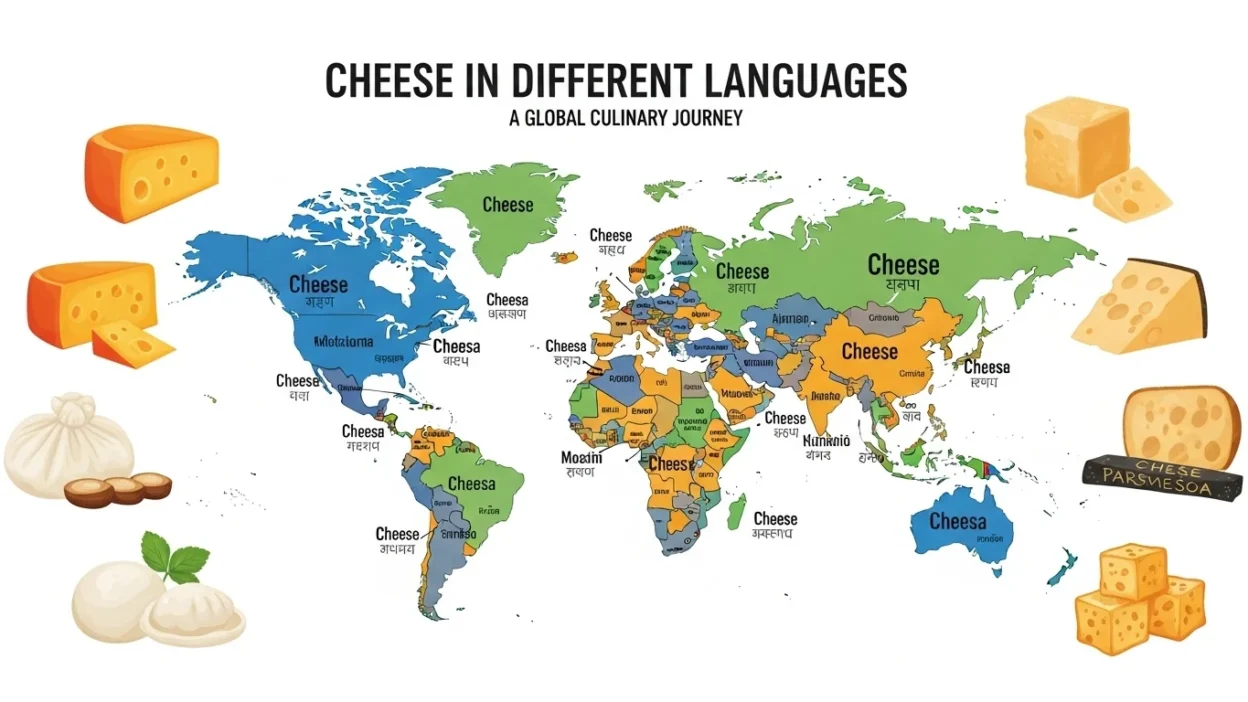
Cheese is one of the most loved foods on the planet. From creamy spreads to aged delicacies, it appears in cuisines across nearly every culture. Because of its global popularity, many people search for cheese in different languages, whether for travel, language learning, cooking, or cultural curiosity.
In this guide, you’ll discover how to say cheese in different languages from around the world. The table below lists 70 languages, including pronunciation and simple everyday examples. This makes it easy to understand cheese translations, learn vocabulary faster, and see how people refer to cheese in daily conversation.
If you’re curious about cheese in all languages or want to know how people talk about cheese around the world, this list will help you learn quickly and clearly.
Cheese in 70 Different Languages
| Language | Pronunciation | Example |
| English | Cheez | I love eating cheese with bread. (English meaning: The speaker enjoys cheese with bread.) |
| Spanish | Queso – KEH-so | Me gusta el queso en mi sandwich. (English meaning: I like cheese in my sandwich.) |
| French | Fromage – Fro-MAHZH | J’aime le fromage avec du pain. (English meaning: I like cheese with bread.) |
| German | Käse – KEH-zuh | Ich esse gern Käse. (English meaning: I like to eat cheese.) |
| Italian | Formaggio – For-MAH-jo | Mangio formaggio con la pasta. (English meaning: I eat cheese with pasta.) |
| Portuguese | Queijo – KAY-zhoo | Eu gosto de queijo na pizza. (English meaning: I like cheese on pizza.) |
| Dutch | Kaas – Kahs | Ik eet kaas elke dag. (English meaning: I eat cheese every day.) |
| Swedish | Ost – OOST | Jag äter ost till frukost. (English meaning: I eat cheese for breakfast.) |
| Danish | Ost – OOST | Jeg kan lide ost. (English meaning: I like cheese.) |
| Norwegian | Ost – OOST | Jeg spiser ost på brød. (English meaning: I eat cheese on bread.) |
| Finnish | Juusto – YOO-sto | Syön juustoa leivän kanssa. (English meaning: I eat cheese with bread.) |
| Polish | Ser – Ser | Lubię ser na kanapce. (English meaning: I like cheese on a sandwich.) |
| Czech | Sýr – Seer | Mám rád sýr. (English meaning: I like cheese.) |
| Slovak | Syr – Seer | Jem syr s chlebom. (English meaning: I eat cheese with bread.) |
| Hungarian | Sajt – Shoyt | Szeretem a sajtot. (English meaning: I love cheese.) |
| Romanian | Brânză – BRUHN-zuh | Îmi place brânza. (English meaning: I like cheese.) |
| Greek | Tyri – Tee-REE | Mou aresi to tyri. (English meaning: I like cheese.) |
| Turkish | Peynir – Pay-NEER | Peynir severim. (English meaning: I like cheese.) |
| Arabic | Jibn – JIBN | Uhibbu al-jibn. (English meaning: I like cheese.) |
| Hebrew | גבינה – Gvee-NAH | Ani ohev gvina. (English meaning: I love cheese.) |
| Persian | Panir – Pah-NEER | Man panir dust daram. (English meaning: I like cheese.) |
| Hindi | Paneer – Puh-NEER | Mujhe paneer pasand hai. (English meaning: I like cheese.) |
| Urdu | Paneer – Puh-NEER | Mujhe paneer pasand hai. (English meaning: I like cheese.) |
| Punjabi | Paneer – Puh-NEER | Mainu paneer changa lagda hai. (English meaning: I like cheese.) |
| Bengali | Ponir – PO-neer | Ami ponir pochondo kori. (English meaning: I like cheese.) |
| Gujarati | Paneer – Puh-NEER | Mane paneer game che. (English meaning: I like cheese.) |
| Marathi | Paneer – Puh-NEER | Mala paneer avadto. (English meaning: I like cheese.) |
| Tamil | Cheese – Cheez | Naan cheese virumbugiren. (English meaning: I like cheese.) |
| Telugu | Cheese – Cheez | Naku cheese ishtam. (English meaning: I like cheese.) |
| Kannada | Cheese – Cheez | Nanage cheese ishta. (English meaning: I like cheese.) |
| Malayalam | Cheese – Cheez | Enikku cheese ishtam. (English meaning: I like cheese.) |
| Thai | Cheese – Cheez | Chan chop cheese. (English meaning: I like cheese.) |
| Vietnamese | Pho mai – Fuh-my | Tôi thích phô mai. (English meaning: I like cheese.) |
| Indonesian | Keju – KAY-joo | Saya suka keju. (English meaning: I like cheese.) |
| Malay | Keju – KAY-joo | Saya makan keju. (English meaning: I eat cheese.) |
| Filipino | Keso – KEH-so | Gusto ko ang keso. (English meaning: I like cheese.) |
| Chinese (Mandarin) | Nǎilào – NAI-lao | Wǒ xǐhuān nǎilào. (English meaning: I like cheese.) |
| Japanese | Chīzu – CHEE-zoo | Watashi wa chīzu ga suki desu. (English meaning: I like cheese.) |
| Korean | Chijeu – CHEE-joo | Naneun chijeu joahaeyo. (English meaning: I like cheese.) |
| Mongolian | Byaslag – BYAS-lag | Bi byaslag iddeg. (English meaning: I eat cheese.) |
| Russian | Syr – Seer | Ya lyublyu syr. (English meaning: I love cheese.) |
| Ukrainian | Syr – Seer | Ya yim syr. (English meaning: I eat cheese.) |
| Belarusian | Syr – Seer | Ya lyublyu syr. (English meaning: I love cheese.) |
| Bulgarian | Sirene – SEE-reh-neh | Obicham sirene. (English meaning: I love cheese.) |
| Serbian | Sir – Seer | Volim sir. (English meaning: I love cheese.) |
| Croatian | Sir – Seer | Volim sir. (English meaning: I love cheese.) |
| Bosnian | Sir – Seer | Ja volim sir. (English meaning: I love cheese.) |
| Slovenian | Sir – Seer | Rad jem sir. (English meaning: I like eating cheese.) |
| Albanian | Djathë – JATH | Më pëlqen djathë. (English meaning: I like cheese.) |
| Lithuanian | Sūris – SOO-ris | Man patinka sūris. (English meaning: I like cheese.) |
| Latvian | Siers – SEE-ers | Man garšo siers. (English meaning: I like cheese.) |
| Estonian | Juust – YOOST | Mulle meeldib juust. (English meaning: I like cheese.) |
| Icelandic | Ostur – OS-tur | Mér líkar ostur. (English meaning: I like cheese.) |
| Irish | Cáis – Kawsh | Is maith liom cáis. (English meaning: I like cheese.) |
| Scottish Gaelic | Càise – KAA-sha | Is toil leam càise. (English meaning: I like cheese.) |
| Welsh | Caws – KOWS | Rwy’n hoffi caws. (English meaning: I like cheese.) |
| Basque | Gazta – GAZ-ta | Gazta gustatzen zait. (English meaning: I like cheese.) |
| Catalan | Formatge – For-MAHT-je | M’agrada el formatge. (English meaning: I like cheese.) |
| Galician | Queixo – KAY-sho | Gústame o queixo. (English meaning: I like cheese.) |
| Swahili | Jibini – Jee-BEE-nee | Ninapenda jibini. (English meaning: I like cheese.) |
| Zulu | Ushizi – Oo-SHEE-zee | Ngithanda ushizi. (English meaning: I like cheese.) |
| Afrikaans | Kaas – Kahs | Ek hou van kaas. (English meaning: I like cheese.) |
| Amharic | Ayib – AH-yib | Ayib ewodalehu. (English meaning: I like cheese.) |
| Somali | Jiis – JEES | Waxaan jeclahay jiis. (English meaning: I like cheese.) |
| Hausa | Cuku – CHOO-koo | Ina son cuku. (English meaning: I like cheese.) |
| Yoruba | Warankasi – Wah-ran-KA-see | Mo fẹ warankasi. (English meaning: I like cheese.) |
| Maori | Tīhi – TEE-hee | He pai ki ahau te tīhi. (English meaning: I like cheese.) |
| Hawaiian | Pālaha – PAH-la-ha | Makemake au i ka pālaha. (English meaning: I like cheese.) |
| Esperanto | Fromaĝo – Fro-MAH-jo | Mi ŝatas fromaĝon. (English meaning: I like cheese.) |
Why Learning Cheese Translations Is Useful
Learning how to say cheese in different languages can be helpful for many situations. Travelers can understand menus more easily, language learners gain useful food vocabulary, and food lovers can explore global cuisine with confidence.
Because cheese appears in dishes from pizza to sandwiches and traditional meals, knowing cheese translations helps people communicate in restaurants, markets, and cooking discussions worldwide.
Cheese Around the World
Cheese has been produced for thousands of years and appears in many cultures. Europe is famous for varieties like aged and soft cheeses, while South Asia commonly uses fresh cheese such as paneer.
Many Asian cuisines use cheese in modern fusion dishes, and African cuisines also include local dairy products.
Understanding cheese in all languages highlights how one simple ingredient connects cultures around the world.
Conclusion
Cheese is a globally loved food, and learning cheese in different languages is a fun way to explore cultures and languages at the same time.
Whether you’re traveling, studying languages, or simply curious about food vocabulary, knowing how to say cheese in different languages helps you communicate more easily and appreciate global cuisine.
FAQs
1. How do you say cheese in different languages?
Cheese has many names worldwide, such as queso in Spanish, fromage in French, käse in German, and paneer in Hindi and Urdu.
2. What is the most common word for cheese worldwide?
In many European languages, similar words like queso, queijo, and queixo originate from the Latin word for cheese.
3. Is paneer the same as cheese?
Paneer is a type of fresh cheese commonly used in South Asian cuisine, especially in India and Pakistan.
4. Why are cheese translations different across languages?
Different cultures developed their own dairy traditions, so each language created its own word for cheese.
5. Which countries are famous for cheese?
Countries like France, Italy, Switzerland, and the Netherlands are globally known for producing many popular types of cheese.

Ely Joseph is a language researcher, writer, and contributor who specializes in words, meanings, and multilingual communication. With a strong interest in how language shapes understanding across cultures, Ely focuses on creating clear, accurate, and reader-friendly content for a global audience.