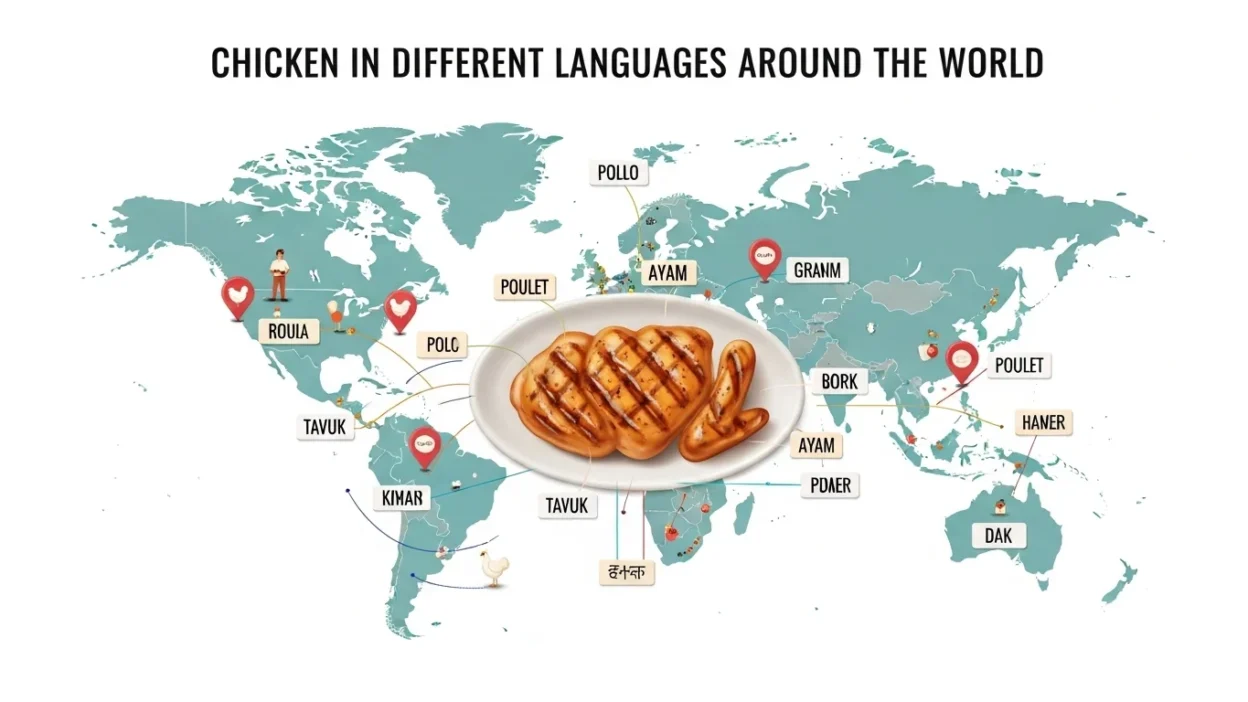
Food connects people across cultures, and chicken is one of the most popular foods around the world. But have you ever wondered how to say chicken in different languages?
Learning chicken in all languages is useful for travelers, language learners, food lovers, and anyone curious about global cultures. Whether you are ordering food abroad, studying vocabulary, or exploring chicken translations around the world, knowing these words can make communication easier.
Below is a simple and mobile-friendly table showing 70 languages, their pronunciation, and a short real-life example sentence using the word for chicken.
Chicken in 70 Different Languages
| Language | Pronunciation | Example |
| English | CHIK-en | I cooked chicken for dinner today. (Meaning: I prepared chicken for dinner.) |
| Spanish | Pollo (POY-yo) | Comí pollo con arroz. (Meaning: I ate chicken with rice.) |
| French | Poulet (POO-lay) | J’aime le poulet grillé. (Meaning: I like grilled chicken.) |
| German | Hähnchen (HEN-shen) | Ich esse gern Hähnchen. (Meaning: I like eating chicken.) |
| Italian | Pollo (POL-lo) | Il pollo è molto buono. (Meaning: The chicken is very tasty.) |
| Portuguese | Frango (FRAN-go) | Eu gosto de frango assado. (Meaning: I like roasted chicken.) |
| Dutch | Kip (KIP) | Ik eet kip vanavond. (Meaning: I will eat chicken tonight.) |
| Russian | Kuritsa (koo-REE-tsa) | Ya gotovlyu kuritsu. (Meaning: I am cooking chicken.) |
| Ukrainian | Kurytsya (koo-RIT-sya) | Ya lyublyu kurytsyu. (Meaning: I love chicken.) |
| Polish | Kurczak (KOOR-chak) | Jem kurczaka na obiad. (Meaning: I eat chicken for lunch.) |
| Czech | Kuře (KOO-rzhe) | Dnes jím kuře. (Meaning: Today I eat chicken.) |
| Slovak | Kurča (KOOR-cha) | Varím kurča dnes. (Meaning: I cook chicken today.) |
| Hungarian | Csirke (CHEER-keh) | Eszem csirkét. (Meaning: I eat chicken.) |
| Romanian | Pui (POO-ee) | Mănânc pui azi. (Meaning: I eat chicken today.) |
| Greek | Kotopoulo (ko-to-POO-lo) | Mou aresei to kotopoulo. (Meaning: I like chicken.) |
| Turkish | Tavuk (ta-VOOK) | Tavuk yiyorum. (Meaning: I am eating chicken.) |
| Arabic | Dajaj (da-JAJ) | Ana akul dajaj. (Meaning: I eat chicken.) |
| Hebrew | Of (OF) | Ani ohev of. (Meaning: I like chicken.) |
| Persian | Morgh (MORG) | Man morgh mikhoram. (Meaning: I eat chicken.) |
| Hindi | Murga (MOOR-ga) | Main murga khata hoon. (Meaning: I eat chicken.) |
| Urdu | Murghi (MOOR-ghee) | Main murghi paka raha hoon. (Meaning: I am cooking chicken.) |
| Punjabi | Murghi (MOOR-ghee) | Main murghi khanda haan. (Meaning: I eat chicken.) |
| Bengali | Murgi (MOOR-gee) | Ami murgi khai. (Meaning: I eat chicken.) |
| Tamil | Kozhi (KO-zhi) | Naan kozhi saapiduven. (Meaning: I eat chicken.) |
| Telugu | Kodi (KO-dee) | Nenu kodi tintanu. (Meaning: I eat chicken.) |
| Kannada | Koli (KO-lee) | Naanu koli tinnuttini. (Meaning: I eat chicken.) |
| Malayalam | Kozhi (KO-zhi) | Njan kozhi kazhikkum. (Meaning: I eat chicken.) |
| Sinhala | Kukula (KOO-koo-la) | Mama kukula kanawa. (Meaning: I eat chicken.) |
| Thai | Gai (GAI) | Chan kin gai. (Meaning: I eat chicken.) |
| Vietnamese | Ga (GA) | Toi an ga. (Meaning: I eat chicken.) |
| Indonesian | Ayam (A-yam) | Saya makan ayam. (Meaning: I eat chicken.) |
| Malay | Ayam (A-yam) | Saya suka ayam. (Meaning: I like chicken.) |
| Filipino | Manok (MA-nok) | Kumakain ako ng manok. (Meaning: I eat chicken.) |
| Chinese (Mandarin) | Ji (JEE) | Wo chi ji. (Meaning: I eat chicken.) |
| Japanese | Niwatori (nee-wa-TO-ri) | Watashi wa niwatori o tabemasu. (Meaning: I eat chicken.) |
| Korean | Dak (DAK) | Naneun dak meogeoyo. (Meaning: I eat chicken.) |
| Mongolian | Tahia (TA-hee-a) | Bi tahia idej baina. (Meaning: I eat chicken.) |
| Nepali | Kukura (KOO-koo-ra) | Ma kukura khanchu. (Meaning: I eat chicken.) |
| Swahili | Kuku (KOO-koo) | Ninakula kuku. (Meaning: I eat chicken.) |
| Zulu | Inkukhu (in-KOO-koo) | Ngidla inkukhu. (Meaning: I eat chicken.) |
| Afrikaans | Hoender (HOON-der) | Ek eet hoender. (Meaning: I eat chicken.) |
| Somali | Digaag (DI-gaag) | Waxaan cunaa digaag. (Meaning: I eat chicken.) |
| Amharic | Doro (DO-ro) | Ene doro bela. (Meaning: I eat chicken.) |
| Yoruba | Adiye (a-DEE-ye) | Mo je adiye. (Meaning: I eat chicken.) |
| Igbo | Okuko (o-KOO-ko) | Ana m eri okuko. (Meaning: I eat chicken.) |
| Hausa | Kaza (KA-za) | Ina cin kaza. (Meaning: I eat chicken.) |
| Malagasy | Akoho (a-KOH-ho) | Mihinana akoho aho. (Meaning: I eat chicken.) |
| Maori | Heihei (HEY-hey) | Ka kai au i te heihei. (Meaning: I eat chicken.) |
| Hawaiian | Moa (MO-a) | Ai au i ka moa. (Meaning: I eat chicken.) |
| Samoan | Moa (MO-a) | Ou te ‘ai moa. (Meaning: I eat chicken.) |
| Fijian | Toa (TO-a) | Au kania toa. (Meaning: I eat chicken.) |
| Estonian | Kana (KA-na) | Ma söön kana. (Meaning: I eat chicken.) |
| Latvian | Vista (VIS-ta) | Es ēdu vistu. (Meaning: I eat chicken.) |
| Lithuanian | Vistiena (vis-TEE-na) | Aš valgau vistieną. (Meaning: I eat chicken.) |
| Finnish | Kana (KA-na) | Syön kanaa. (Meaning: I eat chicken.) |
| Swedish | Kyckling (SHUK-ling) | Jag äter kyckling. (Meaning: I eat chicken.) |
| Norwegian | Kylling (SHIL-ing) | Jeg spiser kylling. (Meaning: I eat chicken.) |
| Danish | Kylling (KY-ling) | Jeg spiser kylling. (Meaning: I eat chicken.) |
| Icelandic | Kjúklingur (KYOO-kling-ur) | Ég borða kjúkling. (Meaning: I eat chicken.) |
| Basque | Oilasko (oy-LAHS-ko) | Oilaskoa jaten dut. (Meaning: I eat chicken.) |
| Catalan | Pollastre (po-LYAS-tre) | Menjo pollastre. (Meaning: I eat chicken.) |
| Galician | Polo (PO-lo) | Como polo. (Meaning: I eat chicken.) |
| Irish | Sicín (SHI-keen) | Ithim sicín. (Meaning: I eat chicken.) |
| Welsh | Cyw Iâr (KOO-yar) | Rwy’n bwyta cyw iâr. (Meaning: I eat chicken.) |
| Scottish Gaelic | Cearc (KYARK) | Ith mi cearc. (Meaning: I eat chicken.) |
| Albanian | Pule (POO-le) | Ha pule sot. (Meaning: I eat chicken today.) |
| Serbian | Piletina (pee-LE-ti-na) | Jedem piletinu. (Meaning: I eat chicken.) |
| Croatian | Piletina (pee-LE-ti-na) | Volim piletinu. (Meaning: I like chicken.) |
| Bosnian | Piletina (pee-LE-ti-na) | Jedem piletinu. (Meaning: I eat chicken.) |
| Slovenian | Piščanec (PEESH-cha-nets) | Jem piščanca. (Meaning: I eat chicken.) |
| Bulgarian | Pile (PEE-leh) | Yadam pile. (Meaning: I eat chicken.) |
| Macedonian | Pileshko (pee-LESH-ko) | Jadám pileshko. (Meaning: I eat chicken.) |
Why Learning Chicken in All Languages Is Useful
Knowing how to say chicken in different languages can help in many situations:
- Ordering food while traveling
- Learning basic vocabulary in new languages
- Understanding menus in foreign restaurants
- Exploring cultural dishes and global cuisine
Because chicken is one of the most widely eaten meats globally, its translation is commonly used in everyday conversations and food contexts.
Chicken Translations Around the World
Different cultures have unique ways of cooking and referring to chicken. For example:
- In Asian countries, chicken is commonly used in rice and noodle dishes.
- In European cuisine, roasted and grilled chicken dishes are popular.
- In African and Middle Eastern cultures, chicken is often prepared with spices and stews.
This diversity shows how the word chicken in different languages reflects both language and culture.
How to Remember Chicken in Different Languages Easily
If you are learning chicken translations in multiple languages, these tips can help:
- Associate the word with a popular dish in that culture.
- Practice speaking the word in simple sentences.
- Use flashcards or language learning apps.
- Repeat the pronunciation regularly.
Learning vocabulary through real examples makes it easier to remember.
Conclusion
Understanding chicken in different languages is a simple yet fascinating way to explore global languages and cultures.
From English and Spanish to Swahili and Japanese, the word for chicken varies widely across the world, yet it represents one of the most common foods shared by many cultures.
Whether you are traveling, studying languages, or exploring international cuisine, learning these chicken translations around the world can improve your vocabulary and cultural awareness.
FAQs
1. How do you say chicken in different languages?
Chicken has many translations depending on the language. For example, it is pollo in Spanish, poulet in French, ayam in Indonesian, and kuku in Swahili.
2. What is chicken called in Asian languages?
In Asian languages, chicken is called gai in Thai, ga in Vietnamese, ji in Mandarin Chinese, and dak in Korean.
3. Why are chicken translations different around the world?
Languages evolve independently across regions, so each culture developed its own word for chicken based on its linguistic history.
4. Is chicken vocabulary useful for travelers?
Yes. Knowing food vocabulary like chicken helps travelers read menus, order meals, and communicate in restaurants.
5. What is the easiest way to learn chicken in many languages?
The easiest way is to practice with simple sentences, listen to pronunciation, and repeat the words regularly.

Ely Joseph is a language researcher, writer, and contributor who specializes in words, meanings, and multilingual communication. With a strong interest in how language shapes understanding across cultures, Ely focuses on creating clear, accurate, and reader-friendly content for a global audience.