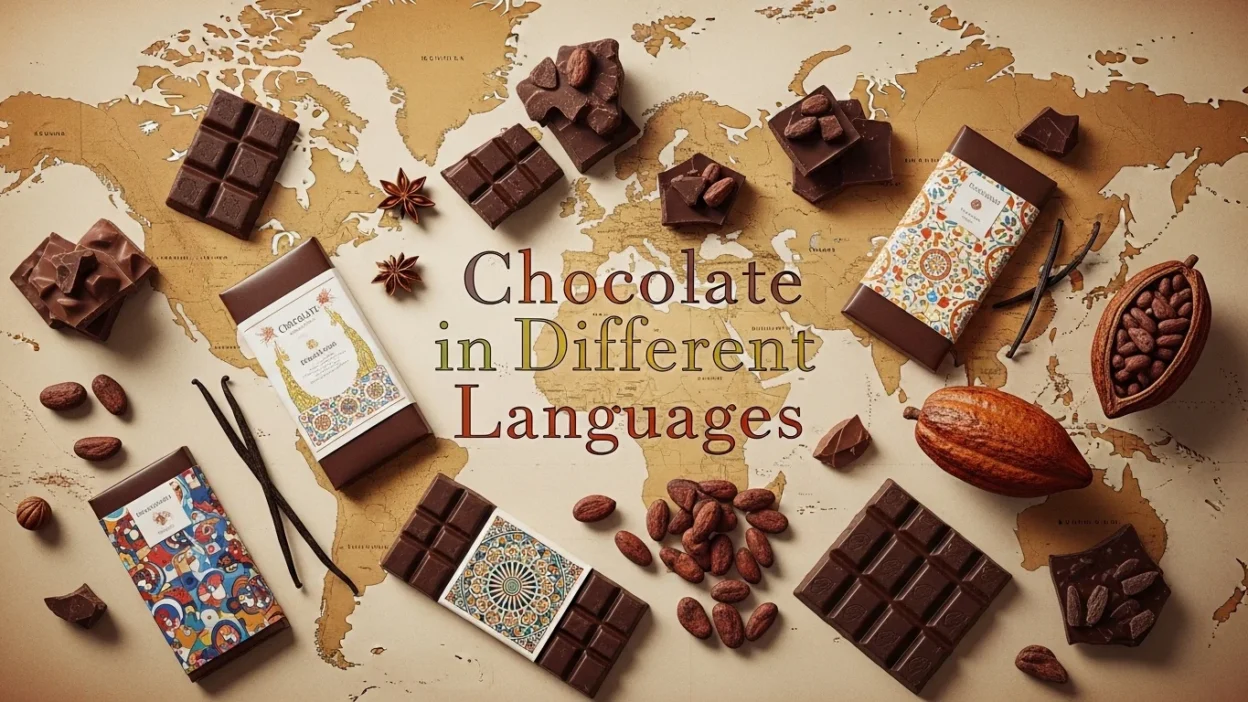
Chocolate is one of the most loved treats on the planet. From creamy milk chocolate bars to rich dark chocolate desserts, this sweet delight is enjoyed in nearly every culture. Because it is so popular globally, the word “chocolate” appears in many languages with unique pronunciations and slight spelling differences.
If you are curious about chocolate in different languages, this guide will help you discover how people say it across the world. Learning these translations is useful for travelers, language learners, and anyone interested in global culture.
Below you will find a simple table showing how to say chocolate in different languages, including pronunciation and a short example sentence. This list highlights how the word for chocolate travels across cultures while keeping its delicious meaning.
Chocolate in All Languages (70 Translations)
| Language | Pronunciation | Example |
| English | CHAW-klit | I love eating chocolate after dinner. (Meaning: I enjoy chocolate after dinner.) |
| Spanish | cho-ko-LAH-te | Me gusta comer chocolate. (Meaning: I like eating chocolate.) |
| French | sho-ko-LA | J’aime le chocolat. (Meaning: I like chocolate.) |
| German | sho-ko-LA-de | Ich esse gern Schokolade. (Meaning: I like eating chocolate.) |
| Italian | cho-ko-LA-to | Mi piace il cioccolato. (Meaning: I like chocolate.) |
| Portuguese | sho-ko-LA-che | Eu gosto de chocolate. (Meaning: I like chocolate.) |
| Dutch | sho-ko-LA-duh | Ik eet graag chocolade. (Meaning: I like eating chocolate.) |
| Afrikaans | sho-ko-LA-de | Ek hou van sjokolade. (Meaning: I like chocolate.) |
| Swedish | SHOK-lad | Jag älskar choklad. (Meaning: I love chocolate.) |
| Danish | sho-ko-LA-the | Jeg elsker chokolade. (Meaning: I love chocolate.) |
| Norwegian | SHOO-ko-lah | Jeg liker sjokolade. (Meaning: I like chocolate.) |
| Finnish | SUK-laa | Rakastan suklaata. (Meaning: I love chocolate.) |
| Estonian | SHOK-o-laad | Ma armastan šokolaadi. (Meaning: I love chocolate.) |
| Latvian | sho-ko-LAA-de | Man patīk šokolāde. (Meaning: I like chocolate.) |
| Lithuanian | sho-ko-LA-das | Aš mėgstu šokoladą. (Meaning: I like chocolate.) |
| Polish | che-ko-LA-da | Lubię czekoladę. (Meaning: I like chocolate.) |
| Czech | cho-ko-LAA-da | Mám rád čokoládu. (Meaning: I like chocolate.) |
| Slovak | cho-ko-LAA-da | Mám rád čokoládu. (Meaning: I like chocolate.) |
| Hungarian | cho-ko-LAA-day | Szeretem a csokoládét. (Meaning: I love chocolate.) |
| Romanian | cho-ko-LA-tuh | Îmi place ciocolata. (Meaning: I like chocolate.) |
| Bulgarian | sho-ko-LAD | Обичам шоколад. (Meaning: I love chocolate.) |
| Russian | sho-ko-LAD | Я люблю шоколад. (Meaning: I love chocolate.) |
| Ukrainian | sho-ko-LAD | Я люблю шоколад. (Meaning: I love chocolate.) |
| Belarusian | sha-ka-LAD | Я люблю шакалад. (Meaning: I love chocolate.) |
| Serbian | cho-ko-LA-da | Volim čokoladu. (Meaning: I love chocolate.) |
| Croatian | cho-ko-LA-da | Volim čokoladu. (Meaning: I love chocolate.) |
| Bosnian | cho-ko-LA-da | Volim čokoladu. (Meaning: I love chocolate.) |
| Slovenian | cho-ko-LA-da | Obožujem čokolado. (Meaning: I love chocolate.) |
| Greek | so-ko-LA-ta | Μου αρέσει η σοκολάτα. (Meaning: I like chocolate.) |
| Turkish | chi-ko-LA-ta | Çikolatayı seviyorum. (Meaning: I love chocolate.) |
| Arabic | shu-ku-LA-ta | أحب الشوكولاتة. (Meaning: I love chocolate.) |
| Hebrew | sho-ko-LAD | אני אוהב שוקולד. (Meaning: I love chocolate.) |
| Persian | she-ko-LAT | من شکلات دوست دارم. (Meaning: I like chocolate.) |
| Hindi | CHOK-let | मुझे चॉकलेट पसंद है। (Meaning: I like chocolate.) |
| Urdu | CHAK-let | مجھے چاکلیٹ پسند ہے۔ (Meaning: I like chocolate.) |
| Bengali | cho-ko-LET | আমি চকলেট পছন্দ করি। (Meaning: I like chocolate.) |
| Punjabi | CHAK-let | ਮੈਨੂੰ ਚਾਕਲੇਟ ਪਸੰਦ ਹੈ। (Meaning: I like chocolate.) |
| Gujarati | CHOK-let | મને ચોકલેટ ગમે છે. (Meaning: I like chocolate.) |
| Marathi | CHOK-let | मला चॉकलेट आवडते. (Meaning: I like chocolate.) |
| Tamil | SAAK-let | எனக்கு சாக்லேட் பிடிக்கும். (Meaning: I like chocolate.) |
| Telugu | CHAAK-let | నాకు చాక్లెట్ ఇష్టం. (Meaning: I like chocolate.) |
| Kannada | CHO-ko-let | ನನಗೆ ಚಾಕೊಲೇಟ್ ಇಷ್ಟ. (Meaning: I like chocolate.) |
| Malayalam | CHOK-let | എനിക്ക് ചോക്ലേറ്റ് ഇഷ്ടമാണ്. (Meaning: I like chocolate.) |
| Sinhala | CHO-ka-let | මම චොකලට් කැමතියි. (Meaning: I like chocolate.) |
| Thai | chok-ko-laet | ฉันชอบช็อกโกแลต. (Meaning: I like chocolate.) |
| Vietnamese | so-ko-la | Tôi thích sô cô la. (Meaning: I like chocolate.) |
| Indonesian | cho-ke-lat | Saya suka cokelat. (Meaning: I like chocolate.) |
| Malay | cho-klat | Saya suka coklat. (Meaning: I like chocolate.) |
| Filipino | tso-ko-LA-te | Mahilig ako sa tsokolate. (Meaning: I like chocolate.) |
| Chinese (Mandarin) | chyao-ke-lee | 我喜欢巧克力。 (Meaning: I like chocolate.) |
| Japanese | cho-ko-RE-to | 私はチョコレートが好きです。 (Meaning: I like chocolate.) |
| Korean | cho-kol-lit | 저는 초콜릿을 좋아해요. (Meaning: I like chocolate.) |
| Mongolian | sho-ko-LAD | Би шоколаданд дуртай. (Meaning: I like chocolate.) |
| Nepali | CHAK-let | मलाई चकलेट मन पर्छ। (Meaning: I like chocolate.) |
| Swahili | cho-ko-LE-ti | Ninapenda chokoleti. (Meaning: I like chocolate.) |
| Zulu | u-sho-ko-LE-di | Ngithanda ushokoledi. (Meaning: I like chocolate.) |
| Somali | shu-ku-LAA-to | Waxaan jeclahay shukulaato. (Meaning: I like chocolate.) |
| Amharic | che-ko-LET | ቸኮሌት እወዳለሁ. (Meaning: I love chocolate.) |
| Yoruba | sho-ko-LA | Mo fẹ́ ṣokólá. (Meaning: I like chocolate.) |
| Igbo | cho-ko-LET | A hụrụ m chọkọlet n’anya. (Meaning: I like chocolate.) |
| Hausa | cha-ku-LAN | Ina son cakulan. (Meaning: I like chocolate.) |
| Malagasy | SO-ko-la | Tiako ny sokola. (Meaning: I like chocolate.) |
| Icelandic | SUK-ku-la-thi | Ég elska súkkulaði. (Meaning: I love chocolate.) |
| Irish | SHAK-lodj | Is maith liom seacláid. (Meaning: I like chocolate.) |
| Scottish Gaelic | SHOK-klit | Is toil leam seoclaid. (Meaning: I like chocolate.) |
| Welsh | SHOK-led | Dw i’n hoffi siocled. (Meaning: I like chocolate.) |
| Catalan | sho-ko-LA-ta | M’agrada la xocolata. (Meaning: I like chocolate.) |
| Basque | cho-ko-LA-te | Txokolatea gustatzen zait. (Meaning: I like chocolate.) |
| Galician | cho-ko-LA-te | Gústame o chocolate. (Meaning: I like chocolate.) |
| Esperanto | cho-ko-LA-do | Mi ŝatas ĉokoladon. (Meaning: I like chocolate.) |
How to Say Chocolate in Different Languages
The word chocolate has spread worldwide because the food itself originated in Mesoamerica and later became popular in Europe and beyond. As chocolate traveled across continents, most languages adopted a similar sounding word.
That is why many chocolate translations resemble each other, such as:
- Chocolate (English)
- Chocolat (French)
- Chocolate (Spanish)
- Cioccolato (Italian)
- Chokolade (Danish)
This similarity makes it easier for travelers to recognize the word when ordering desserts or buying sweets in other countries.
Why the Word Chocolate Is Similar Around the World
The word “chocolate” originally comes from the Nahuatl language spoken by the Aztecs. The word xocolātl referred to a bitter cacao drink.
When chocolate was introduced to Europe in the 16th century, languages adapted the word to their pronunciation systems. Over time, it spread globally with only small spelling or pronunciation changes.
This is why learning chocolate in all languages often reveals a shared linguistic root.
Chocolate Around the World
Chocolate is more than just a sweet snack. It is part of many cultures and traditions worldwide.
Examples include:
- Swiss chocolate craftsmanship
- Belgian chocolate pralines
- Mexican traditional cacao drinks
- Japanese chocolate gift culture during Valentine’s Day
Knowing how to say chocolate in different languages can help you connect with these cultures while traveling or learning new languages.
Conclusion
Chocolate is a universal favorite, and its name appears in many languages with surprisingly similar sounds. From chocolat in French to cioccolato in Italian and 巧克力 in Chinese, the word travels almost as widely as the dessert itself.
Learning chocolate translations is a fun way to explore languages and understand how foods connect cultures around the world.
FAQs
1. How do you say chocolate in different languages?
Chocolate is called chocolat in French, cioccolato in Italian, Schokolade in German, çikolata in Turkish, and 巧克力 in Chinese.
2. Why is the word chocolate similar in many languages?
Most languages borrowed the word from Spanish, which adapted it from the Nahuatl word xocolātl used by the Aztecs.
3. What is chocolate called in Asian languages?
In Japanese it is チョコレート, in Korean 초콜릿, in Chinese 巧克力, and in Hindi चॉकलेट.
4. What language originally used the word chocolate?
The earliest form of the word comes from the Nahuatl language spoken by the Aztec civilization in Mesoamerica.
5. Is the word chocolate the same worldwide?
While pronunciation changes slightly, many languages use a very similar word because the term spread globally along with cacao and chocolate products.