Looking for clean in different languages? Whether you’re traveling, learning a new language, teaching kids, or expanding your vocabulary, knowing how to say “clean” around the world is surprisingly useful. From asking for a clean room to describing fresh clothes, this simple word appears in daily life everywhere.
In this guide, you’ll discover clean in all languages, including pronunciation, real-life example sentences, and their English meanings. If you’ve ever wondered how to say clean in different languages or searched for accurate clean translations, this complete list will help you quickly and easily.
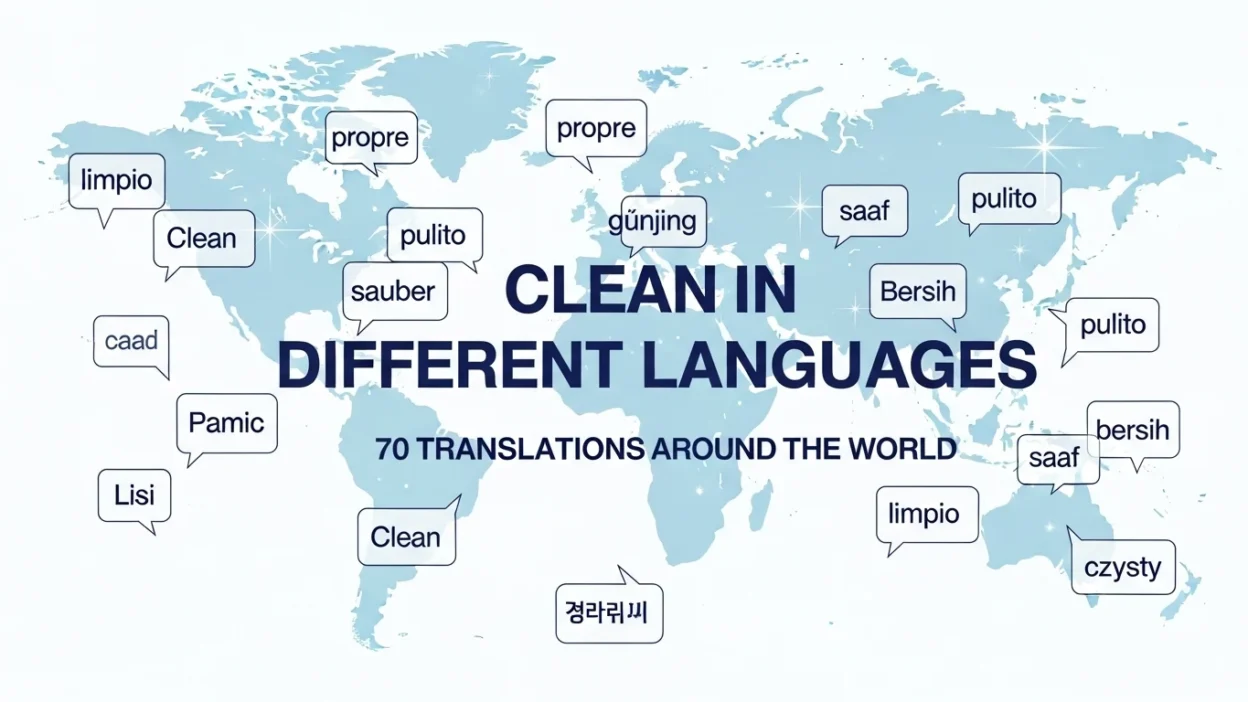
Clean in All Languages – 70 Translations Around the World
Below is a mobile-friendly table listing 70 languages. Each entry includes the word for “clean,” pronunciation, a short example sentence using the word, and its English meaning.
| Language | Pronunciation & Example | English Meaning |
| English | kleen – The room is clean. | The room is clean. |
| Spanish | limpio (LEEM-pyo) – La casa está limpia. | The house is clean. |
| French | propre (propr) – La chambre est propre. | The room is clean. |
| German | sauber (ZOW-ber) – Das Auto ist sauber. | The car is clean. |
| Italian | pulito (poo-LEE-to) – Il pavimento è pulito. | The floor is clean. |
| Portuguese | limpo (LEEM-po) – O quarto está limpo. | The bedroom is clean. |
| Dutch | schoon (skhon) – De keuken is schoon. | The kitchen is clean. |
| Russian | chistyy (CHEES-tyy) – Komnata chistaya. | The room is clean. |
| Chinese (Mandarin) | gānjìng (gan-jing) – Fángjiān hěn gānjìng. | The room is clean. |
| Japanese | kirei (kee-reh) – Heya wa kirei desu. | The room is clean. |
| Korean | kkaekkeut-han (kek-kut-han) – Bangi kkaekkeut-hamnida. | The room is clean. |
| Arabic | nazif (na-ZEEF) – Al-bayt nazif. | The house is clean. |
| Hindi | saaf (saaf) – Ghar saaf hai. | The house is clean. |
| Urdu | saaf (saaf) – Kamra saaf hai. | The room is clean. |
| Turkish | temiz (teh-MEEZ) – Oda temiz. | The room is clean. |
| Greek | katharós (ka-tha-ROS) – To domátio eínai katharó. | The room is clean. |
| Polish | czysty (CHIS-ty) – Pokój jest czysty. | The room is clean. |
| Swedish | ren (ren) – Rummet är rent. | The room is clean. |
| Danish | ren (ren) – Værelset er rent. | The room is clean. |
| Norwegian | ren (ren) – Rommet er rent. | The room is clean. |
| Finnish | puhdas (POOH-das) – Huone on puhdas. | The room is clean. |
| Hebrew | naki (NA-kee) – Hachadar naki. | The room is clean. |
| Thai | sa-aat (sa-AAT) – Hong sa-aat. | The room is clean. |
| Vietnamese | sạch (sahk) – Phòng sạch. | The room is clean. |
| Indonesian | bersih (ber-SIH) – Kamar bersih. | The room is clean. |
| Malay | bersih (ber-SIH) – Bilik itu bersih. | The room is clean. |
| Filipino | malinis (ma-LEE-nis) – Malinis ang bahay. | The house is clean. |
| Swahili | safi (SA-fi) – Nyumba ni safi. | The house is clean. |
| Zulu | hlanzekile (hlan-ze-KEH-le) – Igumbi lihlanzekile. | The room is clean. |
| Afrikaans | skoon (skhoon) – Die kamer is skoon. | The room is clean. |
| Romanian | curat (koo-RAT) – Camera este curată. | The room is clean. |
| Hungarian | tiszta (TEES-ta) – A szoba tiszta. | The room is clean. |
| Czech | čistý (CHIS-tee) – Pokoj je čistý. | The room is clean. |
| Slovak | čistý (CHIS-tee) – Izba je čistá. | The room is clean. |
| Ukrainian | chystyy (CHIS-tyy) – Kimnata chysta. | The room is clean. |
| Bulgarian | chist (CHEEST) – Staiata e chista. | The room is clean. |
| Serbian | čist (CHEEST) – Soba je čista. | The room is clean. |
| Croatian | čist (CHEEST) – Soba je čista. | The room is clean. |
| Bosnian | čist (CHEEST) – Soba je čista. | The room is clean. |
| Slovenian | čist (CHEEST) – Soba je čista. | The room is clean. |
| Lithuanian | švarus (SHVA-rus) – Kambarys švarus. | The room is clean. |
| Latvian | tīrs (TEERS) – Istaba ir tīra. | The room is clean. |
| Estonian | puhas (PU-has) – Tuba on puhas. | The room is clean. |
| Icelandic | hreinn (hrane) – Herbergið er hreint. | The room is clean. |
| Irish | glan (glan) – Tá an seomra glan. | The room is clean. |
| Welsh | glân (glaan) – Mae’r ystafell yn lân. | The room is clean. |
| Albanian | pastër (PAS-ter) – Dhoma është e pastër. | The room is clean. |
| Macedonian | chista (CHEES-ta) – Sobata e chista. | The room is clean. |
| Georgian | suta (SOO-ta) – Otakhi suta. | The room is clean. |
| Armenian | mākūr (ma-KOOR) – Senyake mākūr e. | The room is clean. |
| Persian | tamiz (ta-MIZ) – Otāgh tamiz ast. | The room is clean. |
| Bengali | porishkar (po-REE-shkar) – Ghor porishkar. | The room is clean. |
| Tamil | sutham (SOO-tham) – Arai sutham. | The room is clean. |
| Telugu | subhram (SOO-bhram) – Gadi subhram. | The room is clean. |
| Kannada | shuddha (SHUD-dha) – Kone shuddha. | The room is clean. |
| Malayalam | vrithiyulla (vri-thee-YUL-la) – Muri vrithiyulla. | The room is clean. |
| Marathi | swachha (SWA-chha) – Kholi swachha aahe. | The room is clean. |
| Gujarati | saaf (saaf) – Room saaf chhe. | The room is clean. |
| Punjabi | saaf (saaf) – Kamra saaf hai. | The room is clean. |
| Nepali | safa (SA-fa) – Kotha safa cha. | The room is clean. |
| Sinhala | pirisidu (pi-ri-SI-du) – Kamara pirisidu. | The room is clean. |
| Khmer | saat (SAAT) – Bontub saat. | The room is clean. |
| Lao | sa-at (sa-AAT) – Hong sa-at. | The room is clean. |
| Burmese | than-shin (than-SHIN) – A-khan than-shin de. | The room is clean. |
| Mongolian | tsever (TSE-ver) – Öröö tsever. | The room is clean. |
| Haitian Creole | pwòp (pwop) – Chanm nan pwòp. | The room is clean. |
| Malagasy | madio (MA-dee-o) – Madio ny efitra. | The room is clean. |
How to Say Clean in Different Languages Easily
If you’re learning vocabulary, focus on:
- Common daily situations (house, room, clothes, hands)
- Listening to native pronunciation
- Practicing short phrases like “The room is clean.”
Most languages use a simple adjective structure. Once you know the word, you can easily describe objects, places, or even feelings like “a clean heart” or “clean water.”
Learning clean around the world helps build practical communication skills quickly.
Why Learning Clean Translations Is Useful
Knowing clean in different languages is helpful for:
- Travel and hotels
- Housekeeping communication
- School vocabulary lessons
- Kids’ language learning
- Cultural understanding
It’s one of the most practical and frequently used adjectives globally.
Conclusion
Now you know clean in all languages across 70 different languages worldwide. Whether you’re studying linguistics, preparing for travel, or expanding your vocabulary, these clean translations make communication easier and more confident.
Learning how to say clean in different languages is a small step that makes a big difference in daily conversations around the world.
FAQs About “Clean” in Different Languages
1. How do you say clean in different languages?
You can say “clean” as limpio (Spanish), propre (French), sauber (German), pulito (Italian), gānjìng (Chinese), saaf (Hindi/Urdu), and many more listed above.
2. What is the most common translation of clean worldwide?
Many languages use short adjective forms. Examples include “saaf,” “ren,” “čist,” and “bersih,” depending on the region.
3. Is clean the same word for people and places?
In most languages, yes. However, some languages change endings based on gender or grammar rules.
4. Why should I learn clean in all languages?
It helps in travel, education, hospitality work, and everyday communication.
5. Are these clean translations accurate for daily use?
Yes, these are commonly used words in everyday conversations to describe something that is not dirty.

Ely Joseph is a language researcher, writer, and contributor who specializes in words, meanings, and multilingual communication. With a strong interest in how language shapes understanding across cultures, Ely focuses on creating clear, accurate, and reader-friendly content for a global audience.