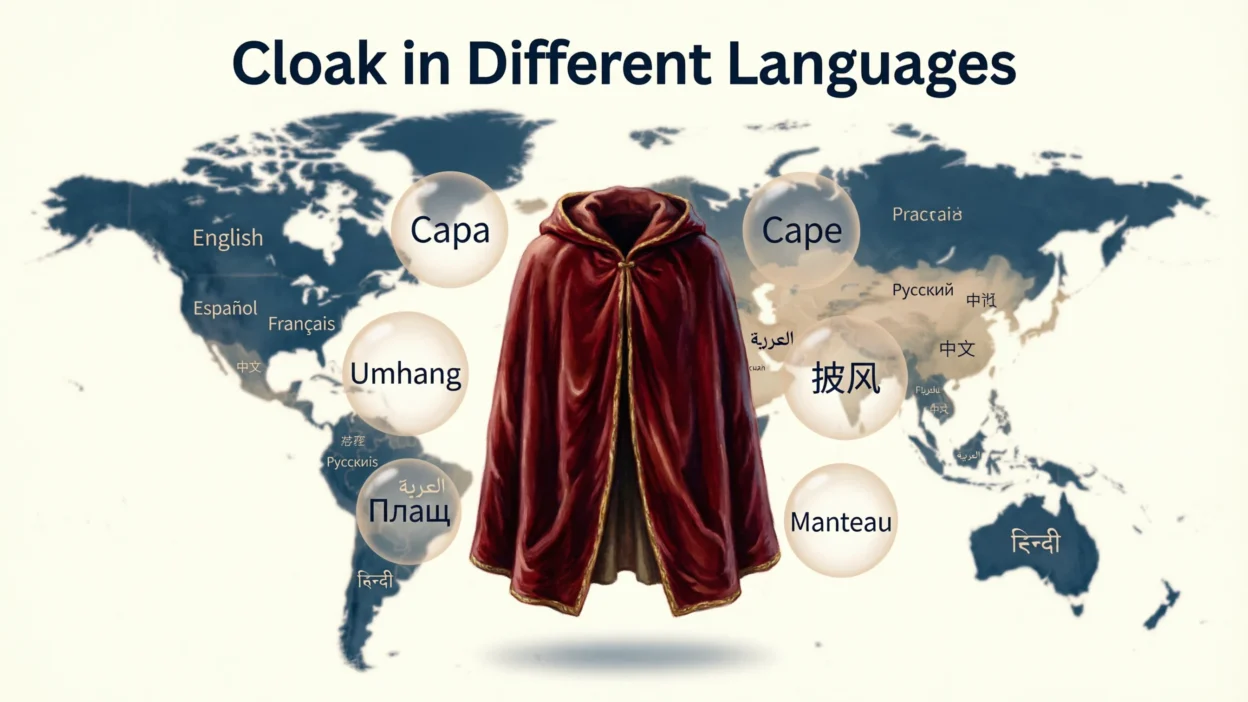
Have you ever wondered how to say cloak in different languages? Whether you’re a language learner, fantasy writer, traveler, or simply curious about global vocabulary, discovering cloak translations can help you understand culture, history, and storytelling across borders.
If you’re searching for how to say cloak in different languages, this article gives you exactly what you need fast, simple, and optimized for easy learning.
Cloak in All Languages – 70 Global Translations
Below is a mobile-friendly table showing cloak around the world in 70 different languages.
| Language | Pronunciation & Example | Example Meaning in English |
| English | Cloak (klohk) – She wore a long cloak in winter. | She wore a long outer garment in winter. |
| Spanish | Capa (KAH-pah) – Ella llevaba una capa negra. | She wore a black cloak. |
| French | Cape (kahp) – Il porte une cape rouge. | He is wearing a red cloak. |
| German | Umhang (OOM-hahng) – Er trägt einen Umhang. | He is wearing a cloak. |
| Italian | Mantello (mahn-TEL-lo) – Indossa un mantello lungo. | She wears a long cloak. |
| Portuguese | Capa (KAH-pah) – Ele usa uma capa escura. | He uses a dark cloak. |
| Dutch | Mantel (MAHN-tel) – Zij draagt een mantel. | She wears a cloak. |
| Russian | Плащ (plash) – Он надел плащ. | He put on a cloak. |
| Arabic | عباءة (a-baa-ya) – ترتدي عباءة سوداء. | She wears a black cloak. |
| Chinese (Mandarin) | 披风 (pee-fung) – 他穿着披风。 | He is wearing a cloak. |
| Japanese | マント (mahn-to) – 彼はマントを着ています。 | He is wearing a cloak. |
| Korean | 망토 (mang-to) – 그녀는 망토를 입었다. | She wore a cloak. |
| Hindi | चोगा (cho-ga) – उसने चोगा पहना। | He wore a cloak. |
| Urdu | چغہ (chu-gha) – اس نے چغہ پہنا۔ | He wore a cloak. |
| Turkish | Pelerin (pe-le-rin) – Uzun bir pelerin giydi. | She wore a long cloak. |
| Greek | Μανδύας (man-THEE-as) – Φοράει μανδύα. | He wears a cloak. |
| Polish | Płaszcz (pwashch) – Nosi płaszcz. | He wears a cloak. |
| Swedish | Kappa (KAH-pa) – Hon bär en kappa. | She wears a cloak. |
| Danish | Kappe (KAH-pe) – Han bærer en kappe. | He wears a cloak. |
| Norwegian | Kappe (KAH-pe) – Hun har på seg en kappe. | She wears a cloak. |
| Finnish | Viitta (VEE-ta) – Hän käyttää viittaa. | He uses a cloak. |
| Czech | Plášť (plahsht) – Má na sobě plášť. | He has a cloak on. |
| Hungarian | Köpeny (KUH-pey) – Köpenyt visel. | He wears a cloak. |
| Romanian | Mantia (MAN-tee-a) – Poartă o mantie. | She wears a cloak. |
| Bulgarian | Плащ (plash) – Той носи плащ. | He wears a cloak. |
| Serbian | Огртач (oghr-tach) – Носи огртач. | He wears a cloak. |
| Croatian | Ogrtač (oghr-tach) – Ima ogrtač. | He has a cloak. |
| Slovak | Plášť (plahsht) – Má plášť. | He has a cloak. |
| Slovenian | Plašč (plashch) – Nosi plašč. | He wears a cloak. |
| Ukrainian | Плащ (plashch) – Він носить плащ. | He wears a cloak. |
| Hebrew | גלימה (g’lee-ma) – היא לובשת גלימה. | She wears a cloak. |
| Persian | شنل (she-nel) – او شنل پوشیده است. | He is wearing a cloak. |
| Bengali | আলখাল্লা (al-kha-lla) – সে আলখাল্লা পরেছে। | He wore a cloak. |
| Tamil | மேலங்கி (me-lan-gee) – அவர் மேலங்கி அணிந்தார். | He wore a cloak. |
| Telugu | కప్పు వస్త్రం (ka-ppu vas-tram) – అతను కప్పు వస్త్రం ధరించాడు. | He wore a cloak. |
| Malay | Jubah (ju-bah) – Dia memakai jubah. | He wears a cloak. |
| Indonesian | Jubah (ju-bah) – Dia mengenakan jubah. | He is wearing a cloak. |
| Thai | ผ้าคลุม (pha khlum) – เขาใส่ผ้าคลุม. | He wears a cloak. |
| Vietnamese | Áo choàng (ao chwong) – Anh ấy mặc áo choàng. | He wears a cloak. |
| Filipino | Balabal (ba-la-bal) – Nakasuot siya ng balabal. | He is wearing a cloak. |
| Swahili | Joho (jo-ho) – Amevaa joho. | He wears a cloak. |
| Zulu | Ingubo (in-goo-bo) – Ugqoke ingubo. | He wears a cloak. |
| Afrikaans | Mantel (MAHN-tel) – Hy dra ‘n mantel. | He wears a cloak. |
| Icelandic | Skikkja (skik-ya) – Hann klæðist skikkju. | He wears a cloak. |
| Irish | Clóca (klo-ka) – Tá clóca air. | He has a cloak on. |
| Welsh | Mantell (MAN-thel) – Mae’n gwisgo mantell. | He wears a cloak. |
| Albanian | Mantel (man-TEL) – Ai mban mantel. | He wears a cloak. |
| Macedonian | Плашт (plash-t) – Тој носи плашт. | He wears a cloak. |
| Georgian | მანტია (man-tee-a) – მას მანტია აცვია. | He is wearing a cloak. |
| Armenian | Թիկնոց (tik-nots) – Նա թիկնոց է հագել։ | He wore a cloak. |
| Mongolian | Нөмрөг (num-rug) – Тэр нөмрөг өмссөн. | He wore a cloak. |
| Kazakh | Шекпен (shek-pen) – Ол шекпен киді. | He wore a cloak. |
| Uzbek | Chopon (cho-pon) – U chopon kiygan. | He wore a cloak. |
| Nepali | ओढ्ने (odh-ne) – उसले ओढ्ने लगायो। | He wore a cloak. |
| Sinhala | කබාය (ka-ba-ya) – ඔහු කබාය ඇඳියා. | He wore a cloak. |
| Khmer | អាវគ្រប (av krop) – គាត់ពាក់អាវគ្រប។ | He wears a cloak. |
| Lao | ເສື້ອຄຸມ (suea khum) – ລາວໃສ່ເສື້ອຄຸມ. | He wears a cloak. |
| Burmese | အင်္ကျီ (in-gyi) – သူ အင်္ကျီ ဝတ်ထားသည်။ | He is wearing a cloak. |
| Haitian Creole | Manto (man-to) – Li mete yon manto. | He put on a cloak. |
| Malagasy | Lamba (lam-ba) – Mitafy lamba izy. | He wears a cloak. |
| Amharic | ካባ (ka-ba) – ካባ ለበሰ። | He wore a cloak. |
| Somali | Go’ (go) – Wuxuu xirtay go’. | He wore a cloak. |
| Basque | Kapusa (ka-poo-sa) – Kapusa darama. | He wears a cloak. |
| Galician | Capa (KA-pa) – Leva unha capa. | He wears a cloak. |
| Catalan | Capa (KA-pa) – Porta una capa. | He wears a cloak. |
| Esperanto | Mantelo (man-TE-lo) – Li portas mantelon. | He wears a cloak. |
| Latin | Pallium (PAL-li-um) – Pallium gerit. | He wears a cloak. |
How to Say Cloak in Different Languages Correctly
Learning cloak translations is easier when you:
- Focus on pronunciation first
- Practice with simple example sentences
- Compare similar languages
- Repeat phrases aloud
Many European languages share similar words like mantel, manto, or capa. Meanwhile, Asian and African languages use completely distinct terms. This makes exploring cloak around the world both educational and fascinating.
Why Learning Cloak in All Languages Is Useful
Understanding how to say cloak in different languages is helpful for:
- Travel conversations
- Fantasy writing and storytelling
- Historical studies
- Costume and fashion research
- Language learning practice
It also builds cultural awareness and vocabulary depth.
Conclusion
Now you know how to say cloak in different languages across 70 global languages. From capa in Spanish to 披风 in Chinese and Плащ in Russian, each translation reflects history and culture.
Use this guide whenever you need accurate, easy-to-read cloak translations for study, writing, or curiosity.
FAQs About Cloak in Different Languages
1. What is cloak in all languages?
Cloak translations vary by language, such as capa (Spanish), cape (French), Umhang (German), and 披风 (Chinese).
2. How do you say cloak in different languages for travel?
You can use translations like mantello (Italian), pelerin (Turkish), or joho (Swahili) depending on your destination.
3. Are cloak and coat the same in translation?
Not always. Some languages use one word for both, while others have specific words for a traditional cloak.
4. What is the most common translation of cloak in Europe?
Words similar to mantel, manto, or capa are common across many European languages.
5. Why do cloak translations differ worldwide?
Language history, climate, clothing traditions, and culture influence how cloak is translated around the world.

Marak Robort is a content writer and researcher with a strong interest in language, meanings, and digital information. His work focuses on presenting clear, easy-to-understand explanations that help readers quickly grasp complex ideas.