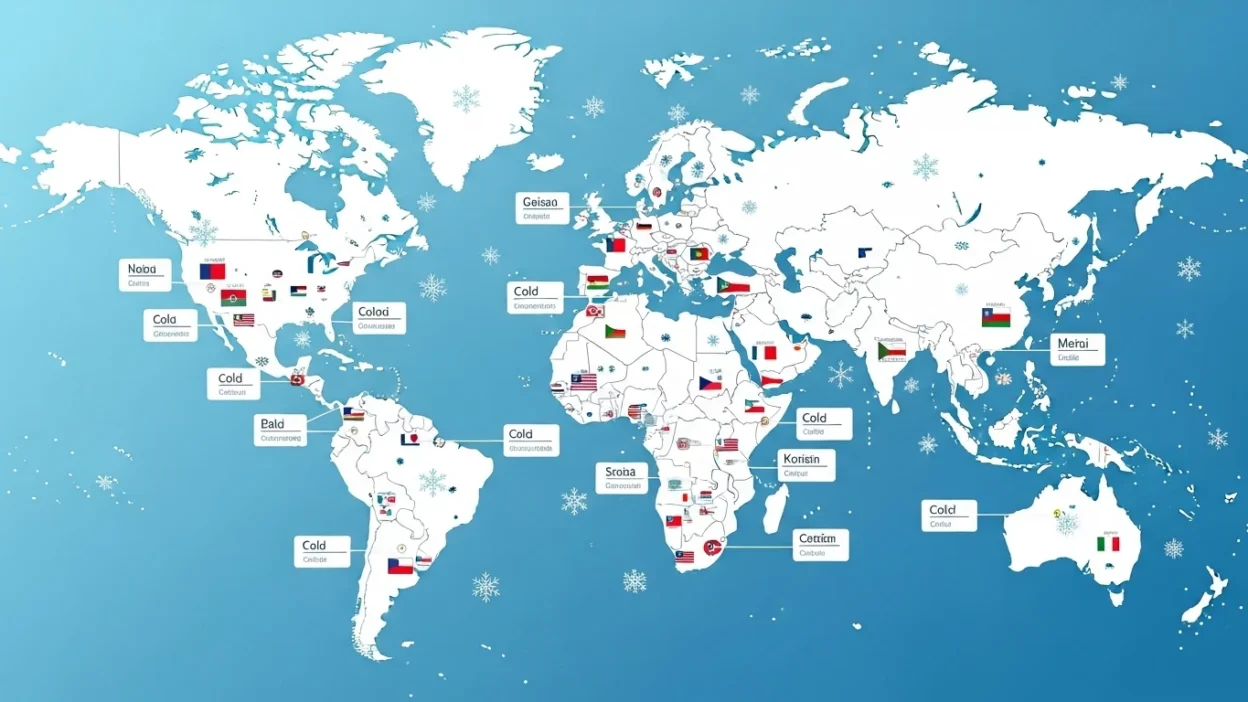
Feeling chilly? Whether you’re traveling, learning a new language, or just curious, knowing how to say cold in different languages can be both practical and fun. From Europe to Asia, each language has its own way of describing the frosty sensation we all experience.
In this article, you’ll discover cold in all languages, learn pronunciations, and see real-life examples that make understanding simple and natural.
Whether you want cold translations for travel, conversation, or language learning, this guide will help you master the word “cold” across 70 different languages, complete with examples you can use right away.
How to Say “Cold” in 70 Different Languages
| Language | Pronunciation | Example | English Meaning |
| Arabic | barid | الجو بارد اليوم | The weather is cold today |
| Spanish | frío | Hace frío afuera | It’s cold outside |
| French | froid | Il fait froid ce matin | It’s cold this morning |
| German | kalt | Das Wasser ist kalt | The water is cold |
| Italian | freddo | Il vento è freddo | The wind is cold |
| Portuguese | frio | Está frio lá fora | It’s cold outside |
| Russian | kholodnyy | Сегодня очень холодно | It’s very cold today |
| Chinese (Mandarin) | lěng | 今天很冷 | It’s very cold today |
| Japanese | samui | 外は寒いです | It’s cold outside |
| Korean | chuun | 밖이 추워요 | It’s cold outside |
| Hindi | thand | आज बहुत ठंड है | It’s very cold today |
| Bengali | thanda | বাইরে ঠান্ডা | It’s cold outside |
| Urdu | thand | آج موسم بہت ٹھنڈا ہے | Today the weather is very cold |
| Turkish | soğuk | Su soğuk | The water is cold |
| Persian | sard | امروز هوا سرد است | The weather is cold today |
| Vietnamese | lạnh | Trời hôm nay lạnh | It’s cold today |
| Thai | yen | วันนี้อากาศเย็น | The weather is cold today |
| Malay | sejuk | Cuaca sejuk hari ini | The weather is cold today |
| Indonesian | dingin | Airnya dingin | The water is cold |
| Greek | psihiros | Σήμερα κάνει κρύο | It’s cold today |
| Polish | zimny | Woda jest zimna | The water is cold |
| Dutch | koud | Het is koud buiten | It’s cold outside |
| Swedish | kall | Vattnet är kallt | The water is cold |
| Norwegian | kald | Det er kaldt i dag | It’s cold today |
| Danish | kold | Udenfor er det koldt | It’s cold outside |
| Finnish | kylmä | Tänään on kylmä | It’s cold today |
| Hungarian | hideg | Ma hideg van | It’s cold today |
| Czech | studený | Voda je studená | The water is cold |
| Slovak | studený | Dnes je veľmi studený deň | Today is a very cold day |
| Romanian | rece | Apa este rece | The water is cold |
| Bulgarian | студен (studen) | Водата е студена | The water is cold |
| Serbian | хладан (hladan) | Време је хладно | The weather is cold |
| Croatian | hladan | Danas je hladno | It’s cold today |
| Bosnian | hladan | Voda je hladna | The water is cold |
| Slovenian | mrzel | Danes je mrzlo | It’s cold today |
| Maltese | kesħ | Il-ikel huwa kesħ | The food is cold |
| Icelandic | kaldur | Það er kalt í dag | It’s cold today |
| Georgian | ts’veli | დღეს ცივი ამინდი გვაქვს | Today we have cold weather |
| Armenian | t’nd | Օդը սառն է | The air is cold |
| Azerbaijani | soyuq | Bu gün hava soyuqdur | The weather is cold today |
| Kazakh | suyıq | Су суық | The water is cold |
| Uzbek | sovuq | Havo sovuq | The weather is cold |
| Kyrgyz | muz | Бүгүн аба ырайы муздай | Today the weather is cold |
| Tajik | sardi | Имрӯз ҳаво сард аст | Today the weather is cold |
| Pashto | yakh | هوا سړه ده | The weather is cold |
| Malay (Brunei) | sejuk | Hari ini sejuk | Today is cold |
| Filipino | malamig | Ang tubig ay malamig | The water is cold |
| Swahili | baridi | Hali ya hewa ni baridi | The weather is cold |
| Zulu | kubanda | Amanzi abanda | The water is cold |
| Xhosa | kubanda | Imozulu ibanda | The weather is cold |
| Somali | qabow | Biyaha waa qabow | The water is cold |
| Amharic | b’ared | እረፍት ቀዝቃዛ ነው | The weather is cold |
| Hebrew | kar | המים קרים | The water is cold |
| Yiddish | kalt | די וועטער איז קאַלט | The weather is cold |
| Lithuanian | šaltas | Vanduo yra šaltas | The water is cold |
| Latvian | auksts | Šodien ir auksts | Today is cold |
| Estonian | külm | Vesi on külm | The water is cold |
| Maltese | kesħ | Il-lvant huwa kesħ | The east is cold |
| Nepali | jhyaalo | पानी चिसो छ | The water is cold |
| Sinhala | thanda | අද කාලගුණය සිසිලයි | Today the weather is cool |
| Burmese | chauk | ရေချိုသည် | The water is cold |
| Mongolian | huiten | Ус нь хүйтэн байна | The water is cold |
| Tibetan | zangs | ཆུ་ཚང་རིན་ཐང་ཡོད། | The water is cold |
| Khmer | thngay | ទឹកត្រជាក់ | The water is cold |
| Lao | yen | ນ້ຳຢັນ | The water is cold |
| Malay (Singapore) | sejuk | Hawa sejuk | The air is cold |
| Hawaiian | anu | Ka wai anu | The water is cold |
| Maori | makariri | Ko te wai makariri | The water is cold |
| Fijian | draki | Na wai draki | The water is cold |
| Samoan | malulu | O le vai malulu | The water is cold |
| Tongan | malō | Ko e vai malō | The water is cold |
Tips for Learning “Cold” in All Languages
Learning how to say cold in different languages is more than memorizing a word. Try these tips:
- Practice pronunciation by listening to native speakers.
- Use the word in real sentences to remember context.
- Compare cold translations across similar languages.
- Create flashcards for quick recall when traveling.
Why Knowing “Cold” Around the World Matters
Whether you’re visiting snowy mountains, tropical regions, or global cities, knowing cold in all languages helps you describe weather, food, or drinks accurately. It’s a small word that opens doors to conversation, cultural understanding, and travel confidence.
Conclusion
Now you have a full guide to saying cold in different languages with practical examples for each.
From Arabic to Tongan, you can confidently describe chilly weather wherever you go.
Keep practicing, and soon this vocabulary will feel natural no matter which country you visit.
FAQs About “Cold” in Different Languages
1. What is the easiest way to learn cold in multiple languages?
Start with common languages like Spanish, French, German, and Mandarin, then gradually expand using examples and flashcards.
2. Are there differences in meaning for “cold” in other languages?
Yes. Some languages distinguish between cold weather, cold objects, or a cold personality. Context matters.
3. Can I use these examples for travel?
Absolutely. These real-life sentences make it easy to communicate temperature or describe the weather abroad.
4. How do I remember pronunciation?
Use audio tools or online dictionaries to hear native speakers, then repeat daily to reinforce memory.
5. Is “cold” translated the same way in all dialects?
No. Some languages have regional variations. For instance, “cold” in Portuguese differs slightly between Portugal and Brazil.

Marak Robort is a content writer and researcher with a strong interest in language, meanings, and digital information. His work focuses on presenting clear, easy-to-understand explanations that help readers quickly grasp complex ideas.