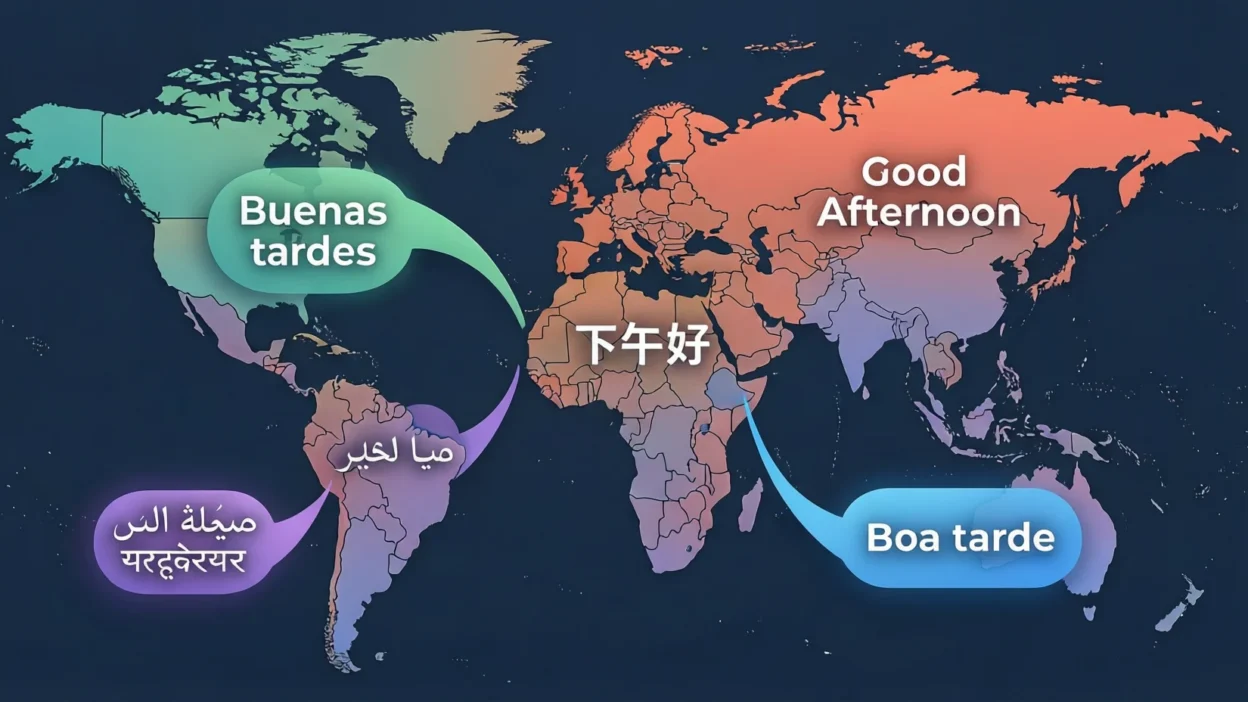
Saying good afternoon in different languages is a simple but powerful way to connect with people across cultures. Whether you are traveling, learning a new language, writing content, or just curious, knowing how to greet someone politely during the afternoon makes communication warmer and more respectful.
In this guide, you’ll discover how to say good afternoon in different languages, with clear pronunciation and real-life examples. This article is designed for quick reading, high clarity, and easy reference, making it perfect for learners and global communicators.
Good Afternoon in Different Languages (70 Translations)
| Language | Pronunciation | Example |
| English | gud af-ter-noon | Good afternoon, how is your day going? — A polite afternoon greeting |
| Spanish | bwe-nas tar-des | Buenas tardes, ¿cómo estás? — Good afternoon, how are you? |
| French | bon a-pray-mee-dee | Bon après-midi, ravi de vous voir. — Good afternoon, nice to see you |
| German | goo-ten nakh-mit-takh | Guten Nachmittag, willkommen. — Good afternoon, welcome |
| Italian | bwon po-me-rid-jo | Buon pomeriggio, signore. — Good afternoon, sir |
| Portuguese | boh-ah tar-je | Boa tarde, tudo bem? — Good afternoon, all good? |
| Dutch | khoot-e-mid-dakh | Goedemiddag, hoe gaat het? — Good afternoon, how are you? |
| Swedish | goo-ef-ter-mid-dag | God eftermiddag, trevligt att träffas. — Good afternoon, nice to meet you |
| Norwegian | goo et-er-mid-dag | God ettermiddag, håper du har det bra. — Good afternoon, hope you are well |
| Danish | goo ef-ter-mid-dag | God eftermiddag, velkommen. — Good afternoon, welcome |
| Finnish | hy-vaa il-ta-pai-vaa | Hyvää iltapäivää, mitä kuuluu? — Good afternoon, how are you? |
| Icelandic | go-than dai-in | Góðan daginn, gaman að sjá þig. — Good afternoon, nice to see you |
| Russian | dob-ree dyen | Добрый день, как дела? — Good afternoon, how are things? |
| Ukrainian | dob-ree den | Добрий день, приємно познайомитись. — Good afternoon, nice to meet you |
| Polish | jen dob-ry | Dzień dobry, miłego dnia. — Good afternoon, have a nice day |
| Czech | dob-rey od-po-led-ne | Dobré odpoledne, vítám vás. — Good afternoon, welcome |
| Slovak | dob-rey po-po-lud-nye | Dobré popoludnie, ako sa máte? — Good afternoon, how are you? |
| Hungarian | yo nap-ot | Jó napot, örülök hogy itt van. — Good afternoon, glad you are here |
| Romanian | boo-nuh zee-wa | Bună ziua, ce mai faceți? — Good afternoon, how are you? |
| Bulgarian | do-bar den | Добър ден, приятно ми е. — Good afternoon, nice to meet you |
| Greek | ka-lo a-po-gev-ma | Καλό απόγευμα, τι κάνετε; — Good afternoon, how are you? |
| Turkish | ee o-len son-ra | İyi öğleden sonra, hoş geldiniz. — Good afternoon, welcome |
| Arabic | ma-saa al-khayr | مساء الخير، كيف حالك؟ — Good afternoon, how are you? |
| Hebrew | a-kha-tsa-ho-ra-yim to-vim | אחר הצהריים טובים, שמח לראותך. — Good afternoon, happy to see you |
| Persian | bad az zohr be-kheyr | بعد از ظهر بخیر، حال شما چطور است؟ — Good afternoon, how are you? |
| Hindi | shubh a-pa-rah-n | शुभ अपराह्न, आप कैसे हैं? — Good afternoon, how are you? |
| Bengali | shub-ho o-po-rah-n | শুভ অপরাহ্ন, আপনাকে স্বাগতম। — Good afternoon, welcome |
| Urdu | ba-khair do-pe-har | بخیر دوپہر، آپ کیسے ہیں؟ — Good afternoon, how are you? |
| Punjabi | shubh du-pe-har | ਸ਼ੁਭ ਦੁਪਹਿਰ, ਤੁਸੀਂ ਕਿਵੇਂ ਹੋ? — Good afternoon, how are you? |
| Marathi | shubh du-par | शुभ दुपार, तुमचे स्वागत आहे. — Good afternoon, welcome |
| Gujarati | shubh ba-por | શુભ બપોર, કેમ છો? — Good afternoon, how are you? |
| Tamil | nal-la ma-dhi-yam | நல்ல மதியம், உங்களை சந்தித்ததில் மகிழ்ச்சி. — Good afternoon, nice to meet you |
| Telugu | shu-bha mad-hya-hnam | శుభ మధ్యాహ్నం, ఎలా ఉన్నారు? — Good afternoon, how are you? |
| Kannada | shu-bha mad-hya-hna | ಶುಭ ಮಧ್ಯಾಹ್ನ, ನಿಮಗೆ ಸ್ವಾಗತ. — Good afternoon, welcome |
| Malayalam | shu-bha mad-hya-hnam | ശുഭ മധ്യാഹ്നം, സുഖമാണോ? — Good afternoon, how are you? |
| Sinhala | su-bha madh-ya-ha-na | සුභ මධ්යහනය, ඔබට කෙසේද? — Good afternoon, how are you? |
| Thai | sa-wa-dee ton-bai | สวัสดีตอนบ่าย ยินดีที่ได้พบคุณ — Good afternoon, nice to meet you |
| Vietnamese | chao bu-oi chieu | Chào buổi chiều, bạn khỏe không? — Good afternoon, how are you? |
| Indonesian | sə-la-mat si-ang | Selamat siang, senang bertemu Anda. — Good afternoon, nice to meet you |
| Malay | sə-la-mat pa-tang | Selamat petang, apa khabar? — Good afternoon, how are you? |
| Filipino | ma-gan-dang ha-pon | Magandang hapon, salamat sa pagpunta. — Good afternoon, thanks for coming |
| Chinese (Mandarin) | shang-wu hao | 下午好,很高兴见到你。 — Good afternoon, nice to meet you |
| Japanese | kon-ni-chi-wa | こんにちは、お元気ですか。 — Good afternoon, how are you? |
| Korean | an-nyeong-ha-se-yo | 안녕하세요, 반갑습니다. — Good afternoon, nice to meet you |
| Mongolian | sain u-des khoi-sh | Сайн үдээс хойш, тавтай морил. — Good afternoon, welcome |
| Nepali | shubh a-pa-rah-n | शुभ अपराह्न, तपाईंलाई भेटेर खुशी लाग्यो। — Good afternoon, nice to meet you |
| Swahili | mcha-na mwe-ma | Mchana mwema, karibu. — Good afternoon, welcome |
| Zulu | n-tam-ba-ma en-hle | Ntambama enhle, unjani? — Good afternoon, how are you? |
| Afrikaans | khoi-e mid-dakh | Goeie middag, welkom. — Good afternoon, welcome |
| Xhosa | em-va kwe-mi-ni en-tle | Emva kwemini entle, ndiyavuya ukukubona. — Good afternoon, glad to see you |
| Estonian | te-re pai-vas-t | Tere päevast, meeldiv tutvuda. — Good afternoon, nice to meet you |
| Latvian | lab-dien | Labdien, kā jums klājas? — Good afternoon, how are you? |
| Lithuanian | la-ba die-na | Laba diena, malonu susipažinti. — Good afternoon, nice to meet you |
| Slovenian | do-ber po-pol-dan | Dober popoldan, lepo vas je videti. — Good afternoon, nice to see you |
| Croatian | do-bar dan | Dobar dan, dobro došli. — Good afternoon, welcome |
| Serbian | do-bar dan | Добар дан, драго ми је. — Good afternoon, pleased to meet you |
| Bosnian | do-bar dan | Dobar dan, kako ste? — Good afternoon, how are you? |
| Albanian | mi-re-di-ta | Mirëdita, mirë se erdhët. — Good afternoon, welcome |
| Macedonian | do-bar den | Добар ден, како сте? — Good afternoon, how are you? |
| Armenian | ba-ri or | Բարի օր, հաճելի հանդիպում։ — Good afternoon, nice meeting you |
| Georgian | shu-a-dghis mshvid-o-ba | შუადღის მშვიდობა, მოგესალმებით. — Good afternoon, greetings |
| Azerbaijani | gu-nor-ta-niz khe-yir | Günortanız xeyir, xoş gördük. — Good afternoon, welcome |
| Kazakh | kai-er-ly kun | Қайырлы күн, қош келдіңіз. — Good afternoon, welcome |
| Uzbek | khayr-li kun | Xayrli kun, sizni ko‘rib xursandman. — Good afternoon, happy to see you |
| Turkmen | hai-yr-ly gun | Haýyrly gün, hoş geldiňiz. — Good afternoon, welcome |
| Tajik | roo-zi khush | Рӯзи хуш, шодам аз диданатон. — Good afternoon, glad to see you |
| Lao | sa-bai-dee ton-bai | ສະບາຍດີຕອນບ່າຍ, ຍິນດີຕ້ອນຮັບ. — Good afternoon, welcome |
| Khmer | suost-dey pel-ro-siel | សួស្តីពេលរសៀល សប្បាយចិត្តជួបអ្នក។ — Good afternoon, happy to meet you |
| Burmese | min-ga-la nei-le | မင်္ဂလာနေ့လယ်ခင်းပါ။ — Good afternoon |
| Maori | ki-a pai te a-hi-a-hi | Kia pai te ahiahi, nau mai. — Good afternoon, welcome |
Why Learning “Good Afternoon” in All Languages Matters
Learning good afternoon in all languages helps you show cultural respect, build trust, and communicate politely in global settings. A simple greeting can create a strong first impression anywhere in the world.
How to Say Good Afternoon in Different Languages Correctly
Some languages use the same phrase for good day or hello, especially in the afternoon. Context, tone, and local customs matter just as much as pronunciation when using good afternoon translations.
Using Good Afternoon Around the World in Daily Life
You can use these greetings while traveling, in international business, language learning, or content creation. Knowing good afternoon around the world makes everyday interactions smoother and friendlier.
Conclusion
Knowing how to say good afternoon in different languages is a small skill with big impact. With these 70 translations, pronunciations, and examples, you can confidently greet people across cultures and situations.
FAQs
1. How do you say good afternoon in different languages?
You say it using language-specific phrases, such as “Buenas tardes” in Spanish or “Bon après-midi” in French.
2. Is good afternoon used the same way in every country?
No, some languages use one phrase for both good day and good afternoon, depending on time and culture.
3. What is the most common good afternoon translation worldwide?
Many languages use a form of “good day,” such as “Dobar dan” or “Добрый день.”
4. Can good afternoon be used in formal situations?
Yes, it is widely acceptable in professional, business, and polite conversations.
5. Why learn good afternoon in all languages?
It improves communication, cultural understanding, and social confidence.

Marak Robort is a content writer and researcher with a strong interest in language, meanings, and digital information. His work focuses on presenting clear, easy-to-understand explanations that help readers quickly grasp complex ideas.