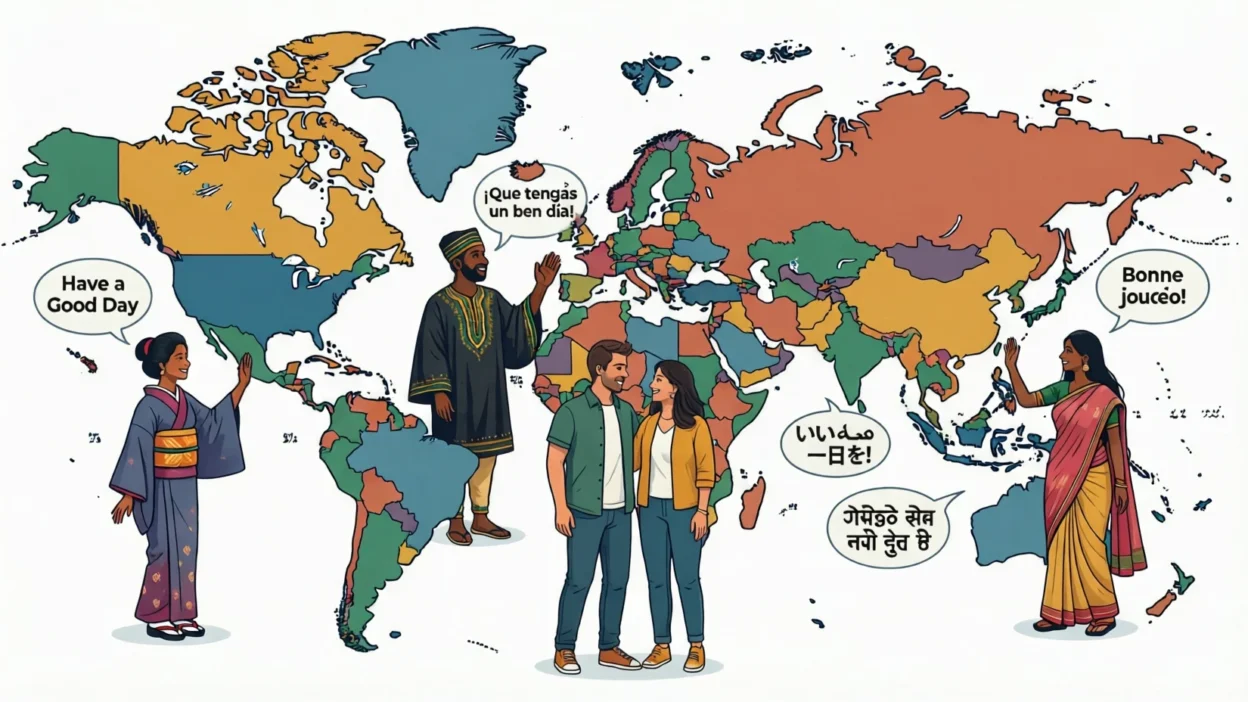
Knowing how to say have a good day in different languages is a simple but powerful way to connect with people across cultures. Whether you’re traveling, learning a new language, writing multilingual content, or just curious, this guide gives you clear, human-friendly translations you can actually use.
Below, you’ll find exactly 70 languages with pronunciation help and short real-life examples. This article is designed to match informational search intent and help you quickly learn how to say have a good day in different languages, all in one place.
Have a Good Day in All Languages (70 Translations With Examples)
| Language | Pronunciation | Example |
| English | hav uh good dey | Have a good day at work! — Meaning: Enjoy your day |
| Spanish | keh ten-gahs oon bwen dee-ah | ¡Que tengas un buen día! — Meaning: Have a nice day |
| French | bun zhoor-nay | Bonne journée ! — Meaning: Have a good day |
| German | shoh-nen tahg | Schönen Tag! — Meaning: Have a nice day |
| Italian | bwohn jor-no | Buona giornata! — Meaning: Have a good day |
| Portuguese | bwoh-ah jee-ah | Tenha um bom dia! — Meaning: Have a good day |
| Dutch | fin-neh dahg | Fijne dag! — Meaning: Have a nice day |
| Swedish | bra dahg | Ha en bra dag! — Meaning: Have a good day |
| Norwegian | bra dahg | Ha en fin dag! — Meaning: Have a nice day |
| Danish | goh dah | Hav en god dag! — Meaning: Have a good day |
| Finnish | hy-vah pah-ee-vah | Hyvää päivää! — Meaning: Have a good day |
| Icelandic | goh-than dahg | Eigðu góðan dag! — Meaning: Have a good day |
| Russian | khah-ro-she-vo dnyah | Хорошего дня! — Meaning: Have a good day |
| Ukrainian | khor-oh-ho dnyah | Гарного дня! — Meaning: Have a good day |
| Polish | mi-woh-go dnyah | Miłego dnia! — Meaning: Have a nice day |
| Czech | hez-kee den | Hezký den! — Meaning: Have a nice day |
| Slovak | pek-nee den | Pekný deň! — Meaning: Have a nice day |
| Hungarian | sep nah-pot | Szép napot! — Meaning: Have a nice day |
| Romanian | oh zee boo-nah | O zi bună! — Meaning: Have a good day |
| Bulgarian | hoo-bav den | Хубав ден! — Meaning: Have a nice day |
| Greek | kah-lee meh-rah | Καλή μέρα! — Meaning: Have a good day |
| Turkish | ee-yee goo-ner | İyi günler! — Meaning: Have a good day |
| Arabic | yah-wm sa-eed | يوم سعيد — Meaning: Have a happy day |
| Hebrew | yom tov | יום טוב — Meaning: Have a good day |
| Persian | rooz-e khosh | روز خوش — Meaning: Have a nice day |
| Hindi | shubh din ho | शुभ दिन हो — Meaning: Have a good day |
| Urdu | acha din ho | اچھا دن ہو — Meaning: Have a good day |
| Bengali | shubho din | শুভ দিন — Meaning: Have a good day |
| Punjabi | changa din | ਚੰਗਾ ਦਿਨ — Meaning: Have a good day |
| Tamil | nalla naal | நல்ல நாள் — Meaning: Have a good day |
| Telugu | manchi roju | మంచి రోజు — Meaning: Have a good day |
| Malayalam | nalla dhinam | നല്ല ദിനം — Meaning: Have a good day |
| Kannada | olle dina | ಒಳ್ಳೆ ದಿನ — Meaning: Have a good day |
| Marathi | changla divas | चांगला दिवस — Meaning: Have a good day |
| Gujarati | saras divas | સરસ દિવસ — Meaning: Have a good day |
| Nepali | ramro din | राम्रो दिन — Meaning: Have a good day |
| Sinhala | hondha dawasak | හොඳ දවසක් — Meaning: Have a good day |
| Thai | wan-dee | ขอให้เป็นวันที่ดี — Meaning: Have a good day |
| Vietnamese | ngay tot lanh | Chúc bạn một ngày tốt lành — Meaning: Have a good day |
| Indonesian | hari yang baik | Semoga harimu baik — Meaning: Have a good day |
| Malay | hari yang baik | Selamat hari — Meaning: Have a good day |
| Filipino | magand-ang araw | Magandang araw! — Meaning: Have a good day |
| Chinese (Mandarin) | jīn tiān hǎo | 祝你今天过得愉快 — Meaning: Have a good day |
| Cantonese | gam yat hou | 今日愉快 — Meaning: Have a good day |
| Japanese | yoi ichi-nichi | 良い一日を — Meaning: Have a good day |
| Korean | joh-eun haru | 좋은 하루 되세요 — Meaning: Have a good day |
| Mongolian | saikhan udur | Сайхан өдөр — Meaning: Have a good day |
| Kazakh | zhaksy kun | Жақсы күн — Meaning: Have a good day |
| Uzbek | yah-shi kun | Yaxshi kun — Meaning: Have a good day |
| Azerbaijani | yahk-shee goon | Yaxşı gün — Meaning: Have a good day |
| Georgian | kargi dghe | კარგი დღე — Meaning: Have a good day |
| Armenian | bari or | Բարի օր — Meaning: Have a good day |
| Swahili | siku njema | Kuwa na siku njema — Meaning: Have a good day |
| Zulu | usuku oluhle | Ube nosuku oluhle — Meaning: Have a good day |
| Afrikaans | goeie dag | Goeie dag! — Meaning: Have a good day |
| Hausa | rana mai kyau | Rana mai kyau — Meaning: Have a good day |
| Yoruba | ojo rere | Ojo rere! — Meaning: Have a good day |
| Igbo | ubochi oma | Nwee ubochi oma — Meaning: Have a good day |
| Amharic | konjo ken | ቆንጆ ቀን — Meaning: Have a good day |
| Somali | maalin wanaagsan | Maalin wanaagsan — Meaning: Have a good day |
| Malagasy | andro tsara | Andro tsara! — Meaning: Have a good day |
| Xhosa | usuku oluhle | Yiba nosuku oluhle — Meaning: Have a good day |
| Shona | zuva rakanaka | Iva nezuva rakanaka — Meaning: Have a good day |
| Sesotho | letsatsi le monate | E-ba le letsatsi le monate — Meaning: Have a good day |
| Basque | egun ona | Egun ona! — Meaning: Have a good day |
| Catalan | bon dia | Bon dia! — Meaning: Have a good day |
| Galician | bo día | Bo día! — Meaning: Have a good day |
| Irish | lá maith | Lá maith agat! — Meaning: Have a good day |
| Welsh | diwrnod da | Cael diwrnod da — Meaning: Have a good day |
| Scottish Gaelic | latha math | Latha math dhut — Meaning: Have a good day |
Why Learning “Have a Good Day” Translations Matters
This phrase is friendly, universal, and culturally safe. Using have a good day translations helps build instant rapport, whether you’re traveling, chatting online, or working with global clients. It’s often one of the first phrases locals appreciate hearing in their own language.
How to Say Have a Good Day in Different Languages Naturally
In many cultures, the phrase changes slightly depending on formality, time of day, or relationship. Still, the expressions above are natural, commonly used, and understood worldwide. That’s why they’re perfect for beginners and casual use.
Have a Good Day Around the World: Cultural Tip
Some languages prefer wishing a good day in the morning and a good rest or good evening later. When in doubt, these phrases remain polite and positive in everyday situations.
Conclusion
Learning how to say have a good day in different languages is a small effort with a big impact. With these 70 translations, pronunciations, and examples, you can confidently spread positivity anywhere in the world—one simple phrase at a time.
FAQs
1. How do you say have a good day in all languages?
There is no single phrase for all languages, but this guide shows common, natural translations used worldwide.
2. What is the most universal way to say have a good day?
English “Have a good day” and French “Bonne journée” are widely understood internationally.
3. Is have a good day formal or informal?
It works in both settings, though some languages adjust tone based on context.
4. Why do translations of have a good day differ by region?
Language structure, culture, and social norms influence how the idea is expressed.
5. Is this list suitable for travelers and beginners?
Yes, all phrases are beginner-friendly and commonly used in daily life.
Meta description:
Learn how to say have a good day in different languages with 70 accurate translations, pronunciations, and real-life examples from around the world.