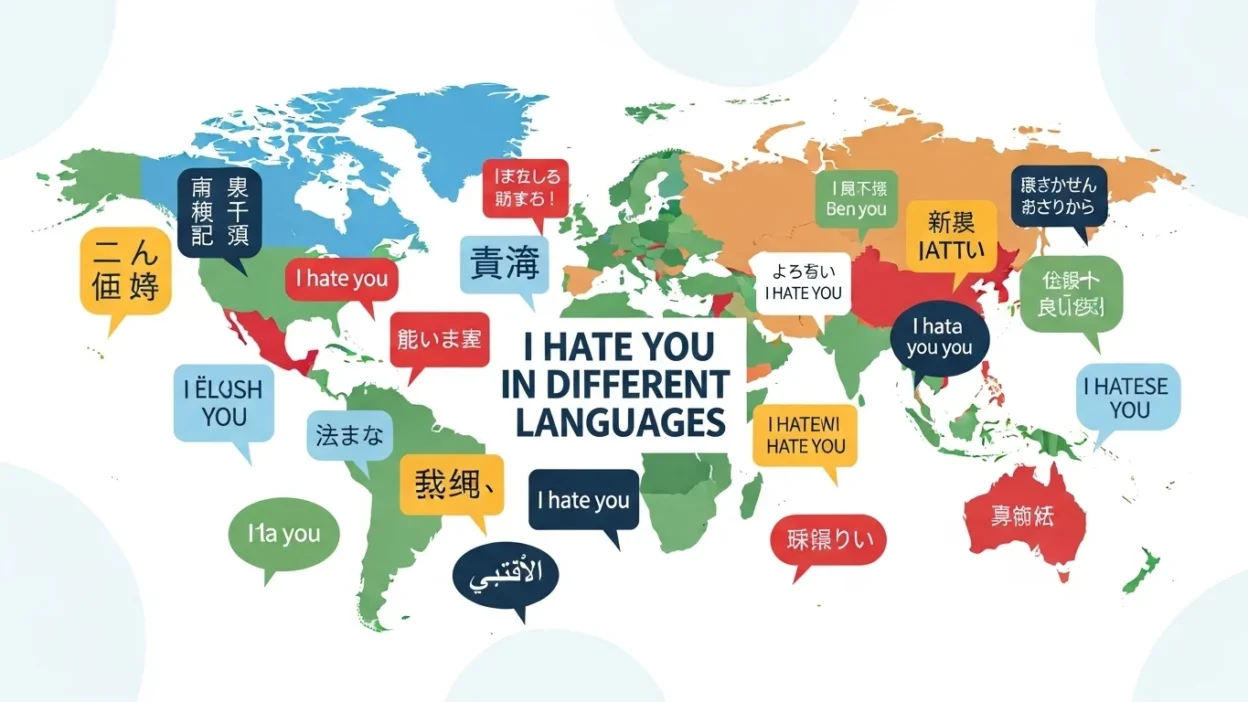
Understanding how to express strong emotions across cultures can be both fascinating and useful.
Whether you’re learning a new language, exploring global expressions, or simply curious, this guide shows you “i hate you in different languages” with clear pronunciation and real-life examples.
I Hate You in All Languages 70 Translations Table
| Language | Pronunciation | Example |
| English | I hate you | I hate you when you lie. (English: I hate you when you lie.) |
| Spanish | Te odio | Te odio por mentir. (English: I hate you for lying.) |
| French | Je te déteste | Je te déteste parfois. (English: I hate you sometimes.) |
| German | Ich hasse dich | Ich hasse dich jetzt. (English: I hate you now.) |
| Italian | Ti odio | Ti odio davvero. (English: I really hate you.) |
| Portuguese | Eu te odeio | Eu te odeio hoje. (English: I hate you today.) |
| Russian | Ya tebya nenavizhu | Ya tebya nenavizhu za eto. (English: I hate you for that.) |
| Arabic | Ana akrahuka | Ana akrahuka jiddan. (English: I hate you very much.) |
| Hindi | Main tumse nafrat karta hun | Main tumse nafrat karta hun ab. (English: I hate you now.) |
| Urdu | Main tum se nafrat karta hun | Main tum se nafrat karta hun kabhi kabhi. (English: I hate you sometimes.) |
| Chinese (Mandarin) | Wo hen ni | Wo hen ni hen jiu le. (English: I have hated you for long.) |
| Japanese | Kimi ga kirai | Kimi ga kirai da yo. (English: I hate you.) |
| Korean | Nan nega silheo | Nan nega silheo jigeum. (English: I hate you now.) |
| Turkish | Senden nefret ediyorum | Senden nefret ediyorum artik. (English: I hate you now.) |
| Dutch | Ik haat je | Ik haat je soms. (English: I hate you sometimes.) |
| Greek | Se miso | Se miso tora. (English: I hate you now.) |
| Polish | Nienawidze cie | Nienawidze cie bardzo. (English: I hate you very much.) |
| Swedish | Jag hatar dig | Jag hatar dig idag. (English: I hate you today.) |
| Danish | Jeg hader dig | Jeg hader dig nu. (English: I hate you now.) |
| Norwegian | Jeg hater deg | Jeg hater deg litt. (English: I hate you a little.) |
| Finnish | Minä vihaan sinua | Minä vihaan sinua nyt. (English: I hate you now.) |
| Czech | Nenavidim te | Nenavidim te opravdu. (English: I really hate you.) |
| Slovak | Nenavidim ta | Nenavidim ta dnes. (English: I hate you today.) |
| Hungarian | Utallak | Utallak nagyon. (English: I hate you very much.) |
| Romanian | Te urasc | Te urasc acum. (English: I hate you now.) |
| Bulgarian | Mrazya te | Mrazya te silno. (English: I hate you strongly.) |
| Serbian | Mrzim te | Mrzim te sada. (English: I hate you now.) |
| Croatian | Mrzim te | Mrzim te ponekad. (English: I hate you sometimes.) |
| Bosnian | Mrzim te | Mrzim te iskreno. (English: I honestly hate you.) |
| Slovenian | Sovrazim te | Sovrazim te danes. (English: I hate you today.) |
| Albanian | Te urrej | Te urrej shume. (English: I hate you a lot.) |
| Estonian | Ma vihkan sind | Ma vihkan sind praegu. (English: I hate you now.) |
| Latvian | Es tevi ienistu | Es tevi ienistu tagad. (English: I hate you now.) |
| Lithuanian | As taves nekenciu | As taves nekenciu visai. (English: I really hate you.) |
| Icelandic | Eg hata tig | Eg hata tig stundum. (English: I hate you sometimes.) |
| Irish | Is fuath liom tu | Is fuath liom tu inniu. (English: I hate you today.) |
| Welsh | Dwi’n casau ti | Dwi’n casau ti nawr. (English: I hate you now.) |
| Maltese | Nobghodek | Nobghodek hafna. (English: I hate you a lot.) |
| Swahili | Ninakuchukia | Ninakuchukia sasa. (English: I hate you now.) |
| Zulu | Ngiyakuzonda | Ngiyakuzonda manje. (English: I hate you now.) |
| Afrikaans | Ek haat jou | Ek haat jou nou. (English: I hate you now.) |
| Somali | Waan ku necbahay | Waan ku necbahay maanta. (English: I hate you today.) |
| Amharic | Ewedishalehu algebam | Ewedishalehu algebam ahun. (English: I hate you now.) |
| Hebrew | Ani sone otcha | Ani sone otcha meod. (English: I hate you very much.) |
| Persian | Man az to badam miyad | Man az to badam miyad alan. (English: I hate you now.) |
| Pashto | Za sta nafrat kawom | Za sta nafrat kawom os. (English: I hate you now.) |
| Bengali | Ami tomake ghina kori | Ami tomake ghina kori ekhon. (English: I hate you now.) |
| Punjabi | Main tenu nafrat karda haan | Main tenu nafrat karda haan hun. (English: I hate you now.) |
| Tamil | Naan unnai verukkiren | Naan unnai verukkiren ippol. (English: I hate you now.) |
| Telugu | Nenu ninnu dveshistunnanu | Nenu ninnu dveshistunnanu ippudu. (English: I hate you now.) |
| Kannada | Naanu ninna dveshisuttene | Naanu ninna dveshisuttene iga. (English: I hate you now.) |
| Malayalam | Njan ninne verukkunnu | Njan ninne verukkunnu ippol. (English: I hate you now.) |
| Thai | Chan kliyat khun | Chan kliyat khun mak. (English: I hate you a lot.) |
| Vietnamese | Toi ghe ban | Toi ghe ban bay gio. (English: I hate you now.) |
| Indonesian | Aku benci kamu | Aku benci kamu sekarang. (English: I hate you now.) |
| Malay | Saya benci awak | Saya benci awak hari ini. (English: I hate you today.) |
| Filipino | Kinamumuhian kita | Kinamumuhian kita ngayon. (English: I hate you now.) |
| Mongolian | Bi chamd durgui | Bi chamd durgui odoo. (English: I hate you now.) |
| Nepali | Ma timilai ghrina garchu | Ma timilai ghrina garchu ahile. (English: I hate you now.) |
| Sinhala | Mama oyata apeksha nehe | Mama oyata apeksha nehe dan. (English: I hate you now.) |
| Burmese | Nga min ko mone de | Nga min ko mone de a khu. (English: I hate you now.) |
| Khmer | Khnhom sralanh min te | Khnhom sralanh min te elov. (English: I hate you now.) |
| Lao | Khony bo mak chao | Khony bo mak chao ton ni. (English: I hate you now.) |
| Georgian | Me shen miqvars ara | Me shen miqvars ara akhla. (English: I hate you now.) |
| Armenian | Yes qez atum em | Yes qez atum em hima. (English: I hate you now.) |
| Azerbaijani | Men senden nifret edirem | Men senden nifret edirem indi. (English: I hate you now.) |
| Kazakh | Men seni jek korem | Men seni jek korem qazir. (English: I hate you now.) |
| Uzbek | Men seni yomon koraman | Men seni yomon koraman hozir. (English: I hate you now.) |
How to Say “I Hate You” in Different Languages
The phrase “I hate you” exists in nearly every language, but its tone and intensity vary. In some cultures, it is used casually, while in others it is considered very strong and offensive.
Learning “i hate you translations” helps you understand emotional expression across cultures and avoid misunderstandings.
When and Where to Use This Phrase
While it’s useful to learn “i hate you in all languages”, be careful when using it:
- It can sound very harsh in formal settings
- In some cultures, it may deeply offend someone
- It is often used jokingly among friends in informal contexts
Always consider tone, relationship, and situation before using such expressions.
Why Learn “I Hate You” Around the World?
Understanding “i hate you around the world” is helpful for:
- Language learners building vocabulary
- Travelers understanding emotional phrases
- Cultural awareness and communication skills
- Writers and creators adding authenticity
It also improves your ability to recognize emotions when listening to native speakers.
Conclusion
This complete guide to “i hate you in different languages” gives you 70 global translations with pronunciation and real life examples.
Whether you’re learning languages or exploring cultural expressions, this list helps you understand how strong emotions are communicated worldwide.
FAQs
1. What is the most common way to say “I hate you” worldwide?
English “I hate you” and Spanish “Te odio” are among the most widely recognized forms globally.
2. Is it rude to say “I hate you” in other languages?
Yes, in most cultures it is considered a strong and negative expression unless used jokingly.
3. How do you politely express dislike instead?
You can say “I don’t like this” instead of “I hate you” to sound more respectful.
4. Why learn negative phrases in different languages?
It helps you understand emotional context, tone, and real conversations more accurately.
5. Are translations of “I hate you” always exact?
Not always. Some languages have softer or stronger variations depending on context.

Ely Joseph is a language researcher, writer, and contributor who specializes in words, meanings, and multilingual communication. With a strong interest in how language shapes understanding across cultures, Ely focuses on creating clear, accurate, and reader-friendly content for a global audience.