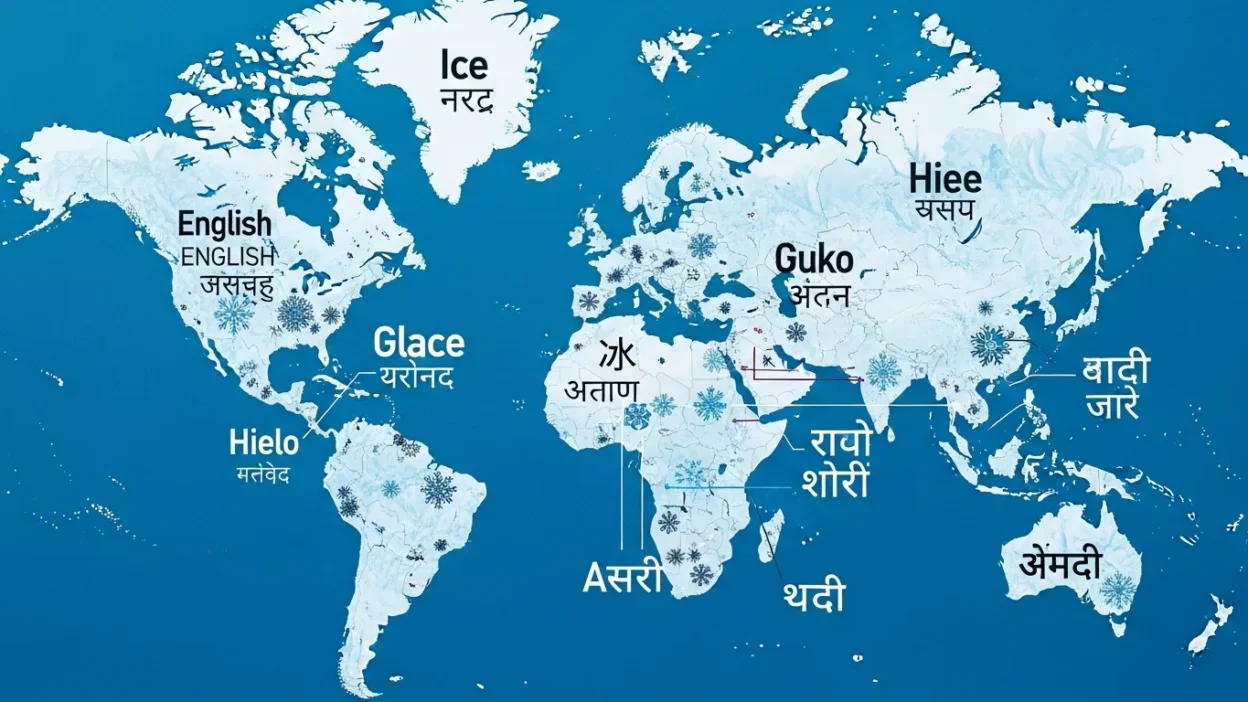
Understanding how to say ice in different languages is useful for travel, language learning, and everyday communication. Whether you’re ordering a cold drink abroad or expanding your vocabulary, knowing these translations helps you connect with people worldwide.
In this guide, you’ll discover ice in all languages, along with pronunciation and real-life examples. This makes it easier to remember and use each term naturally.
Ice in Different Languages (70 Translations Table)
| Language | Pronunciation | Example |
| English | ais | I need ice for my drink. |
| Spanish | hielo (yel-o) | Necesito hielo para mi bebida. |
| French | glace (glas) | Je veux de la glace. |
| German | eis (ice) | Ich brauche Eis. |
| Italian | ghiaccio (gyah-cho) | Voglio del ghiaccio. |
| Portuguese | gelo (zhe-lo) | Eu quero gelo. |
| Dutch | ijs (ice) | Ik wil ijs. |
| Russian | led (lyed) | Mne nuzhen led. |
| Chinese (Mandarin) | bing (bing) | Wo yao bing. |
| Japanese | koori (koh-ree) | Koori o kudasai. |
| Korean | eoreum (uh-rum) | Eoreum juseyo. |
| Arabic | thalj (thalj) | Ureed thalj. |
| Hindi | barf (barf) | Mujhe barf chahiye. |
| Urdu | barf (barf) | Mujhe barf chahiye. |
| Bengali | borof (bo-rof) | Amar borof chai. |
| Turkish | buz (booz) | Buz istiyorum. |
| Greek | pagos (pa-gos) | Thelo pagos. |
| Polish | lod (loot) | Potrzebuje lodu. |
| Swedish | is (ees) | Jag vill ha is. |
| Norwegian | is (ees) | Jeg vil ha is. |
| Danish | is (ees) | Jeg vil have is. |
| Finnish | jaa (yaa) | Haluan jaata. |
| Czech | led (led) | Potrebuji led. |
| Slovak | lad (lad) | Potrebujem lad. |
| Hungarian | jeg (yeg) | Kerek jeg. |
| Romanian | gheata (ghe-a-ta) | Vreau gheata. |
| Bulgarian | led (led) | Iskam led. |
| Serbian | led (led) | Treba mi led. |
| Croatian | led (led) | Trebam led. |
| Ukrainian | lid (leed) | Meni potriben lid. |
| Thai | nam khaeng (nam keng) | Chan ao nam khaeng. |
| Vietnamese | da (za) | Toi can da. |
| Indonesian | es (ess) | Saya mau es. |
| Malay | ais (ice) | Saya mahu ais. |
| Filipino | yelo (ye-lo) | Kailangan ko ng yelo. |
| Swahili | barafu (ba-ra-fu) | Nahitaji barafu. |
| Zulu | iqhwa (ee-khwa) | Ngifuna iqhwa. |
| Afrikaans | ys (ace) | Ek wil ys. |
| Hebrew | kerach (keh-rach) | Ani rotze kerach. |
| Persian | yakh (yakh) | Man yakh mikham. |
| Pashto | yag (yag) | Ma ta yag pakar de. |
| Punjabi | barf (barf) | Mainu barf chahidi hai. |
| Tamil | pani (pa-ni) | Enakku pani venum. |
| Telugu | manchu (man-choo) | Naaku manchu kavali. |
| Kannada | manju (man-joo) | Nanage manju beku. |
| Marathi | baraf (ba-raf) | Mala baraf pahije. |
| Gujarati | baraf (ba-raf) | Mane baraf joie chhe. |
| Nepali | him (heem) | Malai him chahinchha. |
| Sinhala | hima (hee-ma) | Mata hima one. |
| Burmese | yay-gyi (yay-jee) | Ngarr yay-gyi lo chin de. |
| Khmer | tuk kak (tuk kak) | Khnhom chong tuk kak. |
| Lao | nam khaeng (nam keng) | Khoy yak nam khaeng. |
| Mongolian | mos (mos) | Bi mos avmaar baina. |
| Icelandic | is (ees) | Eg vil is. |
| Irish | oighir (oy-ir) | Ba mhaith liom oighir. |
| Welsh | ia (yah) | Dw i eisiau ia. |
| Scottish Gaelic | deigh (jay) | Tha mi ag iarraidh deigh. |
| Basque | izotz (ee-zots) | Izotza nahi dut. |
| Catalan | gel (zhel) | Vull gel. |
| Esperanto | glacio (gla-tsee-o) | Mi volas glacion. |
| Latin | glacies (gla-kee-es) | Glacies volo. |
| Albanian | akull (a-kool) | Dua akull. |
| Macedonian | mraz (mraz) | Sakam mraz. |
| Armenian | sar (sar) | Yes sar em uzum. |
| Georgian | hels (hels) | Me minda hels. |
| Amharic | bered (be-red) | Bered feligalew. |
| Somali | baraf (ba-raf) | Waxaan rabaa baraf. |
| Malagasy | ranomandry (ra-no-man-dree) | Mila ranomandry aho. |
| Haitian Creole | glas (glas) | Mwen bezwen glas. |
| Luxembourgish | ais (ice) | Ech brauch ais. |
Why Learn Ice in Different Languages?
Learning how to say ice in different languages is surprisingly practical. It helps when:
- Traveling to new countries
- Ordering drinks or food
- Understanding menus
- Improving multilingual vocabulary
It’s one of the simplest yet most useful words globally.
Ice Translations Around the World
The word “ice” varies greatly across regions, yet many languages share similar roots. For example:
- European languages often use forms like ice, eis, is
- Asian languages use unique phonetics like bing or koori
- Middle Eastern and South Asian languages often use barf or yakh
This diversity reflects how language evolves across cultures.
Tips to Remember Ice in All Languages
- Group similar-sounding words together
- Practice using real-life sentences
- Focus on pronunciation, not just spelling
- Repeat frequently for memory retention
Conclusion
Now you know ice in different languages, along with pronunciation and examples. This knowledge is useful for travel, communication, and language learning.
With practice, you’ll quickly remember these translations and use them confidently anywhere in the world.
FAQs
1. How do you say ice in different languages?
“Ice” is translated differently in each language, such as hielo (Spanish), glace (French), and barf (Hindi/Urdu).
2. What is the most common word for ice worldwide?
There is no single global word, but variations like ice, eis, and is are common in Europe.
3. Why should I learn ice translations?
It helps in travel, ordering drinks, and basic communication in foreign countries.
4. Are ice translations similar across languages?
Some languages share similarities due to common roots, while others are completely different.
5. How can I easily remember ice in all languages?
Practice daily, group similar words, and use them in real-life situations.

Marak Robort is a content writer and researcher with a strong interest in language, meanings, and digital information. His work focuses on presenting clear, easy-to-understand explanations that help readers quickly grasp complex ideas.