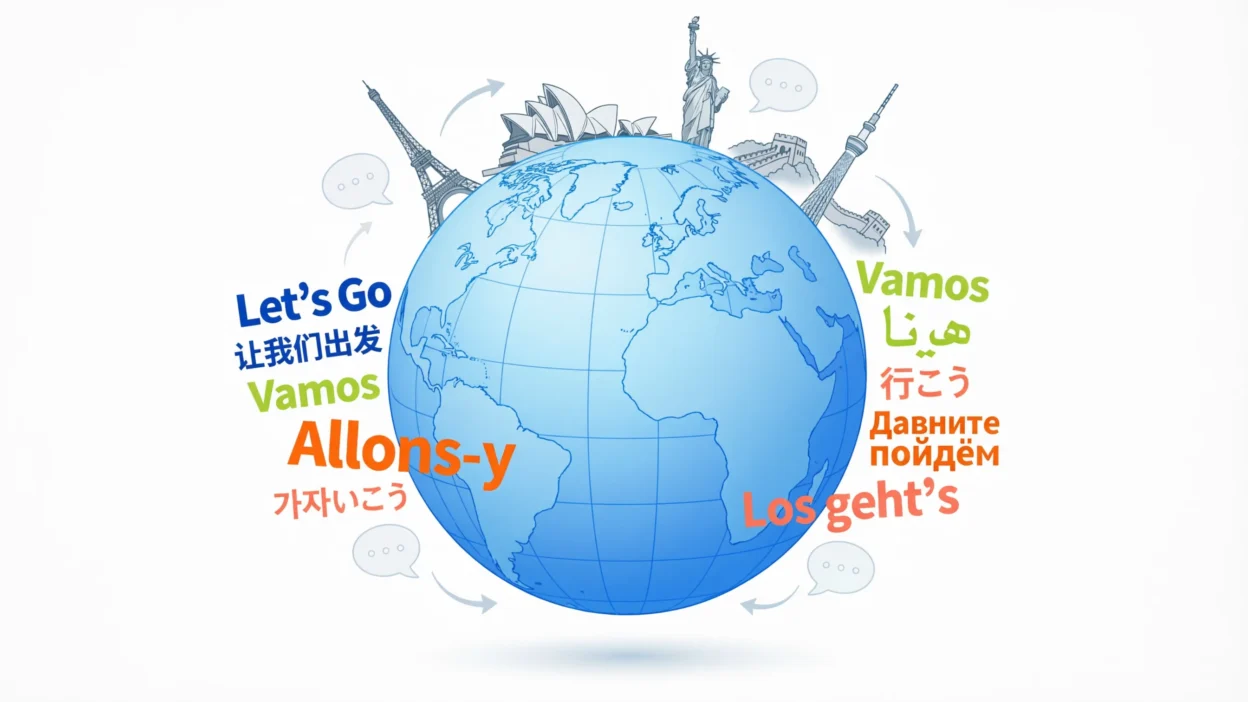
“Let’s go” is one of the most universal, energetic phrases we use every day. It shows excitement, motivation, teamwork, and movement. Whether you’re traveling, learning a new language, or just curious, knowing let’s go in different languages helps you connect naturally with people across cultures.
In this guide, you’ll find how to say “let’s go” in different languages, with real-life examples that show how the phrase is actually used. This is a complete, human-friendly resource for “let’s go in all languages,” “let’s go translations,” and “let’s go around the world.”
Let’s Go in Different Languages (70 Translations)
| Language | Pronunciation | Example |
| English | Let’s go | Let’s go to the park. — We are going to the park. |
| Spanish | Vamos (VAH-mos) | Vamos al parque. — Let’s go to the park. |
| French | Allons-y (ah-lohn-ZEE) | Allons-y maintenant. — Let’s go now. |
| German | Los geht’s (lohs GAYTS) | Los geht’s nach Hause. — Let’s go home. |
| Italian | Andiamo (an-DYAH-mo) | Andiamo a mangiare. — Let’s go eat. |
| Portuguese | Vamos (VAH-mos) | Vamos sair agora. — Let’s go out now. |
| Dutch | Laten we gaan | Laten we gaan werken. — Let’s go work. |
| Swedish | Låt oss gå | Låt oss gå nu. — Let’s go now. |
| Norwegian | La oss gå | La oss gå videre. — Let’s move on. |
| Danish | Lad os gå | Lad os gå hjem. — Let’s go home. |
| Finnish | Mennään | Mennään ulos. — Let’s go outside. |
| Russian | Пойдём (poy-DYOM) | Пойдём вместе. — Let’s go together. |
| Ukrainian | Ходімо (ho-DEE-mo) | Ходімо швидше. — Let’s go faster. |
| Polish | Chodźmy (HODJ-mi) | Chodźmy tam. — Let’s go there. |
| Czech | Pojďme (POY-me) | Pojďme ven. — Let’s go outside. |
| Slovak | Poďme (POJ-me) | Poďme ďalej. — Let’s go further. |
| Hungarian | Menjünk (MEN-yunk) | Menjünk dolgozni. — Let’s go work. |
| Romanian | Hai să mergem | Hai să mergem acasă. — Let’s go home. |
| Greek | Πάμε (PAH-me) | Πάμε τώρα. — Let’s go now. |
| Turkish | Hadi gidelim | Hadi gidelim dışarı. — Let’s go outside. |
| Arabic | هيا بنا (hay-YA bee-na) | هيا بنا الآن. — Let’s go now. |
| Hebrew | בוא נלך (bo ne-LEKH) | בוא נלך לשם. — Let’s go there. |
| Persian | بریم (be-REEM) | بریم بیرون. — Let’s go out. |
| Hindi | चलो (CHA-lo) | चलो चलते हैं। — Let’s go. |
| Urdu | چلو (CHA-lo) | چلو گھر چلتے ہیں۔ — Let’s go home. |
| Bengali | চলো (CHO-lo) | চলো বাইরে যাই। — Let’s go outside. |
| Punjabi | ਚੱਲੋ (CHAL-lo) | ਚੱਲੋ ਚਲਦੇ ਹਾਂ। — Let’s go. |
| Marathi | चला (CHA-la) | चला जाऊया. — Let’s go. |
| Tamil | போகலாம் (PO-ga-laam) | போகலாம் வெளியே. — Let’s go outside. |
| Telugu | వెళ్దాం (VEL-daam) | వెళ్దాం సినిమా. — Let’s go to a movie. |
| Kannada | ಹೋಗೋಣ (HO-go-na) | ಹೋಗೋಣ ಮನೆಗೆ. — Let’s go home. |
| Malayalam | പോകാം (PO-kaam) | പോകാം കട. — Let’s go to the shop. |
| Sinhala | යමු (YA-mu) | යමු දැන්. — Let’s go now. |
| Nepali | जाऔं (JA-um) | जाऔं घर। — Let’s go home. |
| Thai | ไปกันเถอะ (pai gan THER) | ไปกันเถอะเร็วๆนี้. — Let’s go soon. |
| Lao | ໄປກັນ (pai kan) | ໄປກັນເດີ. — Let’s go. |
| Vietnamese | Đi thôi | Đi thôi nào. — Let’s go now. |
| Indonesian | Ayo | Ayo kita pergi. — Let’s go. |
| Malay | Jom | Jom makan. — Let’s go eat. |
| Filipino | Tara | Tara na. — Let’s go now. |
| Japanese | 行こう (i-KOH) | 行こう早く。 — Let’s go quickly. |
| Korean | 가자 (GA-ja) | 가자 지금. — Let’s go now. |
| Chinese | 我们走吧 (wo-men ZOU ba) | 我们走吧。 — Let’s go. |
| Cantonese | 走啦 (zau laa) | 走啦而家. — Let’s go now. |
| Mongolian | Явцгаая | Явцгаая одоо. — Let’s go now. |
| Khmer | ទៅกันเถอะ | ទៅกันเถอะឥឡូវនេះ. — Let’s go now. |
| Burmese | သွားကြမယ် | သွားကြမယ်နော်။ — Let’s go. |
| Swahili | Twende | Twende sasa. — Let’s go now. |
| Zulu | Asambe | Asambe manje. — Let’s go now. |
| Afrikaans | Kom ons gaan | Kom ons gaan nou. — Let’s go now. |
| Amharic | እንሂድ | እንሂድ አሁን. — Let’s go now. |
| Somali | Aan tagno | Aan tagno hadda. — Let’s go now. |
| Hausa | Mu tafi | Mu tafi yanzu. — Let’s go now. |
| Yoruba | Jẹ́ ká lọ | Jẹ́ ká lọ báyìí. — Let’s go now. |
| Igbo | Ka anyi jee | Ka anyi jee ugbu a. — Let’s go now. |
| Malagasy | Andao | Andao izao. — Let’s go now. |
| Maori | Haere tātou | Haere tātou ināianei. — Let’s go now. |
| Samoan | Tatou o | Tatou o nei. — Let’s go now. |
| Tongan | Tau ō | Tau ō taimi ni. — Let’s go now. |
| Hawaiian | E hele kākou | E hele kākou i kēia manawa. — Let’s go now. |
| Fijian | Me da lako | Me da lako mada. — Let’s go now. |
| Georgian | წავიდეთ | წავიდეთ ახლა. — Let’s go now. |
| Armenian | Գնանք | Գնանք հիմա. — Let’s go now. |
| Azerbaijani | Gəlin gedək | Gəlin gedək indi. — Let’s go now. |
| Kazakh | Жүрейік | Жүрейік қазір. — Let’s go now. |
| Uzbek | Yuring | Yuring hozir. — Let’s go now. |
| Tajik | Биёед равем | Биёед равем ҳозир. — Let’s go now. |
| Pashto | راځئ چې ولاړ شو | راځئ چې ولاړ شو اوس. — Let’s go now. |
| Kurdish | Were em biçe | Were em biçe niha. — Let’s go now. |
| Irish | Téimis | Téimis anois. — Let’s go now. |
Why “Let’s Go” Matters Across Languages
This phrase is more than words. It signals action, encouragement, and unity. Learning how to say “let’s go” in different languages helps you sound natural, confident, and friendly in conversations worldwide.
When and How to Use “Let’s Go” Correctly
“Let’s go” is commonly used to:
- Start an activity
- Encourage a group
- Show excitement or urgency
- Motivate someone politely
Most languages use an informal or inclusive verb form, so it instantly creates connection.
Conclusion
Knowing let’s go in different languages opens doors to smoother communication and cultural understanding. From casual chats to global travel, this simple phrase helps you sound natural anywhere in the world.
FAQs
1. What does “let’s go” mean in simple terms?
It means starting an action together or encouraging movement.
2. Is “let’s go” informal in most languages?
Yes, it’s usually informal and friendly.
3. Why are some translations shorter than others?
Some languages use a single verb form instead of multiple words.
4. Can “let’s go” express excitement?
Yes, in many cultures it shows motivation and enthusiasm.
5. Is this phrase commonly used in daily speech worldwide?
Absolutely. It’s one of the most frequently used action phrases globally.