Understanding how to say “man in different languages” is not only useful for travelers and language learners but also helps you connect with cultures across the globe.
Whether you’re curious about man translations, building vocabulary, or exploring how to say man in different languages, this guide provides a clear and practical resource.
Below, you’ll find a carefully structured table featuring 70 languages, along with pronunciation, real life example sentences, and their English meanings. This makes it easy to learn and remember how “man” is used around the world.
Man in All Languages
| Language | Pronunciation | Example |
| English | man | The man is walking. (English meaning: A male person is walking.) |
| Spanish | hombre (om-breh) | El hombre corre. (The man runs.) |
| French | homme (om) | L’homme parle. (The man speaks.) |
| German | Mann (mahn) | Der Mann lacht. (The man laughs.) |
| Italian | uomo (wo-mo) | L’uomo mangia. (The man eats.) |
| Portuguese | homem (oh-mem) | O homem trabalha. (The man works.) |
| Russian | мужчина (mush-chee-na) | Мужчина стоит. (The man stands.) |
| Chinese (Mandarin) | 男人 (nan-ren) | 那个男人来了。 (The man came.) |
| Japanese | 男 (otoko) | 男が来た。 (The man came.) |
| Korean | 남자 (nam-ja) | 남자가 웃어요. (The man smiles.) |
| Arabic | رجل (rajul) | الرجل يجري. (The man runs.) |
| Hindi | आदमी (aadmi) | आदमी बोल रहा है। (The man is speaking.) |
| Urdu | آدمی (aadmi) | آدمی کھڑا ہے۔ (The man is standing.) |
| Bengali | মানুষ (manush) | মানুষ হাঁটছে। (The man is walking.) |
| Punjabi | ਆਦਮੀ (aadmi) | ਆਦਮੀ ਬੋਲਦਾ ਹੈ। (The man speaks.) |
| Turkish | adam (a-dam) | Adam geldi. (The man came.) |
| Persian | مرد (mard) | مرد نشست. (The man sat.) |
| Greek | άντρας (an-tras) | Ο άντρας γελάει. (The man laughs.) |
| Dutch | man (man) | De man slaapt. (The man sleeps.) |
| Swedish | man (mahn) | Mannen springer. (The man runs.) |
| Norwegian | mann (mahn) | Mannen jobber. (The man works.) |
| Danish | mand (man) | Manden taler. (The man speaks.) |
| Finnish | mies (mee-es) | Mies istuu. (The man sits.) |
| Polish | mężczyzna (men-chee-zna) | Mężczyzna idzie. (The man walks.) |
| Czech | muž (moozh) | Muž stojí. (The man stands.) |
| Slovak | muž (moozh) | Muž beží. (The man runs.) |
| Hungarian | férfi (fair-fee) | A férfi beszél. (The man speaks.) |
| Romanian | bărbat (ber-bat) | Bărbatul vine. (The man comes.) |
| Bulgarian | мъж (muzh) | Мъжът чете. (The man reads.) |
| Serbian | мушкарац (moosh-ka-rats) | Мушкарац ради. (The man works.) |
| Croatian | muškarac | Muškarac trči. (The man runs.) |
| Ukrainian | чоловік (cho-lo-veek) | Чоловік іде. (The man walks.) |
| Hebrew | גבר (gever) | הגבר בא. (The man came.) |
| Thai | ผู้ชาย (phu-chai) | ผู้ชายยิ้ม. (The man smiles.) |
| Vietnamese | đàn ông (dan ong) | Người đàn ông đi. (The man walks.) |
| Indonesian | pria (pree-a) | Pria itu datang. (The man came.) |
| Malay | lelaki (leh-lah-kee) | Lelaki itu makan. (The man eats.) |
| Filipino | lalaki (la-la-kee) | Ang lalaki tumatakbo. (The man runs.) |
| Swahili | mwanaume (mwa-na-oo-me) | Mwanaume anatembea. (The man walks.) |
| Zulu | indoda (in-do-da) | Indoda iyahamba. (The man goes.) |
| Afrikaans | man (man) | Die man werk. (The man works.) |
| Icelandic | maður (ma-thur) | Maðurinn talar. (The man speaks.) |
| Irish | fear (far) | Tá an fear ag siúl. (The man is walking.) |
| Welsh | dyn (din) | Mae’r dyn yn rhedeg. (The man runs.) |
| Scottish Gaelic | fear (far) | Tha am fear a’ tighinn. (The man comes.) |
| Latvian | vīrietis (vee-reh-tis) | Vīrietis skrien. (The man runs.) |
| Lithuanian | vyras (vee-ras) | Vyras kalba. (The man speaks.) |
| Estonian | mees (me-es) | Mees tuleb. (The man comes.) |
| Albanian | burrë (boo-reh) | Burri flet. (The man speaks.) |
| Macedonian | маж (mazh) | Мажот оди. (The man walks.) |
| Slovenian | moški (mo-shkee) | Moški teče. (The man runs.) |
| Armenian | մարդ (mart) | Մարդը գալիս է։ (The man comes.) |
| Georgian | კაცი (ka-tsi) | კაცი მოდის. (The man comes.) |
| Nepali | मान्छे (man-che) | मान्छे हिँड्छ। (The man walks.) |
| Sinhala | මිනිහා (mi-ni-ha) | මිනිහා යනවා. (The man goes.) |
| Khmer | បុរស (bo-rah) | បុរសដើរ។ (The man walks.) |
| Lao | ຜູ້ຊາຍ (phu-chai) | ຜູ້ຊາຍມາ. (The man comes.) |
| Burmese | လူ (lu) | လူလာသည်။ (The man comes.) |
| Mongolian | хүн (khun) | Хүн явж байна. (The man walks.) |
| Kazakh | ер (yer) | Ер келді. (The man came.) |
| Uzbek | erkak (er-kak) | Erkak gapiradi. (The man speaks.) |
| Azerbaijani | kişi (kee-shee) | Kişi gəlir. (The man comes.) |
| Somali | nin (neen) | Ninku socdaa. (The man walks.) |
| Amharic | ወንድ (wend) | ወንዱ መጣ። (The man came.) |
| Yoruba | ọkùnrin (o-koon-rin) | Ọkùnrin náà ń rìn. (The man walks.) |
| Igbo | nwoke (nwo-ke) | Nwoke ahụ na-agba ọsọ. (The man runs.) |
| Hausa | namiji (na-mee-jee) | Namiji yana tafiya. (The man walks.) |
How to Say “Man” in Different Languages
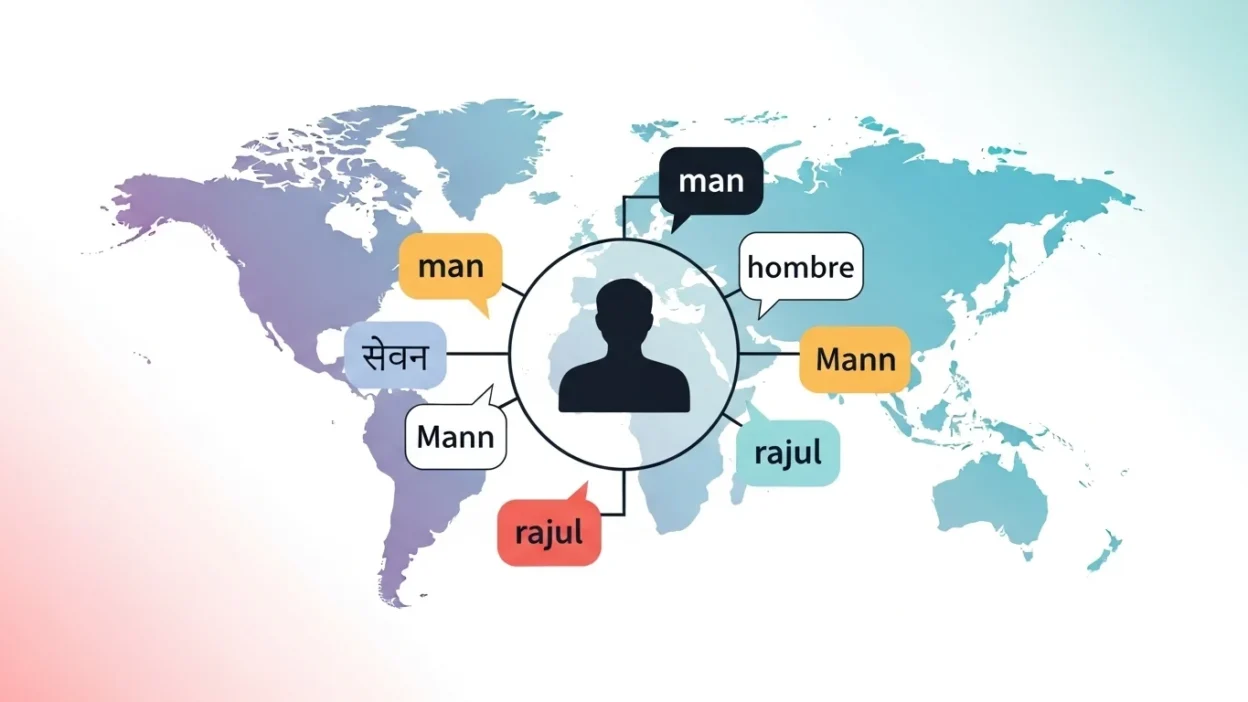
Learning how to say man in different languages helps improve your vocabulary and cultural awareness. While some languages use very similar words (like “man” in English, Dutch, and Afrikaans), others have completely unique terms like “hombre” in Spanish or “rajul” in Arabic.
This diversity shows how language reflects culture and history.
Why Learn “Man” Translations Around the World?
Knowing man in all languages is useful for:
- Travel communication
- Language learning basics
- Cultural understanding
- Improving translation skills
It’s also a great starting point when learning any new language because it’s a common and practical word.
Conclusion
Exploring man in different languages gives you a deeper appreciation of global communication.
From Europe to Asia and Africa, each translation tells a story about language and culture.
Whether you’re learning for travel, study, or curiosity, these translations are a powerful foundation.
FAQs
1. How do you say “man” in most languages?
Most languages have unique words, such as “hombre” (Spanish), “homme” (French), and “Mann” (German).
2. Is “man” similar in different languages?
Yes, some languages share similarities due to common roots, especially in European languages.
3. What is the easiest language to learn “man” in?
Languages like Spanish, French, and German are easier for beginners due to simpler pronunciation.
4. Why are translations of “man” different worldwide?
Differences come from linguistic evolution, culture, and historical influences.
5. Can learning simple words help in fluency?
Yes, starting with basic words like “man” builds a strong vocabulary foundation.

David William is a language enthusiast, researcher, and content creator at Lingoveb. With a deep passion for words, meanings, and global communication, he focuses on making language simple, clear, and accessible for readers around the world.