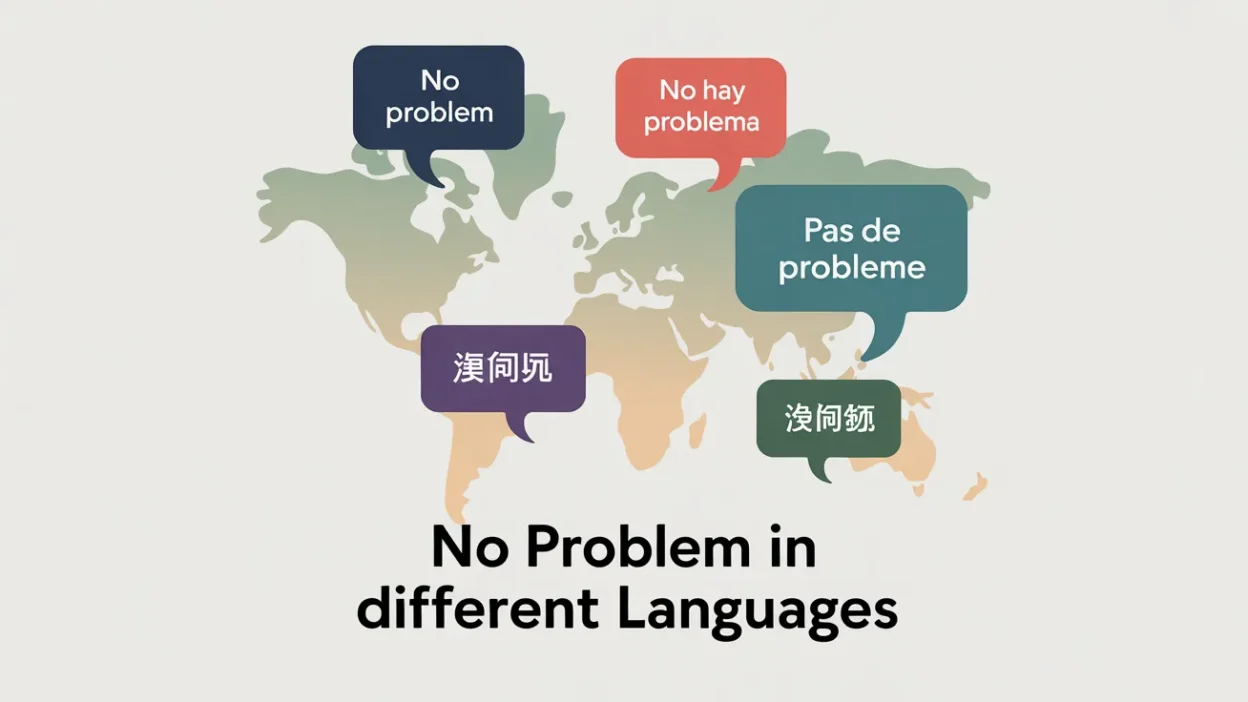
Saying “no problem” is one of the most useful and friendly expressions in everyday conversation. Whether you are traveling, learning a new language, chatting online, or working with international clients, knowing how to say no problem in different languages helps you sound polite, confident, and natural.
In this guide, you’ll find no problem in different languages explained clearly with pronunciation and real-life examples. This article is designed for learners, travelers, and curious readers looking for no problem translations, no problem in all languages, and how this phrase is used around the world.
🌍 No Problem in Different Languages (70 Examples)
Below is a clean, mobile-friendly table featuring 70 languages, each with pronunciation and a simple everyday example.
| Language | Pronunciation | Example |
| English | noh PROB-luhm | No problem, I can help you. — It’s okay, I can help you. |
| Spanish | no eye pruh-BLEH-ma | No hay problema, llego temprano. — No problem, I’ll arrive early. |
| French | pah duh pro-BLEM | Pas de problème, je comprends. — No problem, I understand. |
| German | kine pro-BLEM | Kein Problem, ich warte. — No problem, I’ll wait. |
| Italian | ness-OON pro-BLEH-ma | Nessun problema, va bene. — No problem, it’s fine. |
| Portuguese | seng pro-BLEH-ma | Sem problema, tudo certo. — No problem, all good. |
| Dutch | khayn pro-BLAYM | Geen probleem, hoor. — No problem at all. |
| Swedish | IN-ga pro-BLAYM | Inga problem, jag fixar det. — No problem, I’ll fix it. |
| Norwegian | IK-keh noo pro-BLEM | Ikke noe problem! — No problem! |
| Danish | IN-tet pro-BLAYM | Intet problem, selvfølgelig. — No problem, of course. |
| Finnish | ay oONG-el-maa | Ei ongelmaa, kiitos. — No problem, thanks. |
| Russian | nyet pra-BLYEM | Нет проблем, я помогу. — No problem, I’ll help. |
| Ukrainian | neh-MA pro-BLEM | Нема проблем, добре. — No problem, okay. |
| Polish | nye ma pro-BLE-moo | Nie ma problemu. — No problem. |
| Czech | zhahd-nee pro-BLAYM | Žádný problém. — No problem. |
| Slovak | zhyaad-nee pro-BLAYM | Žiadny problém. — No problem. |
| Hungarian | ninch pro-BLAY-ma | Nincs probléma. — No problem. |
| Romanian | nee-cho pro-BLE-ma | Nicio problemă. — No problem. |
| Bulgarian | nya-MA pro-BLEM | Няма проблем. — No problem. |
| Greek | kah-NEE-na PRO-vlee-ma | Κανένα πρόβλημα. — No problem. |
| Turkish | so-ROON day-EEL | Sorun değil. — No problem. |
| Arabic | laa MUSH-ki-la | لا مشكلة. — No problem. |
| Hebrew | en ba-A-ya | אין בעיה. — No problem. |
| Persian | mosh-ke-LEE nist | مشکلی نیست. — No problem. |
| Urdu | koi mas-LA na-HEEN | کوئی مسئلہ نہیں۔ — No problem. |
| Hindi | koi sa-MAS-ya na-HEEN | कोई समस्या नहीं। — No problem. |
| Bengali | kono sho-mos-sa nay | কোনো সমস্যা নেই। — No problem. |
| Punjabi | koi sa-MAS-ya na-HEEN | ਕੋਈ ਸਮੱਸਿਆ ਨਹੀਂ। — No problem. |
| Tamil | pra-CHA-nai ill-ai | பிரச்சனை இல்லை. — No problem. |
| Telugu | sa-MAS-ya lay-doo | సమస్య లేదు. — No problem. |
| Kannada | sa-MA-she illa | ಸಮಸ್ಯೆ ಇಲ್ಲ. — No problem. |
| Malayalam | pra-shna-mil-la | പ്രശ്നമില്ല. — No problem. |
| Sinhala | pra-shna-yak na-HA | ප්රශ්නයක් නැහැ. — No problem. |
| Thai | mai mee pan-haa | ไม่มีปัญหา — No problem. |
| Vietnamese | khong VAN-dee zee | Không vấn đề gì. — No problem. |
| Indonesian | tee-DAK ma-SA-lah | Tidak masalah. — No problem. |
| Malay | tee-A-da ma-SA-lah | Tiada masalah. — No problem. |
| Filipino | wah-LANG pro-BLE-ma | Walang problema. — No problem. |
| Japanese | mon-DIE ah-ree-MA-sen | 問題ありません。 — No problem. |
| Korean | mun-je ob-SUM-ni-da | 문제 없습니다. — No problem. |
| Chinese (Mandarin) | may wen-TI | 没问题。 — No problem. |
| Cantonese | mo man-tai | 冇問題。 — No problem. |
| Mongolian | a-SOO-dal-gee | Асуудалгүй. — No problem. |
| Nepali | kunai sa-MAS-ya chhai-na | कुनै समस्या छैन। — No problem. |
| Marathi | ka-hee a-DU-chan na-HE | काही अडचण नाही. — No problem. |
| Gujarati | koi sa-MAS-ya na-thi | કોઈ સમસ્યા નથી. — No problem. |
| Swahili | ha-KOO-na ta-tee-ZO | Hakuna tatizo. — No problem. |
| Zulu | a-KOO-kho n-KIN-ga | Akukho nkinga. — No problem. |
| Xhosa | a-KOO-kho n-GA-ki | Akukho ngxaki. — No problem. |
| Afrikaans | khayn pro-BLAYM | Geen probleem. — No problem. |
| Amharic | che-ger yel-LEM | ችግር የለም. — No problem. |
| Somali | dhib ma-la-ha | Dhib malaha. — No problem. |
| Hausa | ba-boo mat-SA-la | Babu matsala. — No problem. |
| Yoruba | kaw see ee-SHO-ro | Kò sí ìṣòro. — No problem. |
| Igbo | n-so-boo ah-DI-ghi | Nsogbu adịghị. — No problem. |
| Latvian | nav pro-BLAY-moo | Nav problēmu. — No problem. |
| Lithuanian | nay-ra pro-BLAY-mos | Nėra problemos. — No problem. |
| Estonian | PO-le pro-BLAY-mee | Pole probleemi. — No problem. |
| Icelandic | EK-kert mahl | Ekkert mál. — No problem. |
| Irish | gon FAHV | Gan fadhb. — No problem. |
| Welsh | dim PRO-blem | Dim problem. — No problem. |
| Scottish Gaelic | khan yel DOO-lee-hgoss an | Chan eil duilgheadas ann. — No problem. |
| Basque | a-ra-ZO-rik ez | Arazorik ez. — No problem. |
| Catalan | cap pro-BLAY-ma | Cap problema. — No problem. |
| Galician | non eye pro-BLAY-ma | Non hai problema. — No problem. |
| Slovenian | nee pro-BLAY-ma | Ni problema. — No problem. |
| Croatian | NEH-ma pro-BLAY-ma | Nema problema. — No problem. |
| Serbian | NEH-ma pro-BLAY-ma | Нема проблема. — No problem. |
| Bosnian | NEH-ma pro-BLAY-ma | Nema problema. — No problem. |
| Albanian | ska pro-BLEM | S’ka problem. — No problem. |
Why Learning “No Problem” in Other Languages Matters
This phrase is used to:
- Respond politely to thanks
- Reassure someone
- Sound friendly and cooperative
- Build instant connection across cultures
Knowing no problem around the world helps you communicate smoothly and confidently.
Common Situations Where “No Problem” Is Used
- After someone says thank you
- When accepting a small request
- To reassure someone after a mistake
- In customer service and business conversations
Conclusion
Learning no problem in different languages is a small effort with a big impact. These simple phrases help you connect, travel smarter, and communicate politely anywhere in the world. Bookmark this list and practice a few every day—you’ll be surprised how often you use them.
FAQs
1. How do you say no problem in different languages?
Each language has its own phrase, such as No hay problema (Spanish) or Pas de problème (French).
2. Is “no problem” polite in all cultures?
Yes, but tone matters. In some cultures, it sounds more polite than “you’re welcome.”
3. What is the most common translation of no problem?
Many languages use a direct translation meaning “there is no problem.”
4. Can no problem be used in formal situations?
Some languages have formal alternatives, but it’s usually acceptable in casual settings.
5. Why is no problem useful for language learners?
It’s simple, versatile, and used in daily conversations worldwide.

Ely Joseph is a language researcher, writer, and contributor who specializes in words, meanings, and multilingual communication. With a strong interest in how language shapes understanding across cultures, Ely focuses on creating clear, accurate, and reader-friendly content for a global audience.