
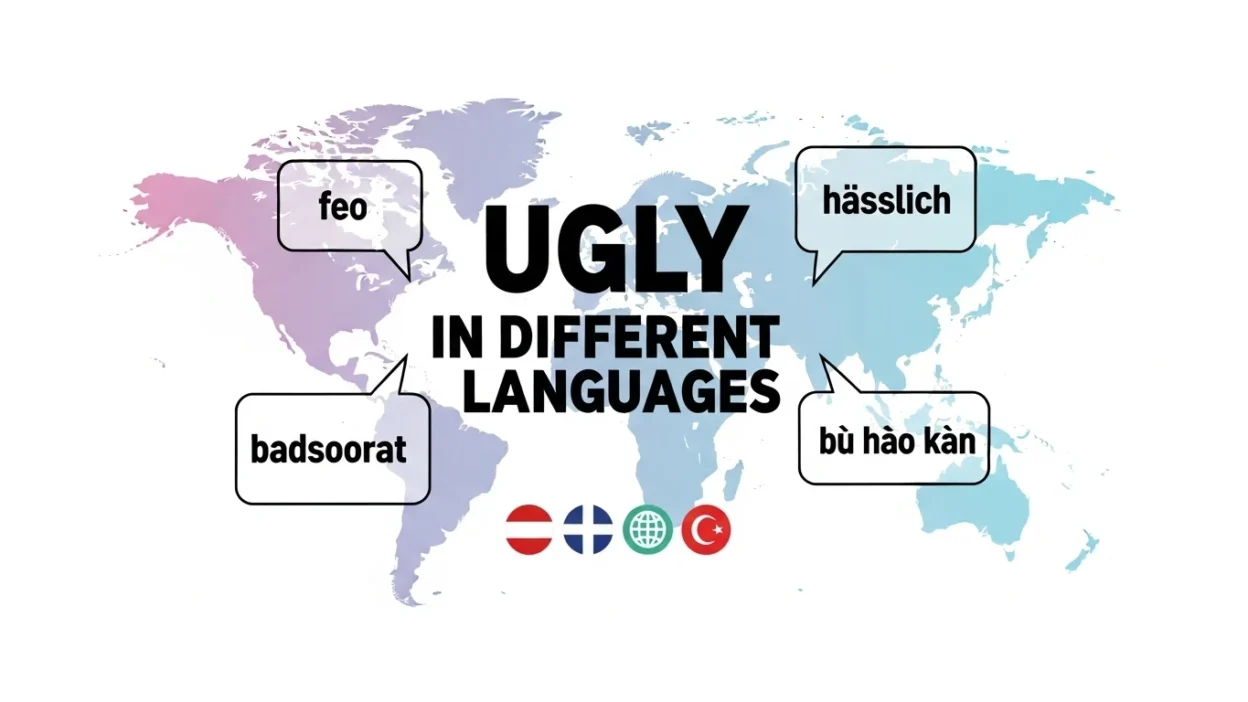
Understanding how to say “ugly in different languages” can be useful for travelers, language learners, and anyone curious about global expressions. This guide gives you a clear, easy-to-read list of ugly translations around the world, along with pronunciation tips and real-life examples so you can actually use them.
Whether you’re exploring cultures or expanding your vocabulary, this article will help you learn how to say ugly in different languages in a simple and practical way.
Ugly in All Languages
| Language | Pronunciation | Example |
| English | u-glee | That building is ugly. (That building is unattractive.) |
| Spanish | oo-glee (feo) | Ese edificio es feo. (That building is ugly.) |
| French | uh-glee (moche) | Ce bâtiment est moche. (That building is ugly.) |
| German | oog-lee (hässlich) | Das Gebäude ist hässlich. (That building is ugly.) |
| Italian | oo-glee (brutto) | Questo edificio è brutto. (That building is ugly.) |
| Portuguese | oo-glee (feio) | Esse prédio é feio. (That building is ugly.) |
| Dutch | oog-lee (lelijk) | Dat gebouw is lelijk. (That building is ugly.) |
| Russian | oog-lee (nekrasivyy) | Это здание некрасивое. (That building is ugly.) |
| Polish | oog-lee (brzydki) | Ten budynek jest brzydki. (That building is ugly.) |
| Turkish | oog-lee (çirkin) | Bu bina çirkin. (That building is ugly.) |
| Arabic | oog-lee (qabih) | هذا المبنى قبيح. (That building is ugly.) |
| Hindi | oog-lee (badsoorat) | यह इमारत बदसूरत है। (That building is ugly.) |
| Urdu | oog-lee (badsoorat) | یہ عمارت بدصورت ہے۔ (That building is ugly.) |
| Bengali | oog-lee (kurup) | এই ভবনটি কুৎসিত। (That building is ugly.) |
| Chinese (Mandarin) | boo-how kan | 这个建筑不好看。 (That building is ugly.) |
| Japanese | busaiku | この建物は不細工です。 (That building is ugly.) |
| Korean | mot-saeng-gin | 이 건물은 못생겼어요. (That building is ugly.) |
| Thai | mai-suay | อาคารนี้ไม่สวย (That building is ugly.) |
| Vietnamese | xau | Tòa nhà này xấu. (That building is ugly.) |
| Indonesian | je-lek | Gedung itu jelek. (That building is ugly.) |
| Malay | je-lek | Bangunan itu jelek. (That building is ugly.) |
| Filipino | pangit | Pangit ang gusali. (That building is ugly.) |
| Greek | as-heem-o | Αυτό το κτίριο είναι άσχημο. (That building is ugly.) |
| Czech | brzi-dkee | Ta budova je ošklivá. (That building is ugly.) |
| Slovak | brzi-dkee | Tá budova je škaredá. (That building is ugly.) |
| Hungarian | rut | Ez az épület ronda. (That building is ugly.) |
| Romanian | oo-glee (urat) | Clădirea este urâtă. (That building is ugly.) |
| Bulgarian | groz-en | Сградата е грозна. (That building is ugly.) |
| Serbian | ruz-an | Zgrada je ružna. (That building is ugly.) |
| Croatian | ruz-na | Zgrada je ružna. (That building is ugly.) |
| Bosnian | ruz-na | Zgrada je ružna. (That building is ugly.) |
| Slovenian | gr-d | Ta stavba je grda. (That building is ugly.) |
| Ukrainian | ne-kra-see-viy | Ця будівля некрасива. (That building is ugly.) |
| Persian | zesht | این ساختمان زشت است. (That building is ugly.) |
| Hebrew | ka-oor | הבניין הזה מכוער. (That building is ugly.) |
| Swahili | mbaya | Jengo hili ni baya. (That building is ugly.) |
| Zulu | mbi | Lesi sakhiwo sibi. (That building is ugly.) |
| Afrikaans | le-lik | Die gebou is lelik. (That building is ugly.) |
| Somali | fool-xun | Dhismahan waa fool xun. (That building is ugly.) |
| Amharic | ti-fo | ይህ ሕንፃ አስጸያፊ ነው። (That building is ugly.) |
| Yoruba | bur-uku | Ilé náà burúkú. (That building is ugly.) |
| Igbo | jo-ro-jo | Ụlọ ahụ jọrọ njọ. (That building is ugly.) |
| Hausa | mu-nu-na | Ginin nan mummuna ne. (That building is ugly.) |
| Finnish | ru-ma | Tuo rakennus on ruma. (That building is ugly.) |
| Swedish | ful | Den byggnaden är ful. (That building is ugly.) |
| Norwegian | stygg | Den bygningen er stygg. (That building is ugly.) |
| Danish | grim | Den bygning er grim. (That building is ugly.) |
| Icelandic | ljot | Þessi bygging er ljót. (That building is ugly.) |
| Estonian | kole | See hoone on kole. (That building is ugly.) |
| Latvian | ne-glits | Šī ēka ir neglīta. (That building is ugly.) |
| Lithuanian | bja-u-rus | Šis pastatas yra bjaurus. (That building is ugly.) |
| Albanian | shem-tu-ar | Kjo ndërtesë është e shëmtuar. (That building is ugly.) |
| Macedonian | groz-en | Оваа зграда е грозна. (That building is ugly.) |
| Georgian | u-la-ma-zi | ეს შენობა ულამაზოა. (That building is ugly.) |
| Armenian | an-gegh-etsik | Այս շենքը անգեղ է։ (That building is ugly.) |
| Mongolian | muu-khai | Энэ барилга муухай. (That building is ugly.) |
| Nepali | naram-ro | यो भवन नराम्रो छ। (That building is ugly.) |
| Sinhala | a-lan-karai nae | මේ ගොඩනැගිල්ල ලස්සන නැහැ. (That building is ugly.) |
| Tamil | azha-gil-lai | இந்த கட்டிடம் அழகில்லை. (That building is ugly.) |
| Telugu | an-dam ledu | ఈ భవనం అందంగా లేదు. (That building is ugly.) |
| Kannada | chenna-gilla | ಈ ಕಟ್ಟಡ ಚೆನ್ನಾಗಿಲ್ಲ. (That building is ugly.) |
| Malayalam | su-nda-ram alla | ഈ കെട്ടിടം സുന്ദരം അല്ല. (That building is ugly.) |
| Marathi | va-it | ही इमारत वाईट दिसते. (That building is ugly.) |
| Gujarati | kharaab | આ ઇમારત ખરાબ છે. (That building is ugly.) |
| Punjabi | bad-soorat | ਇਹ ਇਮਾਰਤ ਬਦਸੂਰਤ ਹੈ। (That building is ugly.) |
| Pashto | bad-surat | دا ودانۍ بدصورت ده. (That building is ugly.) |
| Kazakh | kel-bet-siz | Бұл ғимарат келбетсіз. (That building is ugly.) |
| Uzbek | hu-shsiz | Bu bino xunuk. (That building is ugly.) |
How to Say Ugly in Different Languages
Learning how to say ugly in different languages helps you understand cultural expressions better. In many languages, the word for ugly can vary depending on context—some are used for objects, while others are more sensitive when referring to people.
For example:
- In Spanish, “feo” is common but can sound harsh.
- In Japanese, “busaiku” is informal and should be used carefully.
- In Arabic and Urdu, the word “badsoorat” is widely used but can be offensive depending on tone.
Ugly Translations Around the World
When looking at ugly translations, you’ll notice patterns:
- Many European languages have similar roots (e.g., “brutto,” “brzydki”).
- Asian languages often express “not beautiful” instead of directly saying ugly.
- African languages may use broader words meaning “bad” or “unpleasant.”
This shows how language reflects culture and sensitivity in communication.
Tips for Using the Word “Ugly” in Other Languages
- Be mindful of tone: In many cultures, calling something ugly can be rude.
- Use neutral alternatives when possible: Words like “not attractive” are safer.
- Practice pronunciation: It helps avoid misunderstandings.
Conclusion
This complete guide to ugly in all languages gives you a practical and easy way to learn how to say ugly in different languages. From Europe to Asia and Africa, these translations help you understand how people describe appearance around the world.
Use this knowledge respectfully, and you’ll improve both your language skills and cultural awareness.
FAQs
1. What is “ugly” in most languages?
In many languages, “ugly” translates to words like “feo” (Spanish), “brutto” (Italian), or “hässlich” (German), though meanings may vary slightly.
2. Is it rude to say “ugly” in other languages?
Yes, in most cultures it can be considered offensive, especially when describing people.
3. How do you say ugly in Asian languages?
In Chinese, it’s “bù hǎo kàn,” and in Japanese, “busaiku,” often meaning “not beautiful.”
4. Are there polite alternatives to “ugly”?
Yes, phrases like “not attractive” or “not very सुंदर/सुंदर नहीं” are softer and more acceptable.
5. Why do some languages not directly translate “ugly”?
Some cultures prefer indirect expressions like “not beautiful” to sound more polite.

Ely Joseph is a language researcher, writer, and contributor who specializes in words, meanings, and multilingual communication. With a strong interest in how language shapes understanding across cultures, Ely focuses on creating clear, accurate, and reader-friendly content for a global audience.