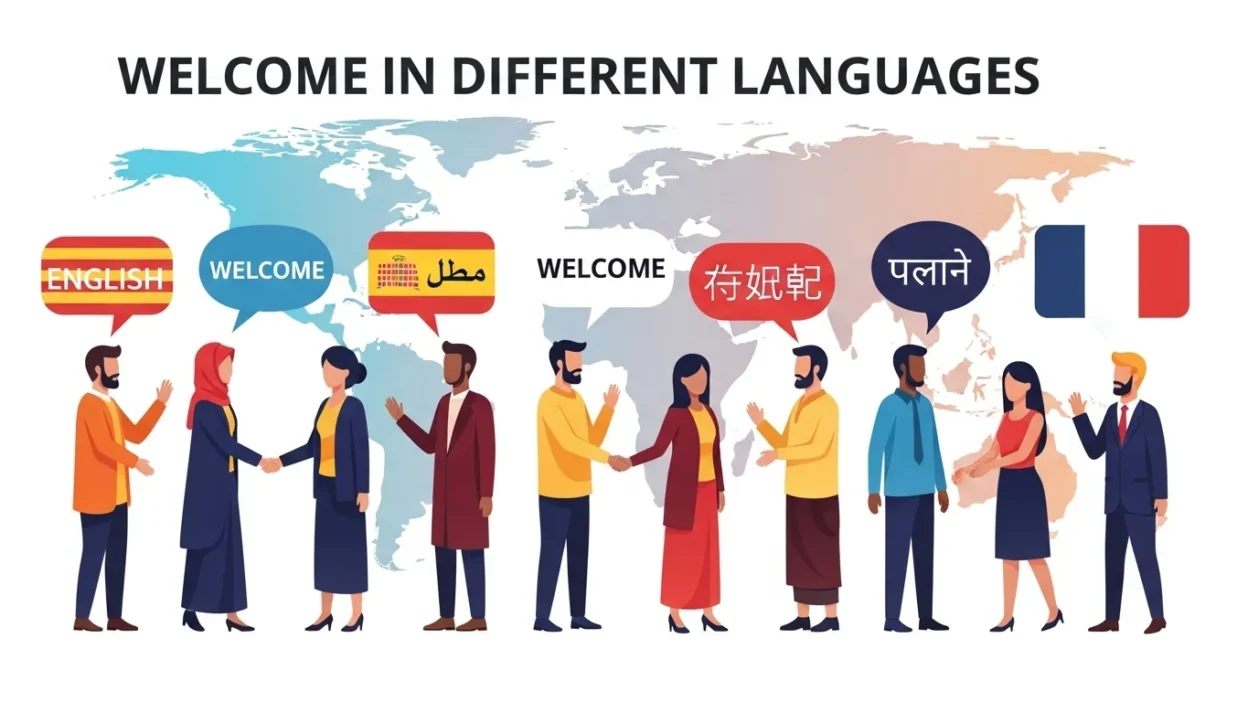
Welcoming someone is one of the simplest yet most powerful ways to build connection. Whether you’re traveling, learning a new language, or just curious about cultures, knowing how to say welcome in different languages can leave a great impression.
This guide gives you a clear and practical list of welcome translations around the world, along with pronunciation and real life examples.
If you’ve ever wondered how to say welcome in different languages, this article provides a complete, easy to read table that’s perfect for quick learning and reference.
Welcome in All Languages
| Language | Pronunciation | Example |
| English | wel-kuhm | Welcome to my home. (Meaning: Greeting someone warmly) |
| Spanish | byehn-beh-nee-doh | Bienvenido a mi casa. (Meaning: Welcome to my house) |
| French | byan-veh-noo | Bienvenue chez moi. (Meaning: Welcome to my place) |
| German | vil-kom-men | Willkommen bei uns. (Meaning: Welcome to us) |
| Italian | ben-veh-noo-toh | Benvenuto a casa. (Meaning: Welcome home) |
| Portuguese | beng-vee-do | Bem-vindo ao Brasil. (Meaning: Welcome to Brazil) |
| Dutch | vel-kom | Welkom in Nederland. (Meaning: Welcome to the Netherlands) |
| Russian | pah-zha-lus-ta | Добро пожаловать. (Meaning: Welcome) |
| Chinese (Mandarin) | huan-ying | 欢迎光临. (Meaning: Welcome) |
| Japanese | yo-koh-so | ようこそ. (Meaning: Welcome) |
| Korean | hwan-young | 환영합니다. (Meaning: Welcome) |
| Arabic | ah-lan wa sah-lan | أهلا وسهلا. (Meaning: Welcome) |
| Hindi | swaa-gat hai | आपका स्वागत है. (Meaning: Welcome) |
| Urdu | khush aam-deed | خوش آمدید. (Meaning: Welcome) |
| Turkish | ho-sh gel-di-niz | Hoş geldiniz. (Meaning: Welcome) |
| Greek | ka-los or-tha-te | Καλώς ήρθατε. (Meaning: Welcome) |
| Swedish | vel-kom-men | Välkommen hit. (Meaning: Welcome here) |
| Danish | vel-kom-men | Velkommen hjem. (Meaning: Welcome home) |
| Norwegian | vel-kom-men | Velkommen til oss. (Meaning: Welcome to us) |
| Finnish | ter-ve-tu-lo-a | Tervetuloa Suomeen. (Meaning: Welcome to Finland) |
| Polish | vi-ta-mi | Witamy serdecznie. (Meaning: Welcome warmly) |
| Czech | vee-tay-te | Vítejte doma. (Meaning: Welcome home) |
| Slovak | vee-tay-te | Vitajte u nás. (Meaning: Welcome to us) |
| Hungarian | ish-ten ho-zot | Isten hozott! (Meaning: Welcome) |
| Romanian | bee-neh veh-neet | Bine ai venit. (Meaning: Welcome) |
| Bulgarian | doh-breh doh-shli | Добре дошли. (Meaning: Welcome) |
| Croatian | doh-broh doh-shli | Dobrodošli! (Meaning: Welcome) |
| Serbian | doh-broh doh-shli | Dobrodošli! (Meaning: Welcome) |
| Slovenian | doh-broh doh-shli | Dobrodošli! (Meaning: Welcome) |
| Ukrainian | doh-broh pah-zha-lu-va-tee | Ласкаво просимо. (Meaning: Welcome) |
| Hebrew | ba-roo-kh ha-bah | ברוך הבא. (Meaning: Welcome) |
| Persian | kho-sh a-ma-deed | خوش آمدید. (Meaning: Welcome) |
| Thai | yin-dee ton-rub | ยินดีต้อนรับ. (Meaning: Welcome) |
| Vietnamese | xin chao mung | Xin chào mừng. (Meaning: Welcome) |
| Indonesian | se-la-mat da-tang | Selamat datang. (Meaning: Welcome) |
| Malay | se-la-mat da-tang | Selamat datang. (Meaning: Welcome) |
| Filipino | ma-bu-hay | Mabuhay! (Meaning: Welcome) |
| Swahili | ka-ree-boo | Karibu sana. (Meaning: Welcome warmly) |
| Zulu | sa-wu-bo-na | Sawubona. (Meaning: Welcome/Hello) |
| Afrikaans | vel-kom | Welkom hier. (Meaning: Welcome here) |
| Amharic | en-kwan dehna me-ta-hu | እንኳን ደህና መጡ. (Meaning: Welcome) |
| Somali | soo dha-woow | Soo dhawoow. (Meaning: Welcome) |
| Hausa | bar-ka da zu-wa | Barka da zuwa. (Meaning: Welcome) |
| Yoruba | ka-bo | Kaabo. (Meaning: Welcome) |
| Igbo | na-ba | Nnọọ. (Meaning: Welcome) |
| Bengali | shaa-goto | স্বাগতম. (Meaning: Welcome) |
| Punjabi | jee aa-yan noo | ਜੀ ਆਇਆਂ ਨੂੰ. (Meaning: Welcome) |
| Tamil | varu-ga varu-ga | வருக வருக. (Meaning: Welcome) |
| Telugu | swaa-gatam | స్వాగతం. (Meaning: Welcome) |
| Kannada | swaa-gata | ಸ್ವಾಗತ. (Meaning: Welcome) |
| Malayalam | swaa-ga-tham | സ്വാഗതം. (Meaning: Welcome) |
| Marathi | swaa-gat aa-he | स्वागत आहे. (Meaning: Welcome) |
| Gujarati | aa-voo swagat che | આવો સ્વાગત છે. (Meaning: Welcome) |
| Nepali | swaa-gat cha | स्वागत छ. (Meaning: Welcome) |
| Sinhala | ayu-bo-wan | ආයුබෝවන්. (Meaning: Welcome) |
| Khmer | sok sab-bai | សូមស្វាគមន៍. (Meaning: Welcome) |
| Lao | nyin-dee ton-rub | ຍິນດີຕ້ອນຮັບ. (Meaning: Welcome) |
| Burmese | ming-ga-la-ba | မင်္ဂလာပါ. (Meaning: Welcome) |
| Mongolian | tav-tai moril | Тавтай морил. (Meaning: Welcome) |
| Icelandic | vel-kom-in | Velkomin heim. (Meaning: Welcome home) |
| Irish | fahl-cha | Fáilte romhat. (Meaning: Welcome) |
| Welsh | kroi-so | Croeso i Gymru. (Meaning: Welcome to Wales) |
| Scottish Gaelic | fal-cha | Fàilte! (Meaning: Welcome) |
| Basque | on-gi e-to-ri | Ongi etorri. (Meaning: Welcome) |
| Catalan | ben-vingut | Benvingut! (Meaning: Welcome) |
| Esperanto | bon-veh-noo-to | Bonvenon! (Meaning: Welcome) |
How to Say Welcome in Different Languages
Learning how to say welcome in different languages helps you connect with people globally. A simple greeting can show respect and openness, especially when traveling or interacting with international communities.
Using the correct pronunciation also improves communication and builds confidence in speaking.
Why Learning Welcome Translations Matters
Understanding welcome in all languages is useful for:
- Traveling and meeting locals
- Building cultural awareness
- Improving language skills
- Creating a friendly first impression
Even a single word like “welcome” can make interactions warmer and more meaningful.
Welcome Around the World: Cultural Insight
Different cultures use “welcome” in unique ways. Some languages include warmth and hospitality directly in the phrase, while others combine it with gestures or tone. Learning these differences gives you deeper insight into global traditions and communication styles.
Conclusion
Knowing welcome in different languages is a simple yet powerful skill. It helps you connect with people, understand cultures, and communicate more effectively worldwide. With these 70 translations, you now have a practical resource to greet anyone with confidence.
FAQs
1. How do you say welcome in different languages?
You can say welcome differently depending on the language, such as “Bienvenue” in French, “Bienvenido” in Spanish, and “Willkommen” in German.
2. What is the most common way to say welcome globally?
English “Welcome” is widely understood, but local languages are always appreciated more.
3. Why should I learn welcome translations?
It helps in travel, cultural understanding, and making positive first impressions.
4. Is pronunciation important when saying welcome?
Yes, correct pronunciation improves clarity and shows respect for the language.
5. Can one word like welcome really make a difference?
Yes, a simple welcome greeting can instantly create a friendly and respectful connection.

David William is a language enthusiast, researcher, and content creator at Lingoveb. With a deep passion for words, meanings, and global communication, he focuses on making language simple, clear, and accessible for readers around the world.