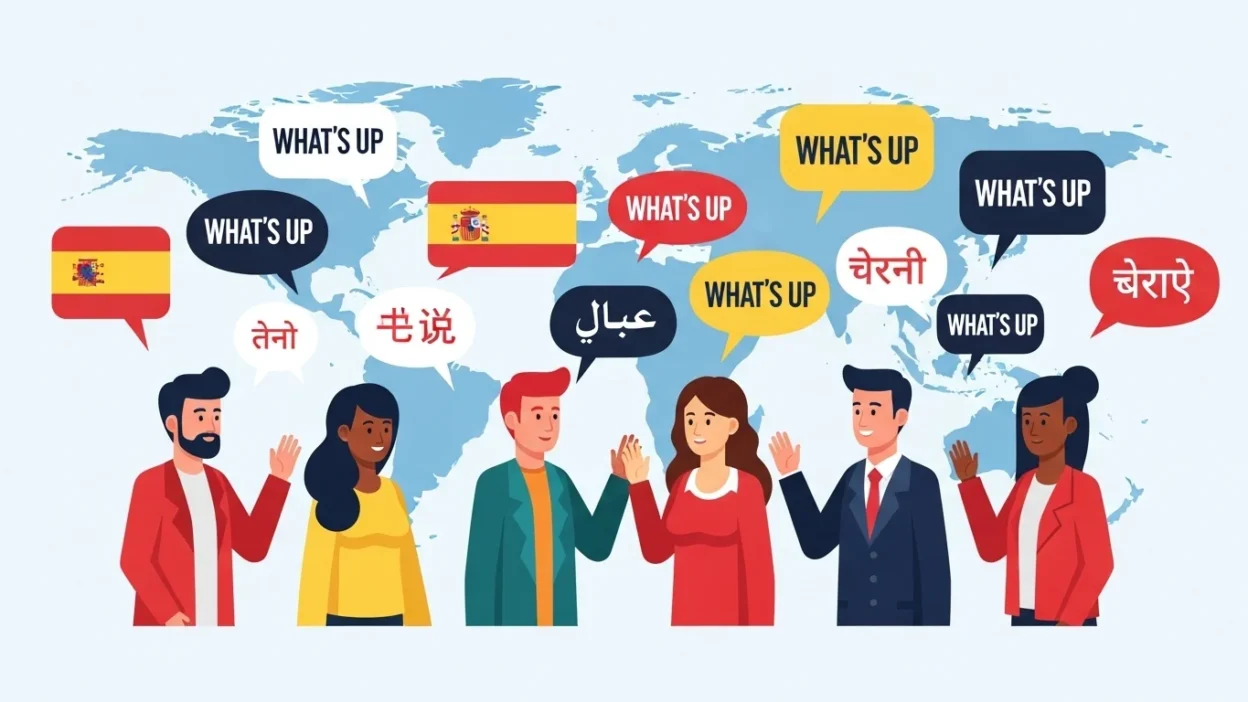
If you’ve ever wondered how to say “what’s up” in different languages, you’re not alone. This casual greeting is used globally to start conversations, check in with friends, or simply say hello in a relaxed way. Learning these phrases can help you connect with people, travel more confidently, and understand cultures better.
In this guide, you’ll discover “what’s up” translations in 70 languages, along with pronunciation and real life examples. Whether you’re curious about what’s up in all languages or just want a quick reference, this table makes it simple and practical.
What’s Up in All Languages
| Language | Pronunciation & Example | English Meaning |
| English | Whats up – Whats up, man? | How are you? |
| Spanish | Que pasa – Que pasa amigo? | What’s happening, friend? |
| French | Ca va – Ca va, mon ami? | How are you, my friend? |
| German | Was geht – Was geht heute? | What’s going on today? |
| Italian | Che succede – Che succede qui? | What’s happening here? |
| Portuguese | E ai – E ai, tudo bem? | What’s up, all good? |
| Dutch | Wat is er – Wat is er aan de hand? | What’s going on? |
| Russian | Kak dela – Kak dela u tebya? | How are things with you? |
| Chinese (Mandarin) | Ni hao ma – Ni hao ma? | How are you? |
| Japanese | Genki – Genki desu ka? | Are you well? |
| Korean | Jal jinae – Jal jinae? | Are you doing well? |
| Arabic | Shoo akhbarak – Shoo akhbarak? | What’s your news? |
| Hindi | Kya haal hai – Kya haal hai? | How are you? |
| Urdu | Kya haal hai – Kya haal hai dost? | How are you, friend? |
| Turkish | Ne haber – Ne haber? | What’s new? |
| Greek | Ti kaneis – Ti kaneis simera? | What are you doing today? |
| Polish | Co slychac – Co slychac u ciebie? | What’s heard with you? |
| Swedish | Vad hander – Vad hander idag? | What’s happening today? |
| Norwegian | Hva skjer – Hva skjer? | What’s happening? |
| Danish | Hvad sker der – Hvad sker der? | What’s going on? |
| Finnish | Mita kuuluu – Mita kuuluu? | What’s up? |
| Thai | Sabai dee mai – Sabai dee mai? | Are you well? |
| Vietnamese | Co gi moi – Co gi moi? | Anything new? |
| Indonesian | Apa kabar – Apa kabar? | How are you? |
| Malay | Apa khabar – Apa khabar? | How are you? |
| Filipino | Kumusta – Kumusta ka? | How are you? |
| Hebrew | Ma nishma – Ma nishma? | What’s heard? |
| Persian | Chetori – Chetori? | How are you? |
| Bengali | Ki khobor – Ki khobor? | What news? |
| Punjabi | Ki haal hai – Ki haal hai? | How are you? |
| Swahili | Habari gani – Habari gani? | What’s the news? |
| Zulu | Unjani – Unjani? | How are you? |
| Afrikaans | Hoe gaan dit – Hoe gaan dit? | How are things? |
| Romanian | Ce faci – Ce faci? | What are you doing? |
| Hungarian | Mi ujsag – Mi ujsag? | What’s new? |
| Czech | Co se deje – Co se deje? | What’s happening? |
| Slovak | Co sa deje – Co sa deje? | What’s going on? |
| Ukrainian | Yak spravy – Yak spravy? | How are things? |
| Bulgarian | Kak si – Kak si? | How are you? |
| Serbian | Sta ima – Sta ima? | What’s up? |
| Croatian | Sto ima – Sto ima? | What’s up? |
| Slovenian | Kaj dogaja – Kaj dogaja? | What’s happening? |
| Estonian | Mis toimub – Mis toimub? | What’s going on? |
| Latvian | Kas jauns – Kas jauns? | What’s new? |
| Lithuanian | Kas naujo – Kas naujo? | What’s new? |
| Icelandic | Hvad er ad – Hvad er ad? | What’s up? |
| Irish | Cad e mar ata tu – Cad e mar ata tu? | How are you? |
| Welsh | Sut mae – Sut mae? | How are you? |
| Scottish Gaelic | Ciamar a tha thu – Ciamar a tha thu? | How are you? |
| Albanian | Si je – Si je sot? | How are you today? |
| Macedonian | Kako si – Kako si? | How are you? |
| Armenian | Vonc es – Vonc es? | How are you? |
| Georgian | Rogor khar – Rogor khar? | How are you? |
| Mongolian | Yamar baina – Yamar baina? | How are things? |
| Nepali | Kasto cha – Kasto cha? | How are you? |
| Sinhala | Kohomada – Kohomada? | How are you? |
| Tamil | Eppadi irukeenga – Eppadi irukeenga? | How are you? |
| Telugu | Ela unnaru – Ela unnaru? | How are you? |
| Kannada | Hegiddira – Hegiddira? | How are you? |
| Marathi | Kasa ahes – Kasa ahes? | How are you? |
| Gujarati | Kem cho – Kem cho? | How are you? |
| Amharic | Endet neh – Endet neh? | How are you? |
| Somali | Sidee tahay – Sidee tahay? | How are you? |
| Yoruba | Bawo ni – Bawo ni? | How are you? |
| Igbo | Kedu – Kedu? | How are you? |
| Haitian Creole | Sak pase – Sak pase? | What’s happening? |
| Luxembourgish | Waat leeft – Waat leeft? | What’s up? |
| Basque | Zer moduz – Zer moduz? | How are you? |
| Catalan | Que tal – Que tal? | How’s it going? |
How to Say “What’s Up” in Different Languages
Learning how to say “what’s up” in different languages helps you sound more natural when speaking with locals. Many languages don’t translate it word-for-word but use phrases like “How are you?” or “What’s new?” instead. These serve the same casual purpose in everyday conversation.
Why Learn “What’s Up” Around the World
Understanding “what’s up” around the world is useful for:
- Traveling and meeting new people
- Building friendships across cultures
- Improving language skills quickly
- Sounding more natural in conversations
Simple greetings often leave the strongest first impression.
Tips for Using These Translations Correctly
- Use informal phrases only with friends or peers
- Match tone with culture (some prefer polite greetings)
- Practice pronunciation for better communication
- Observe how locals actually use the phrase
Conclusion
Now you know what’s up in different languages with 70 useful translations. These phrases are more than just words; they’re a gateway to connecting with people worldwide.
Whether you’re traveling, learning languages, or just curious, these greetings will help you start conversations anywhere.
FAQs
1. What does “what’s up” mean in different languages?
It generally means “how are you,” “what’s happening,” or “what’s new,” depending on the language and culture.
2. Is “what’s up” formal or informal?
It is informal and best used with friends, peers, or in casual situations.
3. How do you say “what’s up” in all languages?
There is no exact translation in every language, but similar greetings like “how are you” are commonly used worldwide.
4. Why do translations of “what’s up” differ?
Languages reflect culture, so some focus on well being while others focus on news or activity.
5. What is the easiest way to learn these phrases?
Practice daily, listen to native speakers, and use them in real conversations.