Understanding how to say woman in different languages is both practical and fascinating. Whether you’re traveling, learning a new language, or simply curious about cultures, knowing these translations helps you communicate better and connect with people worldwide.
In this guide, you’ll find 70 languages, each with pronunciation and real-life examples to make learning easy and useful.
Woman in All Languages
| Language | Pronunciation | Example |
| English | wu-muhn | The woman is walking. (Meaning: A female person is walking.) |
| Spanish | mu-hehr (mujer) | La mujer está feliz. (Meaning: The woman is happy.) |
| French | faam (femme) | La femme parle. (Meaning: The woman speaks.) |
| German | frow (Frau) | Die Frau lacht. (Meaning: The woman laughs.) |
| Italian | don-na (donna) | La donna corre. (Meaning: The woman runs.) |
| Portuguese | mu-lair (mulher) | A mulher canta. (Meaning: The woman sings.) |
| Dutch | vrow (vrouw) | De vrouw leest. (Meaning: The woman reads.) |
| Russian | zhen-shi-na | Женщина идет. (Meaning: The woman is going.) |
| Chinese (Mandarin) | nü-ren | 女人来了. (Meaning: The woman came.) |
| Japanese | on-na | 女が笑う. (Meaning: The woman smiles.) |
| Korean | yo-ja | 여자가 온다. (Meaning: The woman comes.) |
| Arabic | im-ra-ah | المرأة جميلة. (Meaning: The woman is beautiful.) |
| Hindi | au-rat | औरत बोलती है. (Meaning: The woman speaks.) |
| Urdu | au-rat | عورت جا رہی ہے. (Meaning: The woman is going.) |
| Bengali | mohila | মহিলা বসে আছে. (Meaning: The woman is sitting.) |
| Turkish | ka-din | Kadın geliyor. (Meaning: The woman is coming.) |
| Persian | zan | زن میخندد. (Meaning: The woman laughs.) |
| Greek | yi-ne-ka | Η γυναίκα τρέχει. (Meaning: The woman runs.) |
| Polish | ko-bie-ta | Kobieta mówi. (Meaning: The woman speaks.) |
| Swedish | kvin-na | Kvinnan går. (Meaning: The woman walks.) |
| Danish | kvin-de | Kvinden synger. (Meaning: The woman sings.) |
| Norwegian | kvin-ne | Kvinnen leser. (Meaning: The woman reads.) |
| Finnish | nai-nen | Nainen tulee. (Meaning: The woman comes.) |
| Czech | zhe-na | Žena sedí. (Meaning: The woman sits.) |
| Slovak | zhe-na | Žena píše. (Meaning: The woman writes.) |
| Hungarian | noy | A nő fut. (Meaning: The woman runs.) |
| Romanian | fe-me-ie | Femeia vorbește. (Meaning: The woman speaks.) |
| Bulgarian | zhe-na | Жената чете. (Meaning: The woman reads.) |
| Serbian | zhe-na | Žena dolazi. (Meaning: The woman comes.) |
| Croatian | zhe-na | Žena radi. (Meaning: The woman works.) |
| Ukrainian | zhin-ka | Жінка співає. (Meaning: The woman sings.) |
| Hebrew | i-sha | האישה הולכת. (Meaning: The woman walks.) |
| Thai | pu-ying | ผู้หญิงยิ้ม. (Meaning: The woman smiles.) |
| Vietnamese | phu-nu | Người phụ nữ nói. (Meaning: The woman speaks.) |
| Indonesian | wa-ni-ta | Wanita datang. (Meaning: The woman comes.) |
| Malay | wa-ni-ta | Wanita membaca. (Meaning: The woman reads.) |
| Filipino | ba-bae | Babae tumatakbo. (Meaning: The woman runs.) |
| Swahili | mwa-na-mke | Mwanamke anakuja. (Meaning: The woman comes.) |
| Zulu | um-fa-zi | Umfazi uyahamba. (Meaning: The woman walks.) |
| Afrikaans | vrou | Die vrou praat. (Meaning: The woman speaks.) |
| Icelandic | kona | Konan hlær. (Meaning: The woman laughs.) |
| Irish | bean | Tá an bhean ag rith. (Meaning: The woman runs.) |
| Scottish Gaelic | ban | Tha a’ bhan toilichte. (Meaning: The woman is happy.) |
| Welsh | ben-yw | Mae’r fenyw yn darllen. (Meaning: The woman reads.) |
| Basque | e-ma-ku-me | Emakumea dator. (Meaning: The woman comes.) |
| Catalan | do-na | La dona parla. (Meaning: The woman speaks.) |
| Galician | mu-yer | A muller canta. (Meaning: The woman sings.) |
| Latvian | sie-vie-te | Sieviete skrien. (Meaning: The woman runs.) |
| Lithuanian | mo-te-ris | Moteris kalba. (Meaning: The woman speaks.) |
| Estonian | nai-ne | Naine loeb. (Meaning: The woman reads.) |
| Albanian | gru-a | Gruaja ecën. (Meaning: The woman walks.) |
| Macedonian | zhe-na | Жената пее. (Meaning: The woman sings.) |
| Armenian | kin | Կինը գալիս է. (Meaning: The woman comes.) |
| Georgian | ka-li | ქალი წერს. (Meaning: The woman writes.) |
| Mongolian | emeg-tei | Эмэгтэй инээж байна. (Meaning: The woman laughs.) |
| Nepali | ma-hi-la | महिला बोल्छिन्. (Meaning: The woman speaks.) |
| Sinhala | kan-tha-wa | කාන්තාව යනවා. (Meaning: The woman goes.) |
| Tamil | pen | பெண் ஓடுகிறாள். (Meaning: The woman runs.) |
| Telugu | aa-da-mi | ఆడది మాట్లాడుతుంది. (Meaning: The woman speaks.) |
| Kannada | he-nu | ಹೆಣ್ಣು ಬರುತ್ತಾಳೆ. (Meaning: The woman comes.) |
| Malayalam | pe-nnu | പെൺകുട്ടി ചിരിക്കുന്നു. (Meaning: The woman smiles.) |
| Marathi | ma-hi-la | महिला वाचते. (Meaning: The woman reads.) |
| Gujarati | ma-hi-la | મહિલા આવે છે. (Meaning: The woman comes.) |
| Punjabi | au-rat | ਔਰਤ ਹੱਸਦੀ ਹੈ. (Meaning: The woman laughs.) |
| Lao | phu-ying | ຜູ້ຍິງມາ. (Meaning: The woman comes.) |
| Khmer | srey | ស្ត្រីដើរ. (Meaning: The woman walks.) |
| Burmese | main-ma | မိန်းမပြောတယ်. (Meaning: The woman speaks.) |
| Amharic | set | ሴት ትመጣለች. (Meaning: The woman comes.) |
| Somali | ha-weyn | Haweeney socota. (Meaning: The woman walks.) |
How to Say Woman in Different Languages
Learning how to say woman in different languages helps in daily conversations, travel, and cultural understanding. Many languages have unique pronunciations and scripts, but the meaning remains universally important.
Using simple words like this builds a strong foundation when learning any language.
Woman Translations Around the World
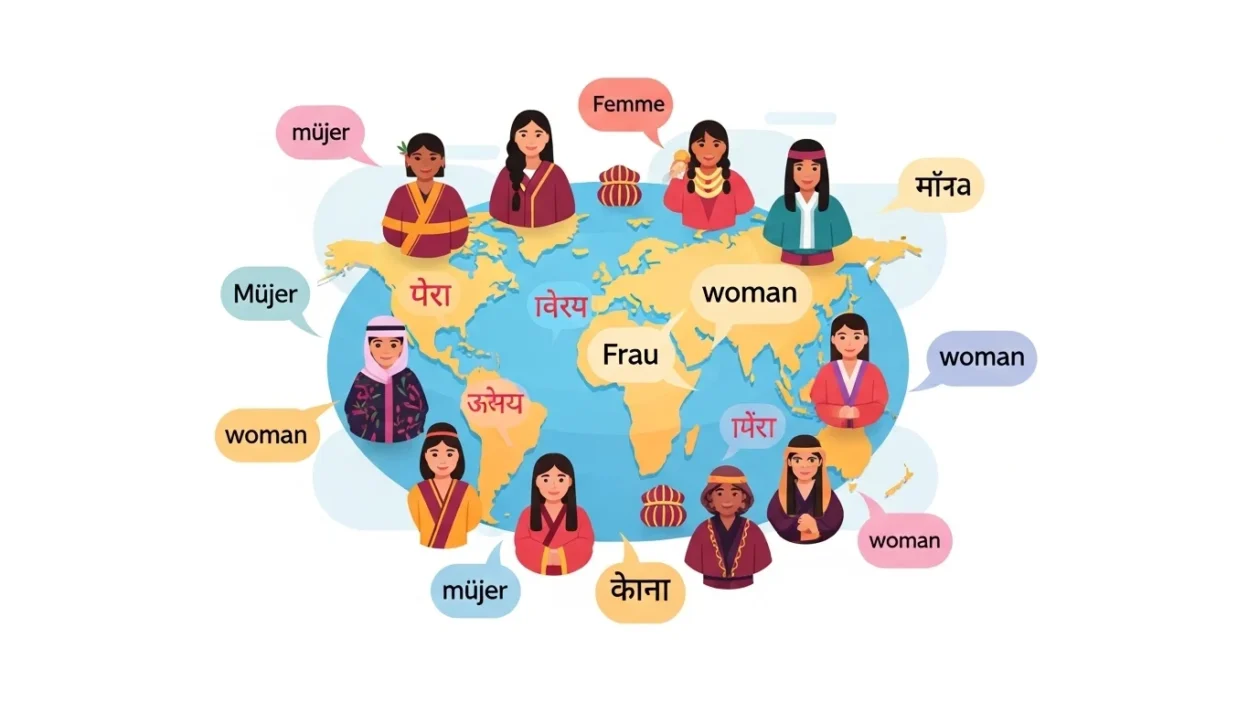
The word woman reflects culture, identity, and social roles across the globe. While translations differ, they all represent the same fundamental concept.
From “mujer” in Spanish to “zan” in Persian, these woman translations show the diversity of language worldwide.
Why Learn Woman in All Languages?
Knowing woman in all languages can help you:
- Communicate better when traveling
- Understand global cultures
- Improve language learning skills
- Build vocabulary quickly
It’s a simple yet powerful word used in everyday communication.
Conclusion
Learning woman in different languages opens the door to global communication and cultural awareness.
With 70 translations, pronunciations, and examples, you now have a practical and easy to use resource for everyday learning.
FAQs
1. How do you say woman in different languages?
You can say “woman” in many ways, such as “mujer” (Spanish), “femme” (French), and “Frau” (German).
2. What is the most common word for woman worldwide?
There is no single universal word, but many languages use simple, short terms like “zan,” “ona,” or “nari.”
3. Why is it useful to learn woman translations?
It helps in communication, travel, and understanding different cultures.
4. Is the pronunciation of woman similar across languages?
No, pronunciation varies widely depending on the language and region.
5. How can I remember woman in all languages easily?
Practice with examples, repetition, and by grouping similar languages together.