
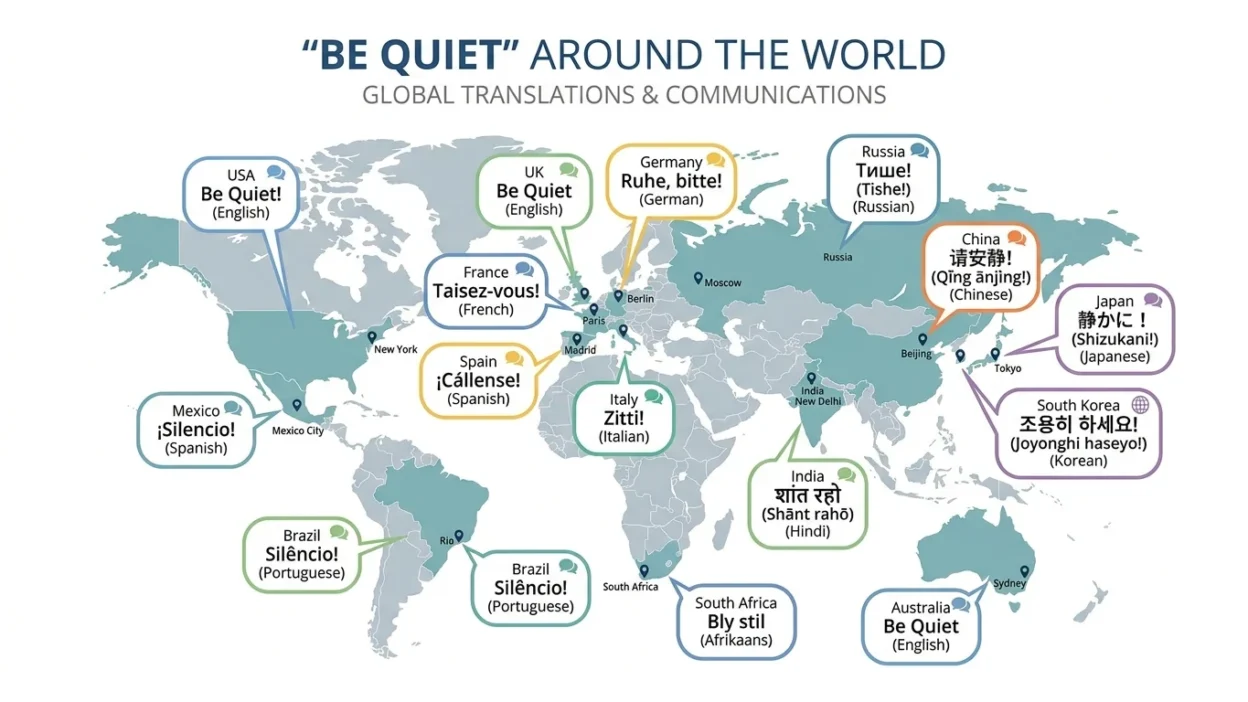
Learning how to say “be quiet” in different languages is useful for travel, cultural awareness, and everyday communication. Whether you’re in a classroom, library, or busy public place, knowing the right phrase helps you express yourself politely and effectively.
In this guide, you’ll discover how to say “be quiet” in different languages, along with pronunciation and real life examples. This resource is designed to match informational search intent and help you quickly understand quiet translations around the world.
Be Quiet in Different Languages
| Language | Pronunciation & Example | Example Meaning |
| English | Be quiet (bee kwai-uht) – Be quiet in the library. | Remain silent in the library. |
| Spanish | Cállate (kai-ya-te) – Cállate por favor. | Be quiet please. |
| French | Tais-toi (tay-twah) – Tais-toi en classe. | Be quiet in class. |
| German | Sei ruhig (zai roo-ig) – Sei ruhig jetzt. | Be quiet now. |
| Italian | Stai zitto (stai zit-to) – Stai zitto qui. | Be quiet here. |
| Portuguese | Fique quieto (fee-keh kwee-eh-to) – Fique quieto aqui. | Be quiet here. |
| Dutch | Wees stil (vays stil) – Wees stil hier. | Be quiet here. |
| Russian | Тихо (tee-kha) – Тихо, пожалуйста. | Be quiet please. |
| Chinese (Mandarin) | 安静 (an-jing) – 请安静。 | Please be quiet. |
| Japanese | 静かに (shizuka-ni) – 静かにしてください。 | Please be quiet. |
| Korean | 조용히 (jo-yong-hi) – 조용히 하세요. | Please be quiet. |
| Arabic | اسكت (us-kut) – اسكت الآن. | Be quiet now. |
| Hindi | चुप रहो (chup raho) – चुप रहो यहाँ। | Be quiet here. |
| Urdu | چپ رہو (chup raho) – یہاں چپ رہو۔ | Be quiet here. |
| Turkish | Sessiz ol (ses-siz ol) – Sessiz ol lütfen. | Be quiet please. |
| Greek | Σκάσε (ska-se) – Σκάσε τώρα. | Be quiet now. |
| Polish | Bądź cicho (bonj chi-ho) – Bądź cicho tutaj. | Be quiet here. |
| Swedish | Var tyst (var tyst) – Var tyst nu. | Be quiet now. |
| Norwegian | Vær stille (ver stil-le) – Vær stille her. | Be quiet here. |
| Danish | Vær stille (ver stil-le) – Vær stille nu. | Be quiet now. |
| Finnish | Ole hiljaa (o-le hil-yaa) – Ole hiljaa nyt. | Be quiet now. |
| Czech | Buď ticho (booj ti-ho) – Buď ticho prosím. | Be quiet please. |
| Slovak | Buď ticho (booj ti-ho) – Buď ticho teraz. | Be quiet now. |
| Hungarian | Légy csendben (layj chend-ben) – Légy csendben itt. | Be quiet here. |
| Romanian | Taci (ta-chee) – Taci acum. | Be quiet now. |
| Bulgarian | Тихо (ti-ho) – Тихо тук. | Be quiet here. |
| Ukrainian | Тихо (ty-kho) – Тихо зараз. | Be quiet now. |
| Thai | เงียบ (ngiap) – เงียบหน่อย | Be quiet please. |
| Vietnamese | Im lặng (im lang) – Im lặng đi. | Be quiet. |
| Indonesian | Diam (dee-am) – Diam sekarang. | Be quiet now. |
| Malay | Diam (dee-am) – Diam di sini. | Be quiet here. |
| Filipino | Tahimik (ta-hi-mik) – Tahimik ka. | You be quiet. |
| Hebrew | שקט (she-ket) – תהיה בשקט | Be quiet. |
| Persian | ساکت باش (sa-ket bash) – ساکت باش الان | Be quiet now. |
| Bengali | চুপ থাকো (chup tha-ko) – চুপ থাকো এখানে | Be quiet here. |
| Tamil | அமைதியாக இரு (a-mai-thi-ya-ga iru) – அமைதியாக இரு | Be quiet. |
| Telugu | నిశ్శబ్దంగా ఉండు (ni-shab-dam-ga undu) – నిశ్శబ్దంగా ఉండు | Be quiet. |
| Kannada | ಮೌನವಾಗಿರು (mou-na-va-gi-ru) – ಮೌನವಾಗಿರು | Be quiet. |
| Marathi | शांत रहा (shaant raha) – शांत रहा इथे | Be quiet here. |
| Gujarati | શાંતિ રાખો (shaan-ti ra-kho) – શાંતિ રાખો અહીં | Be quiet here. |
| Punjabi | ਚੁੱਪ ਰਹੋ (chup raho) – ਇੱਥੇ ਚੁੱਪ ਰਹੋ | Be quiet here. |
| Swahili | Nyamaza (nya-ma-za) – Nyamaza sasa | Be quiet now. |
| Zulu | Thula (thu-la) – Thula manje | Be quiet now. |
| Afrikaans | Bly stil (bly stil) – Bly stil hier | Be quiet here. |
| Somali | Aamus (aa-mus) – Aamus hadda | Be quiet now. |
| Amharic | ዝም በል (zim bel) – ዝም በል አሁን | Be quiet now. |
| Yoruba | Dakẹ (da-ke) – Dakẹ bayii | Be quiet now. |
| Igbo | Jide (jee-de) – Jide ugbu a | Be quiet now. |
| Hausa | Yi shiru (yee shee-ru) – Yi shiru yanzu | Be quiet now. |
| Nepali | चुप लाग (chup laag) – चुप लाग अब | Be quiet now. |
| Sinhala | නිහඬව සිටින්න (ni-ha-da-va) – නිහඬව සිටින්න | Be quiet. |
| Khmer | ស្ងាត់ (sngat) – ស្ងាត់ទៅ | Be quiet. |
| Lao | ງຽບ (ngiap) – ງຽບເດີ | Be quiet please. |
| Burmese | တိတ်နေ (tate nay) – တိတ်နေပါ | Be quiet please. |
| Mongolian | Чимээгүй (chi-mee-gui) – Чимээгүй бай | Be quiet. |
| Icelandic | Vertu hljóður (ver-tu hlo-dur) – Vertu hljóður nú | Be quiet now. |
| Irish | Bí ciúin (bee kyoon) – Bí ciúin anois | Be quiet now. |
| Welsh | Bydd yn dawel (bith un da-wel) – Bydd yn dawel nawr | Be quiet now. |
| Scottish Gaelic | Bi sàmhach (bee saa-vach) – Bi sàmhach a-nis | Be quiet now. |
| Basque | Isilik egon (ee-see-lik e-gon) – Isilik egon hemen | Be quiet here. |
| Catalan | Calla (ka-ya) – Calla ara | Be quiet now. |
| Galician | Cala (ka-la) – Cala agora | Be quiet now. |
| Albanian | Hesht (hesht) – Hesht tani | Be quiet now. |
| Macedonian | Тивко (tiv-ko) – Тивко сега | Be quiet now. |
| Armenian | Լռիր (lrir) – Լռիր հիմա | Be quiet now. |
| Georgian | გაჩუმდი (ga-chum-di) – გაჩუმდი ახლა | Be quiet now. |
| Kazakh | Тыныш бол (ti-nysh bol) – Тыныш бол қазір | Be quiet now. |
How to Say “Be Quiet” in Different Languages
The phrase “be quiet” varies across cultures and languages. Some translations are direct commands, while others are polite requests. For example, in Japanese and Korean, polite forms are commonly used, especially in formal situations.
Understanding tone is important when using be quiet in all languages, as some phrases may sound rude if used incorrectly.
Be Quiet Translations Around the World
Across the world, the phrase is commonly used in:
- Classrooms
- Libraries
- Meetings
- Public transport
In many cultures, softer expressions like “please be quiet” are preferred to show respect.
Tips for Using “Be Quiet” Politely
- Add “please” when possible
- Use a calm tone
- Learn formal vs informal versions
- Observe cultural context
These tips help you communicate effectively when using how to say be quiet in different languages.
Conclusion
Now you know how to say be quiet in different languages with real-life examples and meanings. This knowledge helps in travel, communication, and cultural understanding. Learning simple phrases like this can make a big difference when interacting globally.
FAQs
1. What is the most common way to say “be quiet” globally?
Simple words like “quiet” or short commands are common, but politeness varies by culture.
2. Is “be quiet” considered rude in some languages?
Yes, direct commands can sound rude, so adding polite words is important.
3. How do you say “please be quiet” politely?
Most languages add a word similar to “please” or use a softer tone.
4. Why should I learn “be quiet” in different languages?
It helps in travel, communication, and understanding cultural behavior.
5. Are there formal and informal versions of “be quiet”?
Yes, many languages have both formal and informal forms depending on the situation.