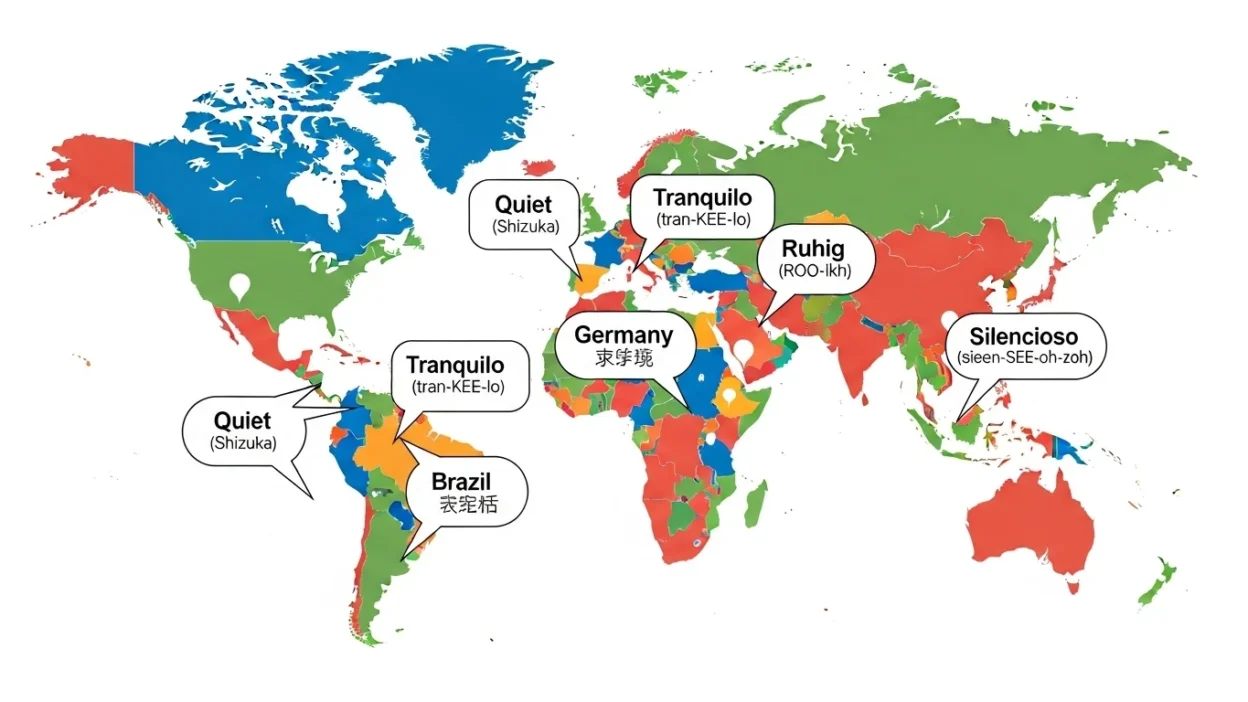
Have you ever wanted to know how to express the concept of “quiet” in different languages? Whether you’re traveling, learning a new language, or simply curious about linguistic diversity, understanding how to say “quiet” around the world can enrich your communication and cultural knowledge.
Quiet in Different Languages: 70 Translations
| Language | Pronunciation | Example | English Meaning |
| Arabic | هادئ (hādiʾ) | الغرفة هادئة اليوم. | The room is quiet today. |
| Spanish | tranquilo | La biblioteca está tranquila. | The library is quiet. |
| French | calme | Le parc est calme ce matin. | The park is quiet this morning. |
| German | ruhig | Bitte sei ruhig. | Please be quiet. |
| Italian | silenzioso | Il corridoio è silenzioso. | The hallway is quiet. |
| Portuguese | silencioso | O jardim está silencioso. | The garden is quiet. |
| Russian | тихий (tikhiy) | Здесь тихо и спокойно. | It is quiet and peaceful here. |
| Chinese (Mandarin) | 安静 (ānjìng) | 教室很安静。 | The classroom is quiet. |
| Japanese | 静か (shizuka) | 部屋は静かです。 | The room is quiet. |
| Korean | 조용한 (joyonghan) | 도서관이 조용하다. | The library is quiet. |
| Hindi | शांत (shānt) | यह कमरा शांत है। | This room is quiet. |
| Bengali | শান্ত (shanto) | বাড়িটি শান্ত। | The house is quiet. |
| Urdu | خاموش (khamosh) | کمرہ خاموش ہے۔ | The room is quiet. |
| Turkish | sessiz | Oda sessiz. | The room is quiet. |
| Persian | ساکت (sāket) | اتاق ساکت است. | The room is quiet. |
| Greek | ήσυχος (ísychos) | Η βιβλιοθήκη είναι ήσυχη. | The library is quiet. |
| Dutch | rustig | De tuin is rustig. | The garden is quiet. |
| Swedish | tyst | Biblioteket är tyst. | The library is quiet. |
| Norwegian | stille | Rommet er stille. | The room is quiet. |
| Danish | stille | Klassen er stille. | The class is quiet. |
| Finnish | hiljainen | Huone on hiljainen. | The room is quiet. |
| Polish | cichy | Pokój jest cichy. | The room is quiet. |
| Czech | tichý | Knihovna je tichá. | The library is quiet. |
| Slovak | tichý | Mesto je tiché. | The city is quiet. |
| Hungarian | csendes | A park csendes. | The park is quiet. |
| Romanian | liniștit | Camera este liniștită. | The room is quiet. |
| Bulgarian | тих (tih) | Залата е тиха. | The hall is quiet. |
| Serbian | тих (tih) | Библиотека је тиха. | The library is quiet. |
| Croatian | tih | Park je tih. | The park is quiet. |
| Bosnian | tih | Ulica je tiha. | The street is quiet. |
| Slovenian | tih | Knjižnica je tiha. | The library is quiet. |
| Malay | senyap | Perpustakaan senyap. | The library is quiet. |
| Indonesian | tenang | Kelas ini tenang. | This class is quiet. |
| Thai | เงียบ (ngiap) | ห้องเรียนเงียบ. | The classroom is quiet. |
| Vietnamese | yên tĩnh | Thư viện rất yên tĩnh. | The library is very quiet. |
| Swahili | kimya | Chumba ni kimya. | The room is quiet. |
| Zulu | thule | Igumbi lithule. | The room is quiet. |
| Xhosa | thule | Igumbi luthule. | The room is quiet. |
| Hebrew | שקט (sheket) | הכיתה שקטה. | The classroom is quiet. |
| Malay (Brunei) | senyap | Perpustakaan senyap. | The library is quiet. |
| Filipino | tahimik | Silid-aralan ay tahimik. | The classroom is quiet. |
| Lithuanian | tylus | Kambarys tylus. | The room is quiet. |
| Latvian | kluss | Bibliotēka ir klusa. | The library is quiet. |
| Estonian | vaikne | Tuba on vaikne. | The room is quiet. |
| Icelandic | hljóðlátur | Herbergið er hljóðlátt. | The room is quiet. |
| Maltese | kwiet | Il-kamra hija kwieta. | The room is quiet. |
| Irish | ciúin | Tá an seomra ciúin. | The room is quiet. |
| Scottish Gaelic | sàmhach | Tha an seòmar sàmhach. | The room is quiet. |
| Welsh | tawel | Mae’r ystafell yn dawel. | The room is quiet. |
| Basque | isil | Liburutegia isil dago. | The library is quiet. |
| Catalan | tranquil | La biblioteca està tranquil·la. | The library is quiet. |
| Galician | calmo | O parque está calmo. | The park is calm. |
| Haitian Creole | trankil | Sal la trankil. | The room is quiet. |
| Armenian | հանգիստ (hangist) | սենյակը հանգիստ է. | The room is quiet. |
| Georgian | ჩუმი (ch’umi) | ოთახი ჩუმია. | The room is quiet. |
| Nepali | शान्त (shanta) | कोठा शान्त छ। | The room is quiet. |
| Sinhala | නිහඬ (nihanda) | කාමරය නිහඬයි. | The room is quiet. |
| Khmer | ស្ងាត់ (sngat) | ថ្នាក់ស្ងាត់។ | The classroom is quiet. |
| Lao | ງຽບ (ngiap) | ຫ້ອງຮຽນງຽບ. | The classroom is quiet. |
| Mongolian | нам гүм (nam güm) | Өрөө нам гүм байна. | The room is quiet. |
| Tibetan | ཞི་གནང་ (zhi gnang) | ཁྱེད་ཀྱི་ཁང་པ་ཞི་གནང་འདུག། | Your room is quiet. |
| Uzbek | jim | Xona jim. | The room is quiet. |
| Kazakh | тыныш (tynysh) | Бөлме тыныш. | The room is quiet. |
| Kyrgyz | тынч (tynch) | Бөлмө тынч. | The room is quiet. |
| Tajik | ором (orom) | Хона ором аст. | The room is quiet. |
| Pashto | چوپ (chop) | خونه چوپه ده. | The room is quiet. |
Why Knowing “Quiet” in Different Languages Matters
Understanding quiet in all languages is more than a translation exercise—it helps you navigate social situations politely. For instance, in libraries, religious spaces, or formal meetings, using the correct word can show respect and cultural awareness. It’s also a simple way to expand your vocabulary while traveling internationally.
Tips for Learning Quiet Translations
- Practice Pronunciation – Listen to native speakers for each language.
- Use Real Life Examples – Like in our table, place “quiet” in context.
- Combine with Polite Requests – Many languages pair “quiet” with “please” for courteous conversation.
- Create Flashcards – Visual reminders reinforce memory.
- Explore Regional Variations – Some languages have multiple words for quiet, depending on formality.
Conclusion
Learning how to say quiet in different languages opens doors to effective communication and cultural understanding.
With this guide of 70 translations, you now have a handy resource for travel, learning, and everyday interactions.
Start practicing today, and notice how such a simple word can connect you across cultures.
FAQs About “Quiet in Different Languages”
1. How do I say quiet in multiple languages?
Refer to the table above to see quiet translations in 70 languages with pronunciation and examples.
2. Why is the word quiet important in other languages?
It is commonly used in social and formal settings, helping you show respect in libraries, schools, or religious spaces.
3. Can “quiet” have different meanings in different languages?
Yes, some languages use different words for quiet depending on context—like silence, calm, or stillness.
4. How do I remember all these translations?
Use flashcards, repeat aloud, and practice with real-life examples to retain pronunciation and meaning.
5. Is there a universal gesture for quiet?
Yes, putting a finger to your lips is widely recognized as a non verbal sign to request silence globally.

Ely Joseph is a language researcher, writer, and contributor who specializes in words, meanings, and multilingual communication. With a strong interest in how language shapes understanding across cultures, Ely focuses on creating clear, accurate, and reader-friendly content for a global audience.