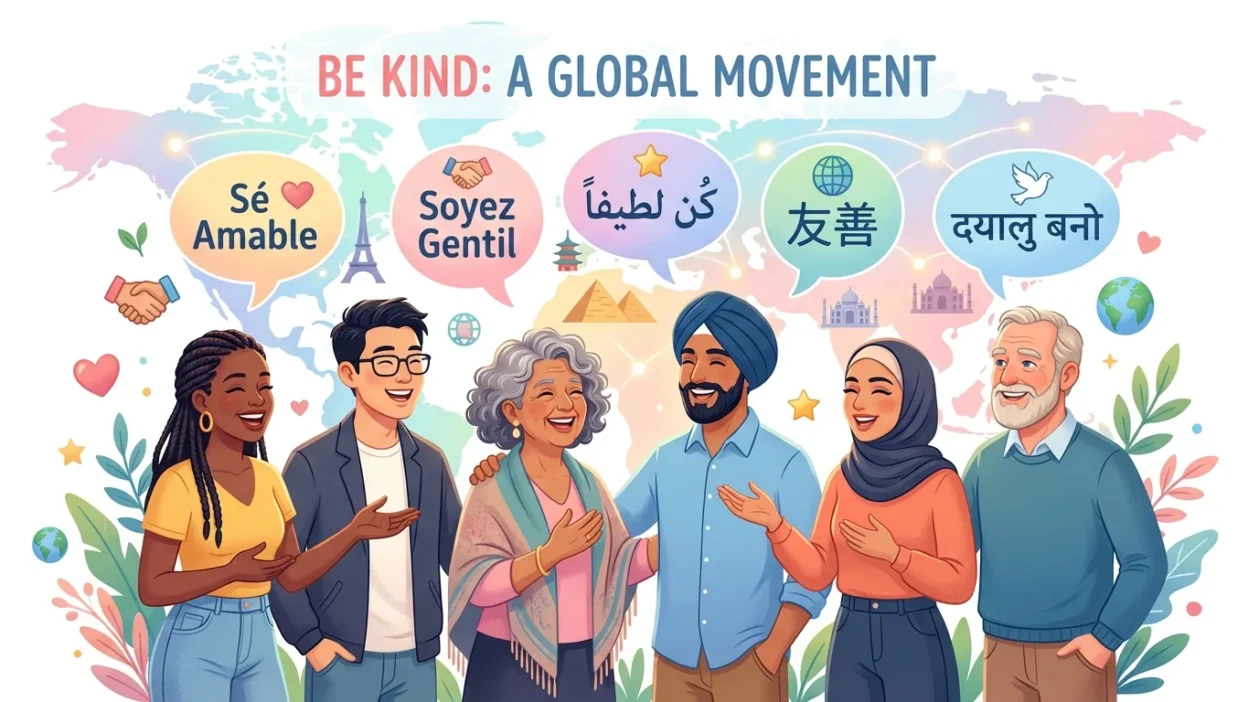
Kindness is a universal language that connects people across cultures, borders, and beliefs. Learning how to say “be kind” in different languages not only helps you communicate better but also shows respect and empathy toward others.
Whether you’re traveling, learning a new language, or simply want to spread positivity, this guide will help you discover how to say be kind in different languages in a practical and meaningful way.
Below, you’ll find a carefully curated list of languages with pronunciation and real life examples. This makes it easy to understand how to say be kind in different languages and use it naturally in everyday conversations.
Be Kind in Different Languages
| Language | Pronunciation | Example |
| English | Be kaind | Be kind to everyone you meet. (Everyone deserves kindness.) |
| Spanish | Sé amable | Sé amable con los demás. (Be kind to others.) |
| French | Soyez gentil | Soyez gentil avec les gens. (Be kind to people.) |
| German | Sei freundlich | Sei freundlich zu allen. (Be kind to everyone.) |
| Italian | Sii gentile | Sii gentile con tutti. (Be kind to everyone.) |
| Portuguese | Seja gentil | Seja gentil com os outros. (Be kind to others.) |
| Dutch | Wees aardig | Wees aardig tegen iedereen. (Be kind to everyone.) |
| Russian | Bud’ dobrym | Bud’ dobrym k lyudyam. (Be kind to people.) |
| Chinese (Mandarin) | Qǐng shàn liáng | Qǐng shàn liáng duì tā rén. (Be kind to others.) |
| Japanese | Yasashiku shite | Minna ni yasashiku shite. (Be kind to everyone.) |
| Korean | Chinjeolhage | Modu-ege chinjeolhage. (Be kind to everyone.) |
| Arabic | Kun latifan | Kun latifan ma’a al-jamee. (Be kind to everyone.) |
| Hindi | Dayalu bano | Sabke saath dayalu bano. (Be kind to everyone.) |
| Urdu | Meherban bano | Sab ke saath meherban bano. (Be kind to everyone.) |
| Turkish | Nazik ol | Herkese nazik ol. (Be kind to everyone.) |
| Greek | Na eisai kalos | Na eisai kalos me olous. (Be kind to everyone.) |
| Polish | Bądź miły | Bądź miły dla wszystkich. (Be kind to everyone.) |
| Swedish | Var snäll | Var snäll mot alla. (Be kind to everyone.) |
| Norwegian | Vær snill | Vær snill mot alle. (Be kind to everyone.) |
| Danish | Vær venlig | Vær venlig mod alle. (Be kind to everyone.) |
| Finnish | Ole ystävällinen | Ole ystävällinen kaikille. (Be kind to everyone.) |
| Czech | Buď laskavý | Buď laskavý ke všem. (Be kind to everyone.) |
| Slovak | Buď milý | Buď milý ku všetkým. (Be kind to everyone.) |
| Hungarian | Légy kedves | Légy kedves mindenkivel. (Be kind to everyone.) |
| Romanian | Fii amabil | Fii amabil cu toți. (Be kind to everyone.) |
| Bulgarian | Badi mil | Badi mil s vsichki. (Be kind to everyone.) |
| Serbian | Budi ljubazan | Budi ljubazan prema svima. (Be kind to everyone.) |
| Croatian | Budi ljubazan | Budi ljubazan prema svima. (Be kind to everyone.) |
| Ukrainian | Bud’ dobrym | Bud’ dobrym do vsikh. (Be kind to everyone.) |
| Hebrew | Heiye nachmad | Heiye nachmad le’kulam. (Be kind to everyone.) |
| Persian | Mehraban bash | Mehraban bash ba hame. (Be kind to everyone.) |
| Thai | Pen khon di | Pen khon di kap thuk khon. (Be kind to everyone.) |
| Vietnamese | Hãy tử tế | Hãy tử tế với mọi người. (Be kind to everyone.) |
| Indonesian | Jadilah baik | Jadilah baik kepada semua. (Be kind to everyone.) |
| Malay | Jadilah baik | Jadilah baik kepada semua. (Be kind to everyone.) |
| Filipino | Maging mabait | Maging mabait sa lahat. (Be kind to everyone.) |
| Swahili | Kuwa mwema | Kuwa mwema kwa wote. (Be kind to everyone.) |
| Zulu | Yiba nomusa | Yiba nomusa kubo bonke. (Be kind to everyone.) |
| Afrikaans | Wees vriendelik | Wees vriendelik teenoor almal. (Be kind to everyone.) |
| Icelandic | Vertu góður | Vertu góður við alla. (Be kind to everyone.) |
| Irish | Bí cineálta | Bí cineálta le gach duine. (Be kind to everyone.) |
| Welsh | Bydd garedig | Bydd garedig i bawb. (Be kind to everyone.) |
| Estonian | Ole lahke | Ole lahke kõigi vastu. (Be kind to everyone.) |
| Latvian | Esi laipns | Esi laipns pret visiem. (Be kind to everyone.) |
| Lithuanian | Būk malonus | Būk malonus visiems. (Be kind to everyone.) |
| Albanian | Ji i sjellshëm | Ji i sjellshëm me të gjithë. (Be kind to everyone.) |
| Macedonian | Bidi ljubazen | Bidi ljubazen kon site. (Be kind to everyone.) |
| Slovenian | Bodi prijazen | Bodi prijazen do vseh. (Be kind to everyone.) |
| Georgian | Ikavi kargi | Ikavi kargi qvelastan. (Be kind to everyone.) |
| Armenian | Yeghir bari | Yeghir bari bolorin. (Be kind to everyone.) |
| Mongolian | Saihan hand | Saihan handaarai bugded. (Be kind to everyone.) |
| Nepali | Dayalu hunu | Sabai sanga dayalu hunu. (Be kind to everyone.) |
| Sinhala | Karunawan wemu | Siyallanta karunawan wemu. (Be kind to everyone.) |
| Tamil | Dayavu seyyungal | Anaivaridam dayavu seyyungal. (Be kind to everyone.) |
| Telugu | Dayachesi undandi | Andariki dayachesi undandi. (Be kind to everyone.) |
| Kannada | Dayavittu irri | Ellarige dayavittu irri. (Be kind to everyone.) |
| Bengali | Doyalu hon | Shobar shathe doyalu hon. (Be kind to everyone.) |
| Punjabi | Mehrban bano | Sareyan naal mehrban bano. (Be kind to everyone.) |
| Gujarati | Dayalu bano | Badha sathe dayalu bano. (Be kind to everyone.) |
| Marathi | Dayalu vha | Sarvanshi dayalu vha. (Be kind to everyone.) |
| Amharic | Tir new hun | Lehulum tir new hun. (Be kind to everyone.) |
| Somali | Naxariis lehow | Qof walba u naxariiso. (Be kind to everyone.) |
| Haitian Creole | Fè janti | Fè janti ak tout moun. (Be kind to everyone.) |
| Lao | Pen khon di | Pen khon di kap thuk khon. (Be kind to everyone.) |
| Khmer | Chea la-or | Chea la-or chumnoun. (Be kind to everyone.) |
| Burmese | Kyay zu tin par | Thu myar ko kyay zu tin par. (Be kind to everyone.) |
| Malagasy | Aoka ho tsara | Aoka ho tsara amin’ny rehetra. (Be kind to everyone.) |
| Samoan | Ia agalelei | Ia agalelei i tagata uma. (Be kind to everyone.) |
Why Learning “Be Kind” in All Languages Matters
Understanding be kind in all languages helps build deeper human connections. Even a simple phrase can break barriers and create trust. When you use kindness in someone’s native language, it shows effort and respect.
It’s especially useful for travelers, educators, and global professionals who interact with diverse cultures.
How to Say “Be Kind” in Different Languages Easily
To remember these be kind translations, focus on:
- Practicing a few languages at a time
- Using them in daily conversations
- Listening to native pronunciation
- Associating phrases with real-life situations
Consistency is key when learning how to say be kind in different languages.
Be Kind Around the World: Cultural Importance
Kindness is valued everywhere, but expressed differently. In some cultures, it’s shown through words, while in others, through actions.
Learning be kind around the world gives insight into cultural values and helps you communicate with empathy and awareness.
Conclusion
Kindness is simple, powerful, and universal. Learning how to say be kind in different languages allows you to spread positivity wherever you go. Whether you use one phrase or many, your effort can make a meaningful difference in someone’s day.
FAQs
1. How do you say be kind in different languages?
You can say it in many ways like “Sé amable” in Spanish, “Soyez gentil” in French, or “Kun latifan” in Arabic.
2. Why should I learn kindness phrases in other languages?
It helps build better relationships, shows respect, and improves communication across cultures.
3. What is the easiest language to learn “be kind” in?
Languages like Spanish, French, and Italian are easier for beginners due to similar vocabulary.
4. Is kindness expressed the same way worldwide?
No, some cultures express kindness through actions more than words, but the meaning remains universal.
5. Can learning simple phrases improve travel experiences?
Yes, using local language phrases like “be kind” creates positive interactions and leaves a good impression.

Marak Robort is a content writer and researcher with a strong interest in language, meanings, and digital information. His work focuses on presenting clear, easy-to-understand explanations that help readers quickly grasp complex ideas.