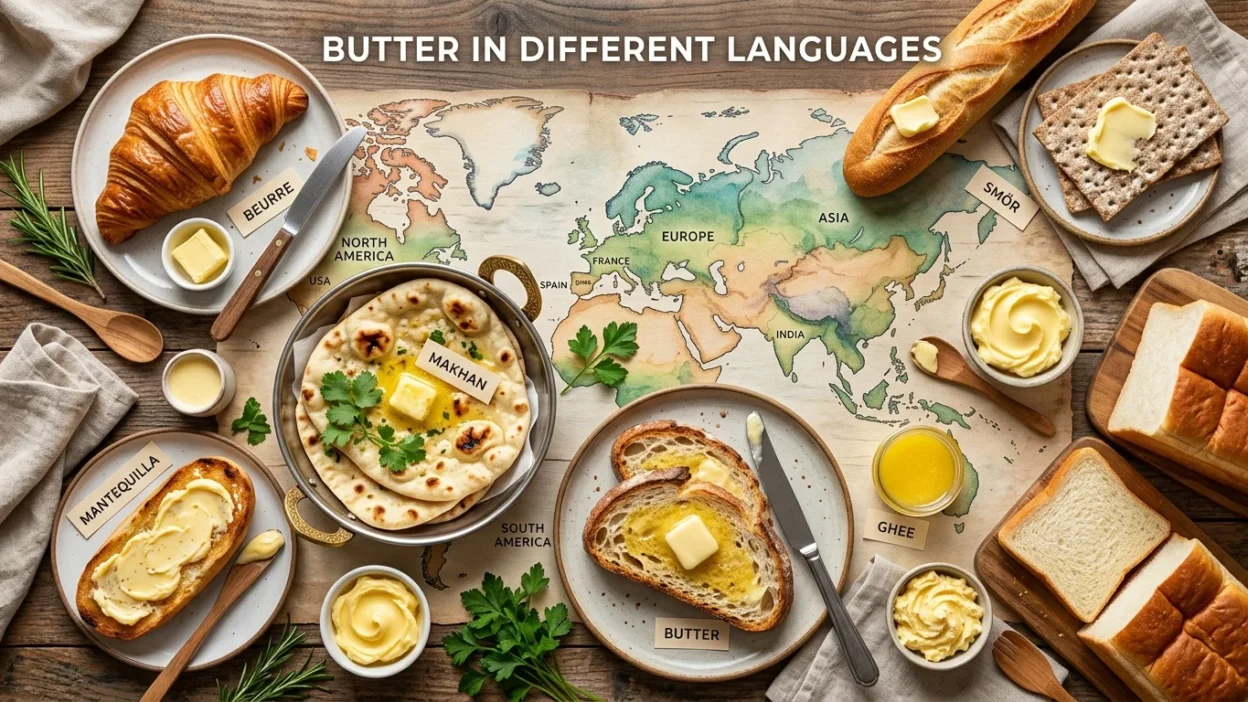
Butter is one of the most commonly used ingredients in kitchens worldwide. Whether you are traveling, learning a new language, or exploring global cuisines, knowing how to say “butter” in different languages can be surprisingly useful. This guide covers butter in different languages, helping you understand how this everyday word is expressed across cultures.
If you’ve ever wondered how to say butter in different languages or searched for butter translations around the world, this article gives you a clear, easy-to-read reference with real-life examples.
Butter in Different Languages (With Pronunciation & Examples)
| Language | Pronunciation & Example | English Meaning |
| English | Butter (buht-er): I spread butter on toast. | I spread butter on toast. |
| Spanish | Mantequilla (man-teh-kee-ya): Uso mantequilla en el pan. | I use butter on bread. |
| French | Beurre (bur): Je mets du beurre sur le pain. | I put butter on bread. |
| German | Butter (boo-ter): Ich esse Brot mit Butter. | I eat bread with butter. |
| Italian | Burro (boo-ro): Metto burro sulla pasta. | I put butter on pasta. |
| Portuguese | Manteiga (man-tay-ga): Eu uso manteiga no pão. | I use butter on bread. |
| Dutch | Boter (bo-ter): Ik eet boter op brood. | I eat butter on bread. |
| Russian | Maslo (mas-lo): Ya lyublyu khleb s maslom. | I love bread with butter. |
| Arabic | Zubda (zoob-da): Akl al-khubz ma’a zubda. | I eat bread with butter. |
| Hindi | Makhan (muk-han): Main makhan lagata hoon. | I spread butter. |
| Urdu | Makhan (muk-han): Main roti par makhan lagata hoon. | I put butter on bread. |
| Chinese (Mandarin) | Huangyou (hwahng-yo): Wo yong huangyou. | I use butter. |
| Japanese | Bata (bah-tah): Pan ni bata o nuru. | I spread butter on bread. |
| Korean | Beoteo (boh-tuh): Butter reul sayonghae. | I use butter. |
| Turkish | Tereyağı (teh-reh-yah): Ekmeğe tereyağı sürüyorum. | I spread butter on bread. |
| Greek | Voutyro (voo-tee-ro): Vazo voutyro sto psomi. | I put butter on bread. |
| Polish | Masło (mas-wo): Jem chleb z masłem. | I eat bread with butter. |
| Swedish | Smör (smur): Jag äter smör på bröd. | I eat butter on bread. |
| Danish | Smør (smur): Jeg bruger smør. | I use butter. |
| Norwegian | Smør (smur): Jeg spiser smør. | I eat butter. |
| Finnish | Voi (voy): Syön voita leivän kanssa. | I eat butter with bread. |
| Czech | Máslo (maas-lo): Jím chléb s máslem. | I eat bread with butter. |
| Hungarian | Vaj (vuy): Kenyeret eszem vajjal. | I eat bread with butter. |
| Romanian | Unt (oont): Mănânc pâine cu unt. | I eat bread with butter. |
| Thai | เนย (noei): Chan chai noei. | I use butter. |
| Vietnamese | Bơ (buh): Tôi ăn bánh mì với bơ. | I eat bread with butter. |
| Indonesian | Mentega (men-teh-ga): Saya pakai mentega. | I use butter. |
| Malay | Mentega (men-teh-ga): Saya makan roti dengan mentega. | I eat bread with butter. |
| Filipino | Mantikilya (man-tee-kil-ya): Kumakain ako ng tinapay na may mantikilya. | I eat bread with butter. |
| Swahili | Siagi (see-ah-gee): Ninatumia siagi. | I use butter. |
| Zulu | Ibhotela (ee-boh-teh-la): Ngisebenzisa ibhotela. | I use butter. |
| Afrikaans | Botter (bot-ter): Ek eet brood met botter. | I eat bread with butter. |
| Hebrew | Chema (khe-ma): Ani ochel lechem im chema. | I eat bread with butter. |
| Persian | Kareh (ka-reh): Man kareh estefade mikonam. | I use butter. |
| Bengali | Makhon (ma-khon): Ami ruti te makhon dei. | I put butter on bread. |
| Tamil | Vennai (ven-nai): Naan vennai use pannuren. | I use butter. |
| Telugu | Venna (ven-na): Nenu venna vadutanu. | I use butter. |
| Marathi | Loni (lo-nee): Mi bhakarwar loni lavto. | I spread butter on bread. |
| Gujarati | Makhan (muk-han): Hu rotli par makhan lagadu. | I put butter on bread. |
| Punjabi | Makhan (muk-han): Main makhan lagaya. | I spread butter. |
| Sinhala | Butter (but-ter): Mama butter use karanawa. | I use butter. |
| Nepali | Makhan (muk-han): Ma makhan prayog garchu. | I use butter. |
| Khmer | Baat (baat): Khnhom prao bat. | I use butter. |
| Lao | Noei (noi): Khoi sai noei. | I use butter. |
| Burmese | Butta (but-ta): Nga butter thone de. | I use butter. |
| Mongolian | Tos (tos): Bi tos ashigladag. | I use butter. |
| Icelandic | Smjör (smyor): Ég borða brauð með smjöri. | I eat bread with butter. |
| Irish | Im (im): Ithim arán le him. | I eat bread with butter. |
| Welsh | Menyn (men-in): Rwy’n defnyddio menyn. | I use butter. |
| Scottish Gaelic | Im (im): Bidh mi ag ithe im. | I eat butter. |
| Basque | Gurina (goo-ree-na): Ogia gurinarekin jaten dut. | I eat bread with butter. |
| Catalan | Mantega (man-teh-ga): Menjo pa amb mantega. | I eat bread with butter. |
| Galician | Manteiga (man-tay-ga): Como pan con manteiga. | I eat bread with butter. |
| Estonian | Või (voy): Söön leiba võiga. | I eat bread with butter. |
| Latvian | Sviests (svee-ests): Es ēdu maizi ar sviestu. | I eat bread with butter. |
| Lithuanian | Sviestas (svee-es-tas): Aš valgau duoną su sviestu. | I eat bread with butter. |
| Slovak | Maslo (mas-lo): Jem chlieb s maslom. | I eat bread with butter. |
| Slovenian | Maslo (mas-lo): Jem kruh z maslom. | I eat bread with butter. |
| Croatian | Maslac (mas-lats): Jedem kruh s maslacem. | I eat bread with butter. |
| Serbian | Maslac (mas-lats): Jedem hleb sa maslacem. | I eat bread with butter. |
| Bosnian | Maslac (mas-lats): Jedem hljeb sa maslacem. | I eat bread with butter. |
| Macedonian | Maslo (mas-lo): Jadham leb so maslo. | I eat bread with butter. |
| Albanian | Gjalpë (gyal-pe): Ha bukë me gjalpë. | I eat bread with butter. |
| Armenian | Karag (ka-rag): Yes karag ogtagorcum em. | I use butter. |
| Georgian | K’aragi (ka-ra-gi): Me k’arags viqeneb. | I use butter. |
Why Learn Butter in All Languages?
Learning butter in all languages is helpful for travelers, food lovers, and language learners. It improves communication when ordering food, shopping in markets, or understanding recipes from different cultures.
It also helps you connect with people globally, especially in everyday situations where food plays a central role.
How to Say Butter in Different Languages Easily
The easiest way to remember butter translations is by grouping similar words:
- European languages often use variations like butter, boter, beurre
- South Asian languages commonly use makhan
- Nordic languages use smör or smør
Practice with simple sentences like “I eat bread with butter” to build memory faster.
Butter Around the World: Cultural Insight
Butter is used differently across cultures:
- In Europe, it’s a staple for bread and pastries
- In South Asia, butter (makhan) is often homemade
- In East Asia, it’s used more in baking than traditional cooking
Understanding butter around the world gives insight into global food habits and traditions.
Conclusion
Knowing how to say butter in different languages is a small but powerful step in learning new cultures and languages. From beurre in French to makhan in Hindi and Urdu, this simple word connects kitchens worldwide.
Use this guide as a quick reference and keep practicing with real-life examples to improve your language skills.
FAQs
1. What is butter called in most languages?
In many languages, butter has similar roots like butter, boter, beurre, or makhan, depending on the region.
2. How do you say butter in Asian languages?
Common translations include makhan (Hindi/Urdu), huangyou (Chinese), and bata (Japanese).
3. Why are butter words similar in European languages?
Many European languages share Latin or Germanic roots, leading to similar words for butter.
4. Is butter used the same way worldwide?
No, butter usage varies by culture common in Western cooking but less traditional in some Asian cuisines.
5. What is the easiest way to learn butter in all languages?
Practice with simple sentences and group similar languages together for faster learning.