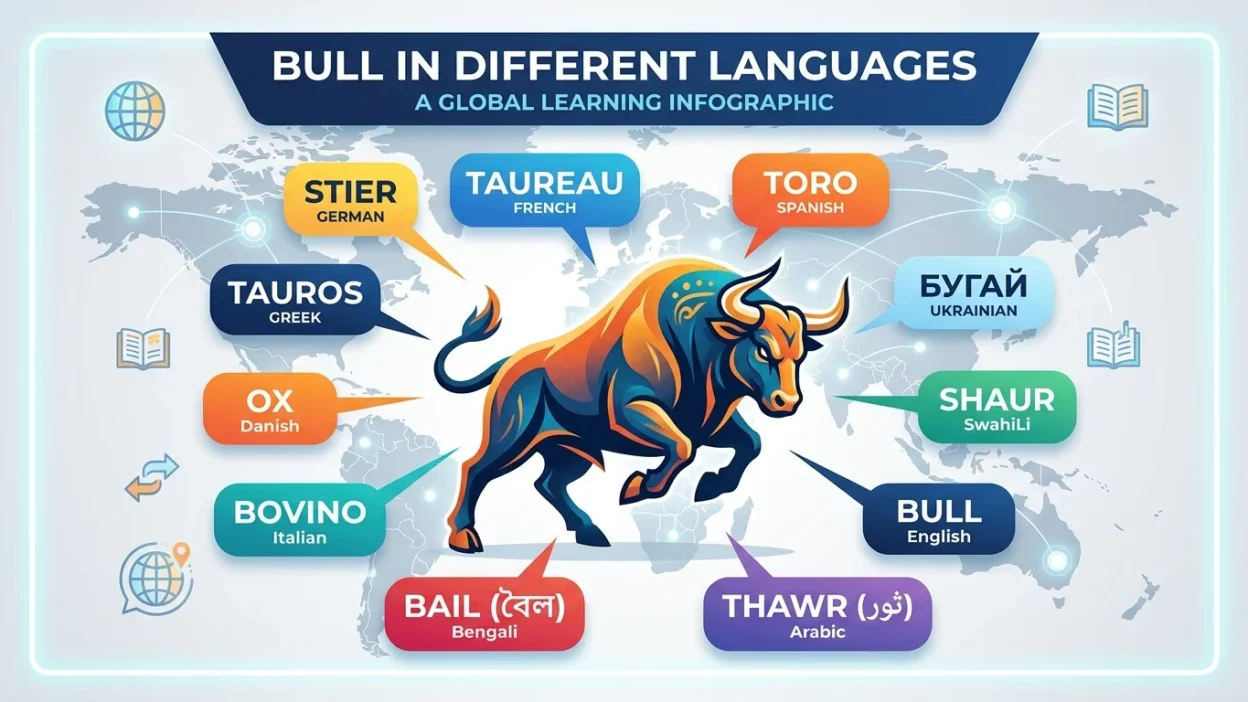
Understanding how to say “bull in different languages” is useful for travelers, language learners, and anyone interested in global vocabulary.
Whether you’re exploring culture, studying linguistics, or just curious, this guide provides a clear and easy way to learn bull translations around the world.
In this article, you’ll find a well organized table featuring languages, along with pronunciation and simple real life examples.
This helps you quickly understand how to say bull in different languages and use it naturally in conversation.
Bull in All Languages
| Language | Pronunciation | Example |
| English | bull | The bull is strong. (Meaning: The bull is powerful.) |
| Spanish | toro | El toro es grande. (Meaning: The bull is big.) |
| French | taureau | Le taureau court vite. (Meaning: The bull runs fast.) |
| German | Stier | Der Stier ist laut. (Meaning: The bull is loud.) |
| Italian | toro | Il toro mangia erba. (Meaning: The bull eats grass.) |
| Portuguese | touro | O touro é bravo. (Meaning: The bull is fierce.) |
| Dutch | stier | De stier slaapt. (Meaning: The bull sleeps.) |
| Russian | бык (byk) | Бык стоит там. (Meaning: The bull stands there.) |
| Chinese (Mandarin) | 公牛 (gōngniú) | 公牛很强壮。(Meaning: The bull is strong.) |
| Japanese | 雄牛 (oushi) | 雄牛は大きい。(Meaning: The bull is big.) |
| Korean | 황소 (hwangso) | 황소가 달린다. (Meaning: The bull runs.) |
| Arabic | ثور (thawr) | الثور قوي. (Meaning: The bull is strong.) |
| Hindi | बैल (bail) | बैल खेत में है। (Meaning: The bull is in the field.) |
| Urdu | بیل (bail) | بیل طاقتور ہے۔ (Meaning: The bull is strong.) |
| Bengali | বলদ (bolod) | বলদ মাঠে আছে। (Meaning: The bull is in the field.) |
| Punjabi | ਬੈਲ (bail) | ਬੈਲ ਦੌੜ ਰਿਹਾ ਹੈ। (Meaning: The bull is running.) |
| Turkish | boğa | Boğa güçlüdür. (Meaning: The bull is strong.) |
| Greek | ταύρος (tavros) | Ο ταύρος τρέχει. (Meaning: The bull runs.) |
| Polish | byk | Byk stoi tam. (Meaning: The bull stands there.) |
| Czech | býk | Býk je velký. (Meaning: The bull is big.) |
| Slovak | býk | Býk beží. (Meaning: The bull runs.) |
| Hungarian | bika | A bika erős. (Meaning: The bull is strong.) |
| Romanian | taur | Taurul aleargă. (Meaning: The bull runs.) |
| Swedish | tjur | Tjuren är stor. (Meaning: The bull is big.) |
| Norwegian | okse | Oksen er sterk. (Meaning: The bull is strong.) |
| Danish | tyr | Tyren løber. (Meaning: The bull runs.) |
| Finnish | härkä | Härkä on iso. (Meaning: The bull is big.) |
| Estonian | härg | Härg seisab. (Meaning: The bull stands.) |
| Latvian | bullis | Bullis skrien. (Meaning: The bull runs.) |
| Lithuanian | bulius | Bulius stiprus. (Meaning: The bull is strong.) |
| Ukrainian | бик (byk) | Бик біжить. (Meaning: The bull runs.) |
| Serbian | бик (bik) | Бик је јак. (Meaning: The bull is strong.) |
| Croatian | bik | Bik trči. (Meaning: The bull runs.) |
| Bosnian | bik | Bik stoji. (Meaning: The bull stands.) |
| Bulgarian | бик (bik) | Бикът е голям. (Meaning: The bull is big.) |
| Albanian | dem | Demi vrapon. (Meaning: The bull runs.) |
| Georgian | ხარი (khari) | ხარი დიდია. (Meaning: The bull is big.) |
| Armenian | ցուլ (tsul) | Ցուլը ուժեղ է։ (Meaning: The bull is strong.) |
| Persian | گاو نر (gav nar) | گاو نر قوی است. (Meaning: The bull is strong.) |
| Pashto | نر غوا (nar ghwa) | نر غوا قوي دی. (Meaning: The bull is strong.) |
| Malay | lembu jantan | Lembu jantan kuat. (Meaning: The bull is strong.) |
| Indonesian | banteng | Banteng berlari. (Meaning: The bull runs.) |
| Thai | วัวตัวผู้ (wua tua phu) | วัวตัวผู้แข็งแรง (Meaning: The bull is strong.) |
| Vietnamese | bò đực | Bò đực chạy. (Meaning: The bull runs.) |
| Filipino | toro | Ang toro ay malakas. (Meaning: The bull is strong.) |
| Swahili | fahali | Fahali anakimbia. (Meaning: The bull runs.) |
| Zulu | inkunzi | Inkunzi inamandla. (Meaning: The bull is strong.) |
| Afrikaans | bul | Die bul is groot. (Meaning: The bull is big.) |
| Somali | dibi | Dibi waa xoog badan. (Meaning: The bull is strong.) |
| Amharic | በሬ (bere) | በሬ ኃይለኛ ነው። (Meaning: The bull is strong.) |
| Yoruba | akọ malu | Akọ malu lagbara. (Meaning: The bull is strong.) |
| Igbo | ehi nwoke | Ehi nwoke siri ike. (Meaning: The bull is strong.) |
| Hausa | bijimi | Bijimi yana gudu. (Meaning: The bull runs.) |
| Malagasy | omby lahy | Omby lahy lehibe. (Meaning: The bull is big.) |
| Hawaiian | bipi kāne | Nui ka bipi kāne. (Meaning: The bull is big.) |
| Maori | puru | Kei te oma te puru. (Meaning: The bull runs.) |
| Samoan | povi poʻa | Povi poʻa malosi. (Meaning: The bull is strong.) |
| Fijian | bulumakau | Bulumakau levu. (Meaning: The bull is big.) |
| Icelandic | naut | Nautið er stórt. (Meaning: The bull is big.) |
| Irish | tarbh | Tá an tarbh láidir. (Meaning: The bull is strong.) |
| Welsh | tarw | Mae’r tarw yn rhedeg. (Meaning: The bull runs.) |
| Scottish Gaelic | tarbh | Tha an tarbh mòr. (Meaning: The bull is big.) |
| Maltese | barri | Il-barri huwa kbir. (Meaning: The bull is big.) |
| Luxembourgish | Stéier | De Stéier leeft. (Meaning: The bull runs.) |
| Catalan | toro | El toro corre. (Meaning: The bull runs.) |
| Basque | zezen | Zezena handia da. (Meaning: The bull is big.) |
| Galician | touro | O touro é forte. (Meaning: The bull is strong.) |
| Esperanto | bovo | La bovo kuras. (Meaning: The bull runs.) |
How to Say Bull in Different Languages
Learning how to say bull in different languages helps expand your vocabulary and cultural understanding. Many languages have similar roots, especially in Europe, while others reflect unique cultural identities.
For example:
- Romance languages use variations of “toro”
- Germanic languages use forms like “stier”
- Asian languages often describe gender explicitly
Bull Translations Around the World
The word “bull” is widely used in farming, symbolism, and even finance. Knowing bull translations can help in:
- Travel communication
- Language learning
- Cultural studies
Different regions may use the word in both literal and symbolic contexts.
Why Learn Bull in All Languages?
Understanding bull in all languages can:
- Improve multilingual skills
- Help with translation work
- Support global communication
- Enhance cultural awareness
It’s a simple but effective way to explore language diversity.
Conclusion
This guide covered ways to say bull around the world, making it easier to understand and use the term globally. Whether you’re learning languages or just curious, these translations provide a strong foundation.
FAQs
1. What is bull in different languages?
Bull is translated differently across languages, such as “toro” in Spanish and “Stier” in German.
2. How do you say bull in Asian languages?
In Chinese it is “gōngniú,” in Japanese “oushi,” and in Korean “hwangso.”
3. Why are bull translations different worldwide?
Languages evolve based on culture, history, and linguistic roots, leading to different words.
4. Is bull the same in all European languages?
No, but many European languages have similar words due to shared origins.
5. Where is the word bull commonly used?
It is used in farming, symbolism, zodiac signs, and financial markets.

David William is a language enthusiast, researcher, and content creator at Lingoveb. With a deep passion for words, meanings, and global communication, he focuses on making language simple, clear, and accessible for readers around the world.