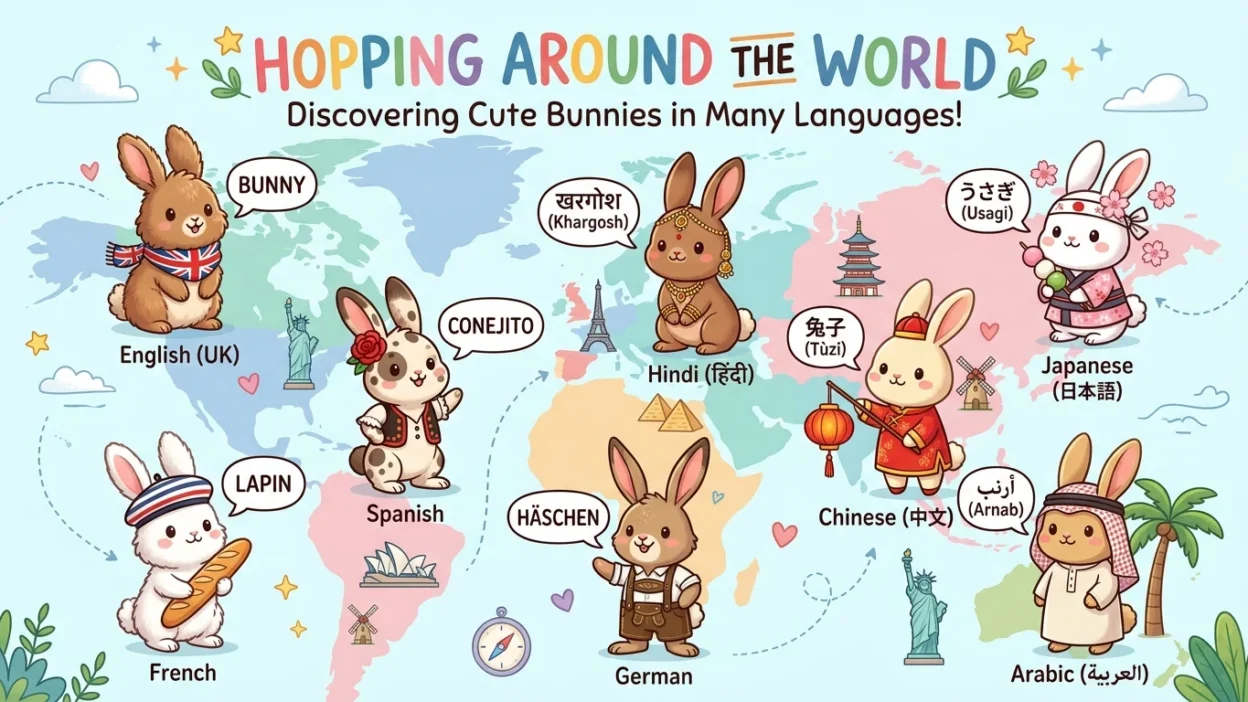
Learning how to say “bunny” in different languages is both fun and useful whether you’re a language enthusiast, traveler, or just curious about global vocabulary.
In this guide, you’ll explore languages with pronunciation and real-life examples, making it easy to understand how “bunny” is used around the world.
If you’ve ever searched for bunny in all languages, how to say bunny in different languages, or wanted simple bunny translations, this article is designed exactly for you.
Bunny in Different Languages (With Pronunciation & Examples)
| Language | Pronunciation | Example |
| English | buh-nee | The bunny is eating a carrot. (A rabbit is eating a carrot.) |
| Spanish | conejito (ko-neh-hee-to) | El conejito es muy lindo. (The bunny is very cute.) |
| French | lapin (la-pan) | Le lapin saute. (The bunny jumps.) |
| German | Häschen (heh-shen) | Das Häschen schläft. (The bunny sleeps.) |
| Italian | coniglietto (ko-neel-yet-to) | Il coniglietto corre. (The bunny runs.) |
| Portuguese | coelhinho (ko-el-yeen-yo) | O coelhinho pula. (The bunny jumps.) |
| Dutch | konijntje (ko-nine-chuh) | Het konijntje eet. (The bunny eats.) |
| Russian | зайчик (zai-chik) | Зайчик прыгает. (The bunny jumps.) |
| Polish | króliczek (kroo-lee-chek) | Króliczek śpi. (The bunny sleeps.) |
| Turkish | tavşancık (tav-shan-juk) | Tavşancık koşuyor. (The bunny runs.) |
| Arabic | أرنب (arnab) | الأرنب لطيف. (The bunny is cute.) |
| Hindi | खरगोश (khar-gosh) | खरगोश दौड़ रहा है। (The bunny is running.) |
| Urdu | خرگوش (khargosh) | خرگوش پیارا ہے۔ (The bunny is cute.) |
| Bengali | খরগোশ (kho-ro-gosh) | খরগোশ দৌড়ায়। (The bunny runs.) |
| Punjabi | ਖਰਗੋਸ਼ (khar-gosh) | ਖਰਗੋਸ਼ ਦੌੜਦਾ ਹੈ। (The bunny runs.) |
| Chinese (Mandarin) | 兔子 (too-dzuh) | 兔子在吃。 (The bunny is eating.) |
| Japanese | うさぎ (oo-sa-gi) | うさぎが走る。 (The bunny runs.) |
| Korean | 토끼 (to-kki) | 토끼가 점프해요. (The bunny jumps.) |
| Thai | กระต่าย (kra-tai) | กระต่ายวิ่ง. (The bunny runs.) |
| Vietnamese | thỏ (tho) | Con thỏ ăn. (The bunny eats.) |
| Indonesian | kelinci (ke-lin-chee) | Kelinci melompat. (The bunny jumps.) |
| Malay | arnab (ar-nab) | Arnab itu comel. (The bunny is cute.) |
| Swahili | sungura (soon-goo-ra) | Sungura anakimbia. (The bunny runs.) |
| Zulu | unogwaja (u-no-gwa-ja) | Unogwaja uyagijima. (The bunny runs.) |
| Afrikaans | hasie (ha-see) | Die hasie spring. (The bunny jumps.) |
| Greek | κουνελάκι (koo-ne-la-kee) | Το κουνελάκι τρέχει. (The bunny runs.) |
| Swedish | kanin (ka-neen) | Kaninen hoppar. (The bunny jumps.) |
| Norwegian | kanin (ka-neen) | Kaninen løper. (The bunny runs.) |
| Danish | kanin (ka-neen) | Kaninen spiser. (The bunny eats.) |
| Finnish | pupu (poo-poo) | Pupu juoksee. (The bunny runs.) |
| Icelandic | kanína (ka-nee-na) | Kanína hoppar. (The bunny jumps.) |
| Czech | králíček (kra-lee-chek) | Králíček běží. (The bunny runs.) |
| Slovak | zajačik (za-ya-chik) | Zajačik skáče. (The bunny jumps.) |
| Hungarian | nyuszi (nyu-see) | A nyuszi fut. (The bunny runs.) |
| Romanian | iepuraș (ye-poo-rash) | Iepurașul sare. (The bunny jumps.) |
| Bulgarian | зайче (zai-che) | Зайчето тича. (The bunny runs.) |
| Serbian | зец (zets) | Зец трчи. (The bunny runs.) |
| Croatian | zeko (ze-ko) | Zeko skače. (The bunny jumps.) |
| Slovenian | zajček (zai-chek) | Zajček teče. (The bunny runs.) |
| Ukrainian | зайчик (zai-chyk) | Зайчик стрибає. (The bunny jumps.) |
| Hebrew | ארנב (ar-nav) | הארנב קופץ. (The bunny jumps.) |
| Persian | خرگوش (khar-goosh) | خرگوش میدود. (The bunny runs.) |
| Pashto | سوی (sway) | سوی منډه وهي. (The bunny runs.) |
| Nepali | खरायो (kha-ra-yo) | खरायो दौडन्छ। (The bunny runs.) |
| Sinhala | හාවා (haa-va) | හාවා දුවනවා. (The bunny runs.) |
| Tamil | முயல் (mu-yal) | முயல் ஓடுகிறது. (The bunny runs.) |
| Telugu | కుందేలు (kun-de-lu) | కుందేలు పరుగెడుతోంది. (The bunny runs.) |
| Kannada | ಮೊಲ (mo-la) | ಮೊಲ ಓಡುತ್ತದೆ. (The bunny runs.) |
| Malayalam | മുയൽ (mu-yal) | മുയൽ ഓടുന്നു. (The bunny runs.) |
| Marathi | ससा (sa-sa) | ससा धावतो. (The bunny runs.) |
| Gujarati | સસલું (sas-lu) | સસલું દોડે છે. (The bunny runs.) |
| Khmer | ទន្សាយ (ton-sai) | ទន្សាយរត់. (The bunny runs.) |
| Lao | ກະຕ່າຍ (ka-tai) | ກະຕ່າຍແລ່ນ. (The bunny runs.) |
| Burmese | ယုန် (yone) | ယုန် ပြေးတယ်. (The bunny runs.) |
| Mongolian | туулай (too-lai) | Туулай гүйж байна. (The bunny runs.) |
| Kazakh | қоян (koyan) | Қоян жүгіріп жүр. (The bunny runs.) |
| Uzbek | quyon (koo-yon) | Quyon yuguradi. (The bunny runs.) |
| Azerbaijani | dovşan (dov-shan) | Dovşan qaçır. (The bunny runs.) |
| Georgian | კურდღელი (kur-dghe-li) | კურდღელი დარბის. (The bunny runs.) |
| Armenian | նապաստակ (na-pas-tak) | Նապաստակը վազում է։ (The bunny runs.) |
| Albanian | lepur (le-poor) | Lepuri vrapon. (The bunny runs.) |
| Maltese | fenek (fe-nek) | Il-fenek jiġri. (The bunny runs.) |
| Estonian | jänes (ya-nes) | Jänes jookseb. (The bunny runs.) |
| Latvian | trusis (troo-sis) | Trusis skrien. (The bunny runs.) |
| Lithuanian | triušis (tree-oo-shis) | Triušis bėga. (The bunny runs.) |
| Irish | coinín (kuh-neen) | Tá an coinín ag rith. (The bunny runs.) |
| Welsh | cwningen (koo-ning-en) | Mae’r gwningen yn rhedeg. (The bunny runs.) |
How to Say Bunny in Different Languages
The word “bunny” often changes based on culture and tone. In many languages, there are both formal and cute/diminutive versions. For example, Spanish uses conejo (rabbit) and conejito (bunny). This pattern appears across many languages, reflecting affection and familiarity.
When learning bunny in different languages, it helps to focus on pronunciation and context, especially for everyday conversations.
Bunny Translations Around the World
Across continents, the concept of a bunny remains universal, but the sounds and structures vary. European languages often share similar roots, while Asian and African languages introduce unique phonetics.
Understanding these bunny translations can improve vocabulary, cultural awareness, and even communication skills when traveling or learning a new language.
Why Learn Bunny in All Languages?
Learning simple words like “bunny” can:
- Build a strong foundation in new languages
- Help with memory and pronunciation skills
- Make learning fun and engaging
- Improve cultural understanding
Whether you’re studying linguistics or just exploring bunny around the world, this knowledge is surprisingly useful.
Conclusion
Exploring how to say “bunny” in 70 different languages shows just how diverse and fascinating languages can be. From Europe to Asia and beyond, each translation carries its own sound and cultural touch. Use this guide to expand your vocabulary and enjoy learning languages in a fun way.
FAQs
1. What is bunny in all languages?
“Bunny” has different translations depending on the language, such as lapin in French, usagi in Japanese, and arnab in Arabic.
2. How do you say bunny in different languages easily?
Start with commonly spoken languages and practice pronunciation using simple example sentences.
3. Is bunny the same as rabbit in all languages?
Not always. Many languages have separate words for “rabbit” and “bunny” (cute or informal version).
4. Why are bunny translations different across countries?
Languages evolve differently based on culture, history, and pronunciation systems.
5. Which language has the cutest word for bunny?
This is subjective, but words like usagi (Japanese) and pupu (Finnish) are often considered cute.