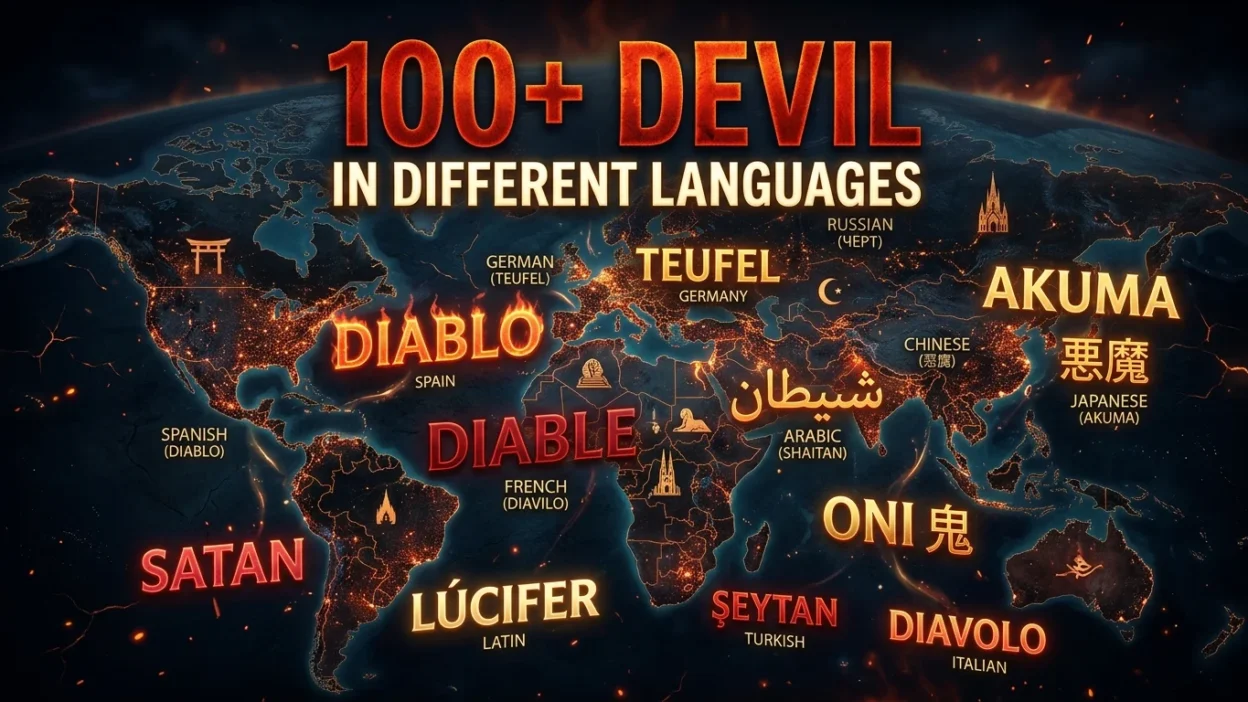
The word “devil” exists in nearly every culture and language across the world. Whether used in religion, folklore, literature, or everyday conversation, people are often curious about how to say devil in different languages. Learning these translations can help language learners, travelers, writers, and culture enthusiasts better understand global communication and traditions.
In this guide, you will discover ways to say “devil” in different languages, along with pronunciation and simple example sentences. This article is designed to help users searching for devil in all languages, devil translations, and how to say devil around the world.
Devil in Different Languages
| Language | Pronunciation | Example |
| English | Dev-il | The devil scared the villagers. (English meaning: The devil frightened the villagers.) |
| Spanish | Dia-blo | El diablo apareció en la historia. (English meaning: The devil appeared in the story.) |
| French | Dyab-l | Le diable est dans la légende. (English meaning: The devil is in the legend.) |
| German | Toy-fel | Der Teufel ist gefährlich. (English meaning: The devil is dangerous.) |
| Italian | Dya-vo-lo | Il diavolo rideva forte. (English meaning: The devil laughed loudly.) |
| Portuguese | Dee-a-bloo | O diabo assustou todos. (English meaning: The devil frightened everyone.) |
| Dutch | Duy-vel | De duivel kwam vannacht. (English meaning: The devil came tonight.) |
| Russian | Chyort | Чёрт был злым. (English meaning: The devil was evil.) |
| Ukrainian | Bis | Біс зник швидко. (English meaning: The devil disappeared quickly.) |
| Polish | Dya-bel | Diabeł mieszkał w lesie. (English meaning: The devil lived in the forest.) |
| Czech | Dya-bel | Ďábel přišel později. (English meaning: The devil came later.) |
| Slovak | Dya-bel | Diabol bol nahnevaný. (English meaning: The devil was angry.) |
| Hungarian | Er-dyog | Az ördög futott el. (English meaning: The devil ran away.) |
| Romanian | Drahk | Dracul era în peșteră. (English meaning: The devil was in the cave.) |
| Bulgarian | Dya-vol | Дяволът говореше тихо. (English meaning: The devil spoke softly.) |
| Serbian | Dya-vo | Ђаво је нестао. (English meaning: The devil disappeared.) |
| Croatian | Jya-vo | Đavao je čekao tamo. (English meaning: The devil waited there.) |
| Bosnian | Jya-vo | Đavo je bio strašan. (English meaning: The devil was terrifying.) |
| Slovenian | Hoo-dich | Hudič je odprl vrata. (English meaning: The devil opened the door.) |
| Greek | Dya-vo-los | Ο διάβολος γελούσε. (English meaning: The devil was laughing.) |
| Turkish | Shey-tan | Şeytan kapıda durdu. (English meaning: The devil stood at the door.) |
| Arabic | Shay-tan | الشيطان كان مخيفاً. (English meaning: The devil was scary.) |
| Hebrew | Sa-tan | השטן הופיע בלילה. (English meaning: The devil appeared at night.) |
| Persian | Shay-tan | شیطان فرار کرد. (English meaning: The devil escaped.) |
| Hindi | Shai-taan | शैतान जंगल में था। (English meaning: The devil was in the forest.) |
| Urdu | Shai-taan | شیطان ہنس رہا تھا۔ (English meaning: The devil was laughing.) |
| Bengali | Shoi-tan | শয়তান দরজায় ছিল। (English meaning: The devil was at the door.) |
| Punjabi | Shai-taan | ਸ਼ੈਤਾਨ ਬਹੁਤ ਡਰਾਉਣਾ ਸੀ। (English meaning: The devil was very frightening.) |
| Gujarati | Shai-taan | શેતાન અંધારામાં હતો। (English meaning: The devil was in the dark.) |
| Marathi | Shai-taan | शैतान जवळ उभा होता। (English meaning: The devil stood nearby.) |
| Tamil | Saath-thaan | சாத்தான் வந்தான். (English meaning: The devil arrived.) |
| Telugu | Sai-thaan | సైతాను నవ్వాడు. (English meaning: The devil laughed.) |
| Kannada | Pishaa-chi | ಪಿಶಾಚಿ ಓಡಿಹೋಯಿತು. (English meaning: The devil ran away.) |
| Malayalam | Pisha-cha | പിശാച് അവിടെ നിന്നു. (English meaning: The devil stood there.) |
| Sinhala | Ya-ka | යකා ගුහාවේ සිටියේය. (English meaning: The devil was in the cave.) |
| Nepali | Shay-taan | शैतान करायो। (English meaning: The devil screamed.) |
| Chinese (Mandarin) | Mo-gwei | 魔鬼来了。 (English meaning: The devil came.) |
| Japanese | Aku-ma | 悪魔が笑った。 (English meaning: The devil laughed.) |
| Korean | Ak-ma | 악마가 나타났다. (English meaning: The devil appeared.) |
| Vietnamese | Quy-du | Quỷ dữ rất mạnh. (English meaning: The devil was very powerful.) |
| Thai | Phee-sart | ปีศาจอยู่ที่นี่. (English meaning: The devil is here.) |
| Indonesian | Se-tan | Setan masuk rumah. (English meaning: The devil entered the house.) |
| Malay | Syai-tan | Syaitan hilang tiba-tiba. (English meaning: The devil disappeared suddenly.) |
| Filipino | Dya-blo | Ang diyablo ay galit. (English meaning: The devil was angry.) |
| Swahili | She-ta-ni | Shetani aliondoka. (English meaning: The devil left.) |
| Zulu | UDeveli | UDeveli wafika ebusuku. (English meaning: The devil arrived at night.) |
| Afrikaans | Duy-wel | Die duiwel het geskree. (English meaning: The devil screamed.) |
| Hausa | Shai-dan | Shaidan yana can. (English meaning: The devil is there.) |
| Yoruba | Eshu | Eshu duro ni ọna. (English meaning: The devil stood on the road.) |
| Igbo | Ekwo-mo | Ekwomọ bịara ngwa ngwa. (English meaning: The devil came quickly.) |
| Somali | Shay-daan | Shaydaan wuu cararay. (English meaning: The devil ran away.) |
| Amharic | Sey-tan | ሰይጣን ጮኸ። (English meaning: The devil shouted.) |
| Latin | Dia-bo-lus | Diabolus in silva erat. (English meaning: The devil was in the forest.) |
| Irish | Dye-vul | Bhí an diabhal ann. (English meaning: The devil was there.) |
| Scottish Gaelic | Dye-vel | Bha an diabhal feargach. (English meaning: The devil was angry.) |
| Welsh | Dya-vul | Roedd y diafol yn gryf. (English meaning: The devil was strong.) |
| Danish | Dye-vul | Djævlen ventede udenfor. (English meaning: The devil waited outside.) |
| Swedish | Dya-vul-en | Djävulen log högt. (English meaning: The devil smiled loudly.) |
| Norwegian | Dye-ve-len | Djevelen kom sent. (English meaning: The devil came late.) |
| Finnish | Paholainen | Paholainen juoksi pois. (English meaning: The devil ran away.) |
| Estonian | Kurat | Kurat oli vihainen. (English meaning: The devil was angry.) |
| Latvian | Velns | Velns dzīvoja alā. (English meaning: The devil lived in a cave.) |
| Lithuanian | Vel-nias | Velnias juokėsi garsiai. (English meaning: The devil laughed loudly.) |
| Albanian | Dya-vul | Djalli erdhi natën. (English meaning: The devil came at night.) |
| Georgian | Esh-ma-ki | ეშმაკი წავიდა. (English meaning: The devil left.) |
| Armenian | Sa-ta-na | Սատանան խոսեց։ (English meaning: The devil spoke.) |
| Azerbaijani | Shay-tan | Şeytan gizləndi. (English meaning: The devil hid.) |
| Kazakh | Shay-tan | Шайтан күлді. (English meaning: The devil laughed.) |
| Uzbek | Shay-ton | Shayton qorong‘ida edi. (English meaning: The devil was in the dark.) |
| Mongolian | Shu-lam | Шулам алга болов. (English meaning: The devil disappeared.) |
| Khmer | Preay | ព្រាយមកហើយ។ (English meaning: The devil has arrived.) |
| Lao | Phee-saad | ຜີສາດຢູ່ນັ້ນ. (English meaning: The devil is there.) |
| Burmese | Nat-soe | နတ်ဆိုး ပြေးသွားသည်။ (English meaning: The devil ran away.) |
| Icelandic | Fjo-sko-ttur | Fjandinn kallaði hátt. (English meaning: The devil shouted loudly.) |
| Maltese | Xay-tan | Ix-xitan kien hemm. (English meaning: The devil was there.) |
How to Say Devil in Different Languages
The word “devil” changes significantly from one language to another. In some languages, the translation is closely connected to religion, while in others it appears mainly in mythology, storytelling, or cultural expressions.
For example:
- “Shaitan” is common in Arabic, Urdu, Hindi, Persian, and several Central Asian languages.
- European languages often use forms related to “Diablo” or “Diable.”
- East Asian languages have unique local translations connected to spiritual traditions and folklore.
Learning devil translations can improve vocabulary, cultural understanding, and pronunciation skills.
Devil Translations Around the World
The term “devil” is one of the most recognized mythological and religious words worldwide. Across cultures, it may symbolize evil spirits, temptation, fear, or supernatural power.
People often search for:
- Devil in all languages
- How to say devil in different languages
- Devil translations
- Devil around the world
- Devil meaning in foreign languages
This topic is especially useful for students, translators, writers, gamers, and language enthusiasts.
Why Learn Devil in Different Languages?
There are many reasons why people search for devil in different languages:
- Improving multilingual vocabulary
- Understanding folklore and mythology
- Writing fiction or fantasy stories
- Learning cultural expressions
- Traveling and communicating globally
- Exploring religious terminology
Knowing how words change across cultures can make language learning more interesting and memorable.
Conclusion
Learning how to say devil in different languages is a fascinating way to explore global cultures, languages, and traditions. From European languages like Spanish and French to Asian and African languages, every translation reflects unique cultural roots and linguistic history. This collection of devil translations helps readers understand how the word is used around the world in everyday language and storytelling.
FAQs
1. How do you say devil in different languages?
The word devil can be translated differently depending on the language, such as Diablo in Spanish, Diable in French, and Shaitan in Arabic and Urdu.
2. What is devil in all languages?
There is no single universal word for devil, but nearly every language has its own translation connected to religion, folklore, or mythology.
3. How do you pronounce devil in foreign languages?
Pronunciation varies by language. For example, Diablo is pronounced “Dee-ah-blo,” while Akuma in Japanese is pronounced “Ah-koo-ma.”
4. Why do people search for devil translations?
People search for devil translations for language learning, writing, gaming, cultural research, and curiosity about global expressions.
5. Which languages use the word Shaitan for devil?
Languages such as Arabic, Urdu, Hindi, Persian, Bengali, and Kazakh commonly use variations of the word Shaitan.

Marak Robort is a content writer and researcher with a strong interest in language, meanings, and digital information. His work focuses on presenting clear, easy-to-understand explanations that help readers quickly grasp complex ideas.