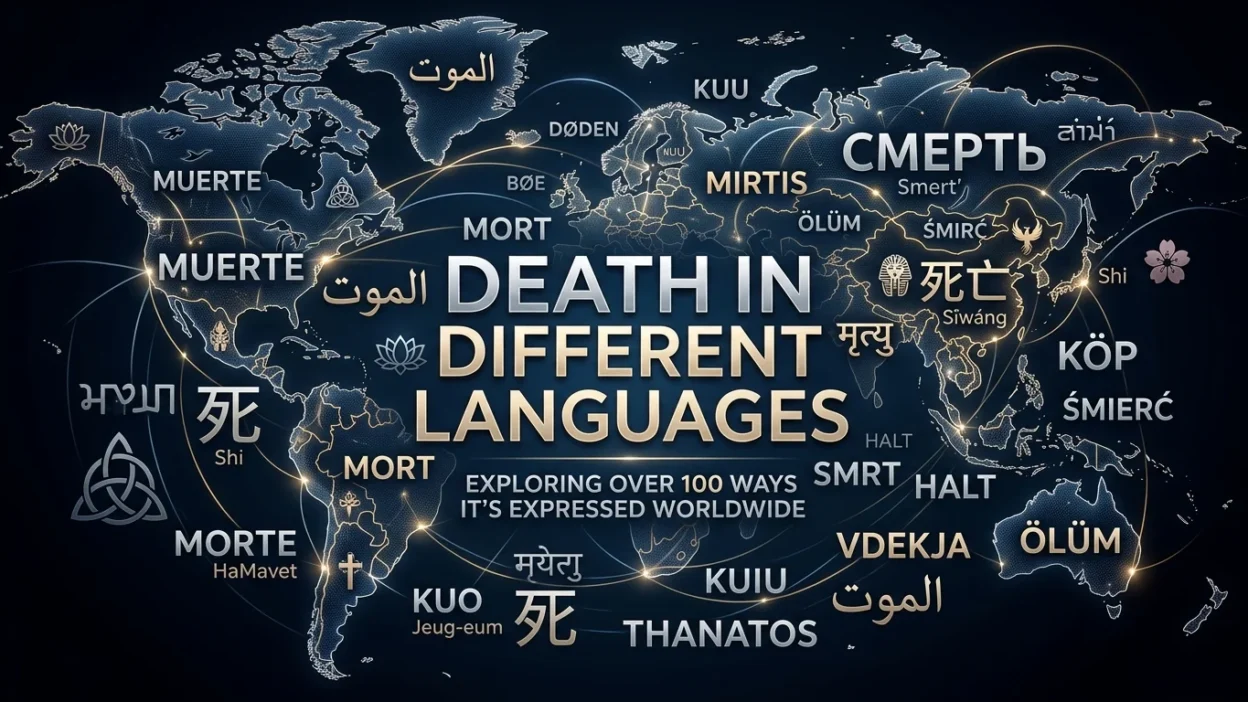
Death is one of the most universal human experiences, and every culture has its own unique word and expression for it. Learning how to say “death” in different languages helps people understand global cultures, literature, history, religion, movies, and everyday communication.
In this guide, you will discover translations of the word “death” around the world, along with pronunciation tips and simple real life examples. Whether you are studying languages, writing creatively, traveling, or researching cultural vocabulary, this article gives you a quick and easy reference for death in all languages.
Death in Different Languages
| Language | Pronunciation | Example |
| English | deth | Death is a natural part of life. (Meaning: Death happens to every living being.) |
| Spanish | mwair-teh | La muerte es inevitable. (Meaning: Death is unavoidable.) |
| French | la mor | La mort fait partie de la vie. (Meaning: Death is part of life.) |
| German | toht | Der Tod kommt für alle. (Meaning: Death comes for everyone.) |
| Italian | mor-teh | La morte spaventa molte persone. (Meaning: Death frightens many people.) |
| Portuguese | mor-chee | A morte é silenciosa. (Meaning: Death is silent.) |
| Dutch | doht | De dood is onvermijdelijk. (Meaning: Death is unavoidable.) |
| Russian | smyert | Смерть приходит внезапно. (Meaning: Death comes suddenly.) |
| Ukrainian | smerht | Смерть є частиною життя. (Meaning: Death is part of life.) |
| Polish | shmyehrch | Śmierć jest tajemnicą. (Meaning: Death is a mystery.) |
| Czech | smrht | Smrt je přirozená. (Meaning: Death is natural.) |
| Slovak | smrt | Smrť prichádza ku každému. (Meaning: Death comes to everyone.) |
| Croatian | smrt | Smrt je neizbježna. (Meaning: Death is inevitable.) |
| Serbian | smrt | Smrt plaši ljude. (Meaning: Death scares people.) |
| Slovenian | smrt | Smrt je del življenja. (Meaning: Death is part of life.) |
| Bosnian | smrt | Smrt dolazi svima. (Meaning: Death comes to all.) |
| Bulgarian | smart | Смъртта е тъжна. (Meaning: Death is sad.) |
| Romanian | moar-teh | Moartea schimbă vieți. (Meaning: Death changes lives.) |
| Greek | tha-na-tos | Ο θάνατος είναι αναπόφευκτος. (Meaning: Death is unavoidable.) |
| Turkish | oo-lum | Ölüm hayatın gerçeğidir. (Meaning: Death is the reality of life.) |
| Arabic | mawt | الموت حقيقة. (Meaning: Death is truth.) |
| Hebrew | ma-vet | המוות מגיע לכולם. (Meaning: Death reaches everyone.) |
| Persian | marg | مرگ بخشی از زندگی است. (Meaning: Death is part of life.) |
| Urdu | maut | موت ایک حقیقت ہے۔ (Meaning: Death is a reality.) |
| Hindi | mrityu | मृत्यु जीवन का हिस्सा है। (Meaning: Death is part of life.) |
| Bengali | mrittu | মৃত্যু অনিবার্য। (Meaning: Death is inevitable.) |
| Punjabi | maut | ਮੌਤ ਸੱਚ ਹੈ। (Meaning: Death is truth.) |
| Gujarati | mrutyu | મૃત્યુ બધાને આવે છે। (Meaning: Death comes to everyone.) |
| Marathi | mrityu | मृत्यू अटळ आहे। (Meaning: Death is unavoidable.) |
| Tamil | ma-ra-nam | மரணம் வாழ்க்கையின் பகுதி. (Meaning: Death is part of life.) |
| Telugu | ma-ra-nam | మరణం సహజం. (Meaning: Death is natural.) |
| Kannada | ma-ra-na | ಮರಣ ಜೀವನದ ಸತ್ಯ. (Meaning: Death is the truth of life.) |
| Malayalam | ma-ra-nam | മരണം അനിവാര്യമാണ്. (Meaning: Death is inevitable.) |
| Sinhala | ma-ra-na-ya | මරණය ස්වාභාවිකය. (Meaning: Death is natural.) |
| Nepali | mri-tyu | मृत्यु सत्य हो। (Meaning: Death is truth.) |
| Sanskrit | mri-tyu | मृत्यु अनिवार्यः। (Meaning: Death is unavoidable.) |
| Chinese (Mandarin) | si-wang | 死亡是生命的一部分。 (Meaning: Death is part of life.) |
| Cantonese | sei-mong | 死亡無法避免。 (Meaning: Death cannot be avoided.) |
| Japanese | shi | 死は自然なことです。 (Meaning: Death is natural.) |
| Korean | ju-geum | 죽음은 피할 수 없다. (Meaning: Death cannot be escaped.) |
| Vietnamese | cai chet | Cái chết là điều tự nhiên. (Meaning: Death is natural.) |
| Thai | kwaam tai | ความตายเป็นเรื่องจริง. (Meaning: Death is real.) |
| Indonesian | ke-ma-ti-an | Kematian datang kepada semua orang. (Meaning: Death comes to everyone.) |
| Malay | ke-ma-ti-an | Kematian adalah sebahagian hidup. (Meaning: Death is part of life.) |
| Filipino | ka-ma-ta-yan | Ang kamatayan ay hindi maiiwasan. (Meaning: Death is unavoidable.) |
| Swahili | ki-fo | Kifo ni sehemu ya maisha. (Meaning: Death is part of life.) |
| Zulu | uku-fa | Ukufa kuza kubo bonke. (Meaning: Death comes to everyone.) |
| Afrikaans | dohdt | Die dood is onvermydelik. (Meaning: Death is inevitable.) |
| Somali | dhimasho | Geeridu waa xaqiiqo. (Meaning: Death is reality.) |
| Amharic | mot | ሞት እውነት ነው። (Meaning: Death is truth.) |
| Hausa | mutuwa | Mutuwa tana zuwa ga kowa. (Meaning: Death comes to everyone.) |
| Yoruba | iku | Iku jẹ apakan igbesi aye. (Meaning: Death is part of life.) |
| Igbo | onwu | Ọnwụ bụ eziokwu. (Meaning: Death is truth.) |
| Latin | mors | Mors omnibus venit. (Meaning: Death comes to all.) |
| Esperanto | mor-to | Morto estas natura. (Meaning: Death is natural.) |
| Finnish | kuo-le-ma | Kuolema kuuluu elämään. (Meaning: Death belongs to life.) |
| Swedish | dohd | Döden är oundviklig. (Meaning: Death is unavoidable.) |
| Norwegian | doh-den | Døden kommer til alle. (Meaning: Death comes to everyone.) |
| Danish | doh-den | Døden er naturlig. (Meaning: Death is natural.) |
| Icelandic | dau-di | Dauðinn er hluti lífsins. (Meaning: Death is part of life.) |
| Hungarian | ha-lal | A halál elkerülhetetlen. (Meaning: Death is unavoidable.) |
| Finnish | kuo-le-ma | Kuolema on osa elämää. (Meaning: Death is part of life.) |
| Estonian | surm | Surm tuleb kõigile. (Meaning: Death comes to everyone.) |
| Lithuanian | mir-tis | Mirtis yra natūrali. (Meaning: Death is natural.) |
| Latvian | nave | Nāve ir neizbēgama. (Meaning: Death is unavoidable.) |
| Albanian | vdekje | Vdekja është pjesë e jetës. (Meaning: Death is part of life.) |
| Georgian | si-kvdi-li | სიკვდილი ბუნებრივია. (Meaning: Death is natural.) |
| Armenian | mah | Մահը կյանքի մասն է։ (Meaning: Death is part of life.) |
| Mongolian | uh-el | Үхэл бол үнэн. (Meaning: Death is truth.) |
| Kazakh | olim | Өлім өмірдің бөлігі. (Meaning: Death is part of life.) |
| Uzbek | o’lim | O’lim hayotning bir qismi. (Meaning: Death is part of life.) |
| Azerbaijani | olum | Ölüm qaçılmazdır. (Meaning: Death is unavoidable.) |
| Kurdish | mirin | Mirin rastiyek e. (Meaning: Death is reality.) |
How to Say Death in Different Languages
People often search for how to say death in different languages for educational, cultural, literary, and translation purposes. The word changes greatly depending on region, pronunciation, and writing system. Some languages use ancient roots connected to spirituality, while others use direct and simple expressions.
Understanding death translations can also improve language learning and communication when reading books, watching movies, studying religion, or exploring world history.
Death Around the World and Cultural Meaning
Different cultures describe death in unique ways. In some societies, the word is spoken very directly, while in others softer expressions are preferred.
For example:
- In Japanese culture, death-related words are sometimes avoided in formal situations.
- In Latin, the word “mors” appears in many classical writings.
- Arabic and Persian literature often connect death with philosophy and destiny.
- European languages such as Spanish, French, and Italian share similar roots because of Latin influence.
These variations make death in all languages an interesting topic for students, travelers, translators, and writers.
Why People Search for Death Translations
Many users look for death translations online because they want to:
- Learn vocabulary in multiple languages
- Create multilingual tattoos or artwork
- Write stories, poems, or songs
- Understand international movies and books
- Study cultural beliefs around the world
- Improve language learning skills
Learning how different countries express death can also help people understand emotions and traditions across cultures.
Common Related Words for Death in Different Languages
Along with the main word, many languages also have related expressions connected to death around the world, such as:
- Afterlife
- Funeral
- Grave
- Soul
- Spirit
- Loss
- Mourning
- Rebirth
These words often carry deep cultural and emotional meaning.
Conclusion
Learning about death in different languages helps people explore cultures, communication styles, and global traditions. From European and Asian languages to African and Middle Eastern expressions, every translation reflects unique cultural history and human experience. This collection of languages gives a useful reference for students, travelers, writers, and language enthusiasts worldwide.
FAQs
1. How do you say death in all languages?
The word for death changes across languages and cultures. Examples include “muerte” in Spanish, “mort” in French, “shi” in Japanese, and “maut” in Urdu.
2. What is the most common translation of death around the world?
Many European languages use words derived from Latin roots, while Asian and Middle Eastern languages have their own distinct terms for death.
3. Why do people search for death in different languages?
People search for death translations for education, language learning, creative writing, cultural research, and international communication.
4. Is the pronunciation of death difficult in foreign languages?
Most translations are easy to learn with pronunciation guides. Languages like Japanese, Spanish, and Italian often have simple pronunciation patterns.
5. Which language has the shortest word for death?
Japanese uses the very short word “shi,” while several other languages also use compact terms for death.

Ely Joseph is a language researcher, writer, and contributor who specializes in words, meanings, and multilingual communication. With a strong interest in how language shapes understanding across cultures, Ely focuses on creating clear, accurate, and reader-friendly content for a global audience.