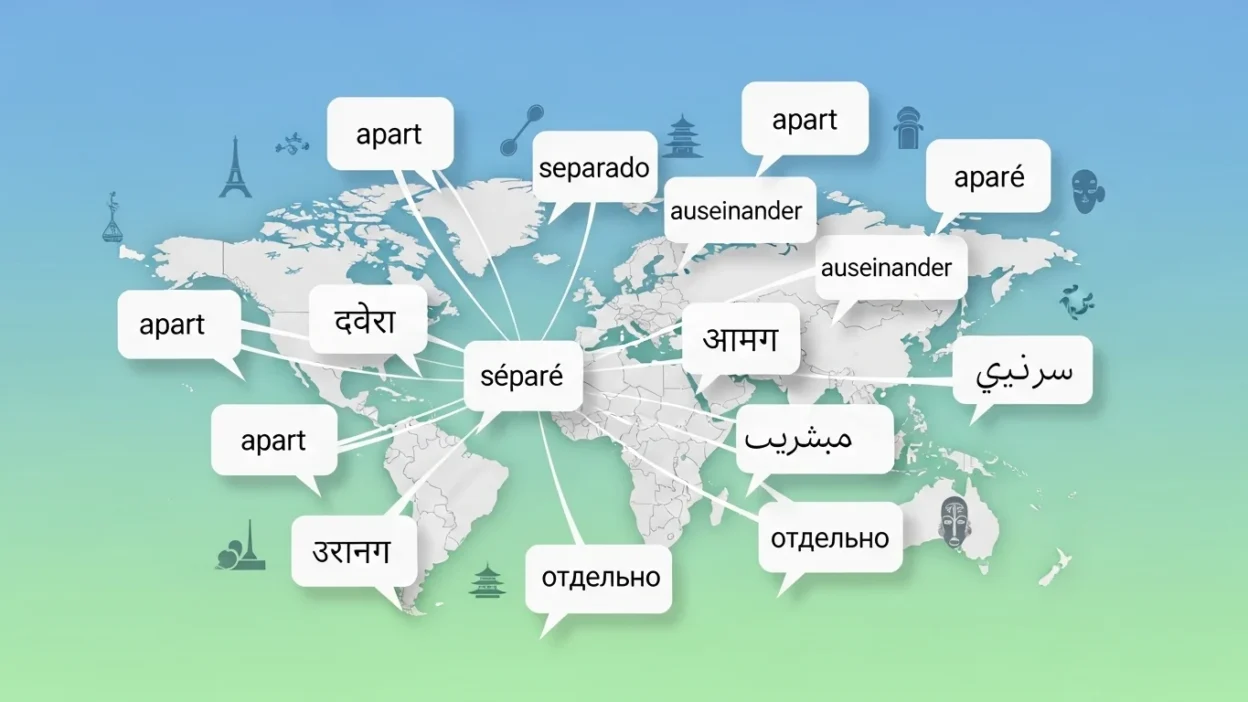
Understanding how to express “100+ apart in different languages” helps you communicate distance, separation, and distinction across cultures.
Whether you’re learning a new language, traveling, or expanding your vocabulary, knowing how to say “apart” in multiple languages is incredibly useful.
In this guide, you’ll discover how to say “apart” in different languages, along with pronunciation and real life example sentences.
This makes it easier to grasp not just the word, but how it’s naturally used in daily conversation.
100+ Apart in All Languages
| Language | Pronunciation | Example |
| English | uh-part | We live miles apart. (We live far from each other.) |
| Spanish | ah-part-eh | Vivimos aparte. (We live separately.) |
| French | ah-par | Nous vivons à part. (We live apart.) |
| German | ap-art | Wir leben getrennt. (We live apart.) |
| Italian | ah-par-teh | Viviamo separati. (We live apart.) |
| Portuguese | a-par-chee | Vivemos separados. (We live apart.) |
| Dutch | ap-art | We wonen apart. (We live apart.) |
| Russian | ot-del-no | Мы живем отдельно. (We live separately.) |
| Chinese (Mandarin) | fēn kāi | 我们分开住。 (We live apart.) |
| Japanese | betsu betsu | 私たちは別々に住んでいます。 (We live separately.) |
| Korean | ttaro | 우리는 따로 산다. (We live apart.) |
| Arabic | munfaṣil | نحن نعيش منفصلين. (We live separately.) |
| Hindi | alag | हम अलग रहते हैं। (We live apart.) |
| Urdu | alag | ہم الگ رہتے ہیں۔ (We live apart.) |
| Bengali | alada | আমরা আলাদা থাকি। (We live apart.) |
| Turkish | ay-ri | Ayrı yaşıyoruz. (We live apart.) |
| Greek | ho-ree-sta | Ζούμε χωριστά. (We live separately.) |
| Polish | odd-ziel-nye | Żyjemy oddzielnie. (We live separately.) |
| Swedish | isär | Vi bor isär. (We live apart.) |
| Norwegian | i-sær | Vi bor i sær. (We live apart.) |
| Danish | i-sær | Vi bor i sær. (We live apart.) |
| Finnish | erillään | Asumme erillään. (We live apart.) |
| Czech | od-dye-le-nye | Žijeme odděleně. (We live separately.) |
| Slovak | od-de-le-ne | Žijeme oddelene. (We live apart.) |
| Hungarian | kü-lön | Külön élünk. (We live apart.) |
| Romanian | se-pa-rat | Trăim separat. (We live apart.) |
| Bulgarian | ot-del-no | Живеем отделно. (We live apart.) |
| Croatian | od-vo-je-no | Živimo odvojeno. (We live apart.) |
| Serbian | od-vo-je-no | Živimo odvojeno. (We live apart.) |
| Slovenian | lo-che-no | Živimo ločeno. (We live apart.) |
| Ukrainian | ok-re-mo | Ми живемо окремо. (We live apart.) |
| Hebrew | muf-rad | אנחנו חיים בנפרד. (We live separately.) |
| Persian | joda | ما جدا زندگی میکنیم. (We live apart.) |
| Thai | yaek | เราอยู่แยกกัน (We live apart.) |
| Vietnamese | tach rieng | Chúng tôi sống tách riêng. (We live apart.) |
| Indonesian | ter-pi-sah | Kami hidup terpisah. (We live apart.) |
| Malay | ter-pi-sah | Kami hidup terpisah. (We live apart.) |
| Filipino | hi-walay | Nakatira kami hiwalay. (We live apart.) |
| Swahili | to-fa-u-ti | Tunaishi tofauti. (We live apart.) |
| Zulu | hla-ka-na | Sihlala ngokwehlukana. (We live apart.) |
| Afrikaans | a-par-te | Ons leef apart. (We live apart.) |
| Icelandic | i sund-ur | Við búum í sundur. (We live apart.) |
| Latvian | at-se-vish-ki | Mēs dzīvojam atsevišķi. (We live apart.) |
| Lithuanian | at-ski-rai | Mes gyvename atskirai. (We live apart.) |
| Estonian | eral-di | Me elame eraldi. (We live apart.) |
| Albanian | ve-ça-mas | Jetojmë veçmas. (We live apart.) |
| Macedonian | od-del-no | Живееме одделно. (We live apart.) |
| Armenian | ar-and-zin | Մենք ապրում ենք առանձին։ (We live apart.) |
| Georgian | ga-mo-kve-ta | ჩვენ ცალკე ვცხოვრობთ. (We live apart.) |
| Mongolian | tus-daa | Бид тусдаа амьдардаг. (We live apart.) |
| Nepali | alag | हामी अलग बस्छौं। (We live apart.) |
| Sinhala | ven-ven | අපි වෙන වෙන ජීවත් වෙමු. (We live apart.) |
| Khmer | dae-khnea | យើងរស់នៅដាច់ពីគ្នា។ (We live apart.) |
| Lao | yaek | ພວກເຮົາຢູ່ແຍກກັນ. (We live apart.) |
| Burmese | kweh | ကျွန်ုပ်တို့ သီးခြားနေကြသည်။ (We live apart.) |
| Amharic | te-le-ya-ye | እኛ ተለያይተን እንኖራለን። (We live apart.) |
| Somali | go-ni | Waxaan ku nool nahay gooni. (We live apart.) |
| Hausa | ra-ba | Muna rayuwa raba. (We live apart.) |
| Yoruba | ya-to | A n gbe yato. (We live apart.) |
| Igbo | i-che | Anyị bi iche. (We live apart.) |
| Malagasy | mi-sa-ra-ka | Mipetraka misaraka izahay. (We live apart.) |
| Maori | wehe | Kei te noho wehe matou. (We live apart.) |
| Samoan | va-e-se | Matou te nonofo vaese. (We live apart.) |
| Hawaiian | ka-a-wa-le | Noho kaʻawale mākou. (We live apart.) |
| Basque | be-re-zi | Bananduta bizi gara. (We live apart.) |
| Catalan | a-part | Vivim a part. (We live apart.) |
| Galician | a-par-te | Vivimos aparte. (We live apart.) |
| Luxembourgish | ge-trennt | Mir liewen getrennt. (We live apart.) |
How to Say “Apart” in Different Languages
The word “apart” usually expresses separation, distance, or distinction. Across languages, it is commonly translated into words meaning “separate,” “divided,” or “independent.”
For example:
- In European languages, it often relates to “separate living.”
- In Asian languages, it emphasizes physical or emotional distance.
- In African languages, it can also imply individuality or distinction.
This makes learning “apart in all languages” useful for both conversation and cultural understanding.
Why Learn “Apart” Translations?
Learning “100+ apart in different languages” is helpful because:
- It improves communication when traveling
- It helps in understanding relationships and context
- It builds stronger language skills
- It enhances cultural awareness
Even a simple word like “apart” can carry deep meaning depending on context.
Common Uses of “Apart” Around the World
You’ll often see “apart” used in phrases like:
- Living apart
- Standing apart from others
- Taking something apart
- Emotional distance
Each language adapts the meaning slightly, which is why “apart translations” are so interesting to explore.
Conclusion
Learning how to say “apart” in different languages opens the door to better communication and deeper cultural insight. From Europe to Asia and beyond, the idea of separation is expressed in unique and meaningful ways. Expanding your vocabulary with global translations helps you connect more effectively across languages.
FAQs
1. What does “apart” mean in different languages?
It generally means separated, divided, or not together, though usage varies by language.
2. How do you say “apart” in the most common languages?
In Spanish it’s “aparte,” in French “à part,” and in German “getrennt.”
3. Why are there different meanings of “apart”?
Because languages reflect cultural context, the word can imply physical, emotional, or conceptual separation.
4. Is “apart” used the same way everywhere?
Not exactly. Some languages emphasize distance, while others focus on independence or separation.
5. What is the easiest way to learn “apart” in all languages?
Using tables, examples, and real life sentences makes it easier to remember and apply.

Marak Robort is a content writer and researcher with a strong interest in language, meanings, and digital information. His work focuses on presenting clear, easy-to-understand explanations that help readers quickly grasp complex ideas.