Understanding how to express love and deep admiration across cultures is both fascinating and meaningful.
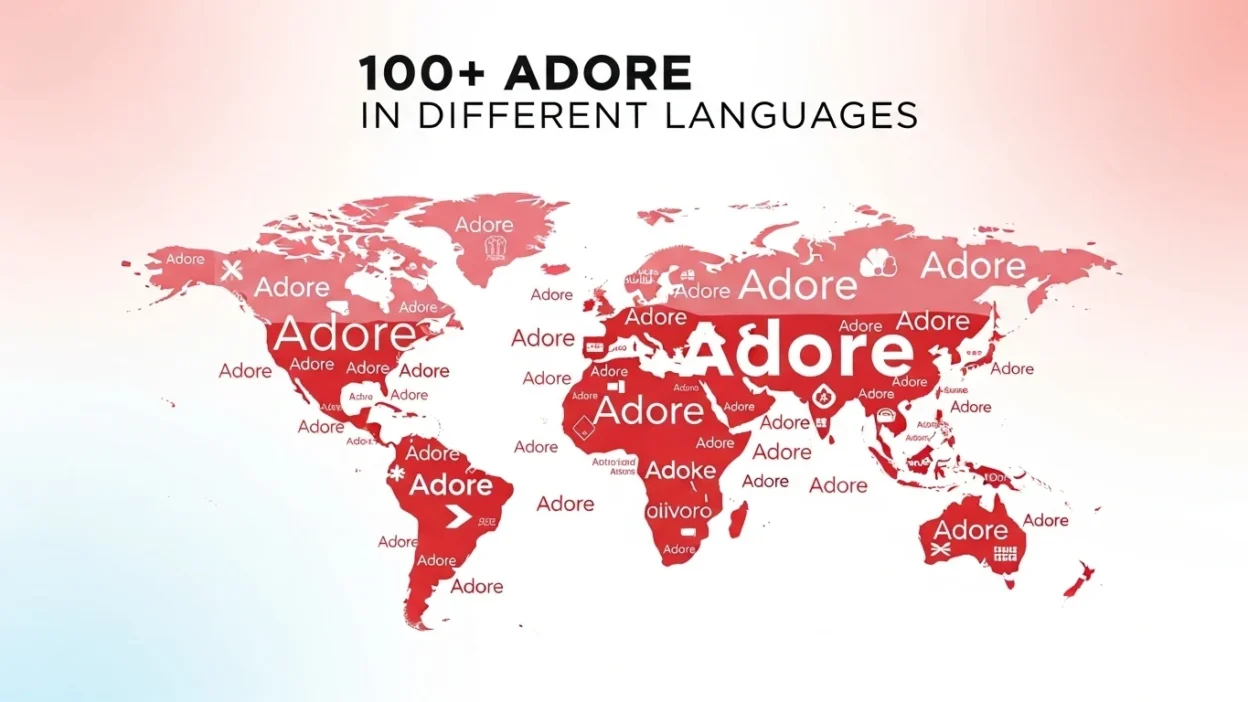
If you’ve ever searched for “100+ adore in different languages” or wondered how to say “adore” in different languages, this guide is exactly what you need.
In this article, you’ll discover how the word “adore” is translated around the world, along with pronunciation and real-life examples.
Whether you’re learning a new language, writing romantic messages, or simply exploring global expressions, these “adore translations” will help you connect more deeply.
Adore in All Languages
| Language | Pronunciation | Example |
| English | uh-dor | I adore you so much. (I love you deeply.) |
| Spanish | ah-doh-rar | Te adoro con todo mi corazón. (I adore you with all my heart.) |
| French | ah-dor | Je t’adore énormément. (I adore you very much.) |
| German | ah-doh-ren | Ich verehre dich. (I adore you.) |
| Italian | ah-doh-rah-reh | Ti adoro tanto. (I adore you so much.) |
| Portuguese | ah-doh-rahr | Eu te adoro muito. (I adore you a lot.) |
| Dutch | ah-doh-reh-ren | Ik aanbid jou. (I adore you.) |
| Russian | ah-bah-zhat | Я обожаю тебя. (I adore you.) |
| Polish | oo-bee-yam | Uwielbiam cię. (I adore you.) |
| Turkish | ah-doh-reh et-mek | Sana bayılıyorum. (I adore you.) |
| Arabic | u-heeb | أنا أعشقك. (I adore you.) |
| Hindi | ah-door kar-na | मैं तुमसे बहुत प्यार करता हूँ। (I adore you.) |
| Urdu | ah-doh-ray kar-na | میں تمہیں بہت چاہتا ہوں۔ (I adore you.) |
| Bengali | bhalobashi | আমি তোমায় খুব ভালোবাসি। (I adore you.) |
| Punjabi | pyar kar-na | ਮੈਂ ਤੈਨੂੰ ਬਹੁਤ ਪਿਆਰ ਕਰਦਾ ਹਾਂ। (I adore you.) |
| Japanese | ai-su-ru | あなたを愛しています。 (I adore you.) |
| Korean | sa-rang-hae | 나는 너를 사랑해. (I adore you.) |
| Chinese (Mandarin) | ai ni | 我爱你。 (I adore you.) |
| Thai | rak khun | ฉันรักคุณมาก. (I adore you.) |
| Vietnamese | yeu | Tôi yêu bạn. (I adore you.) |
| Indonesian | ah-dohr | Aku sangat mencintaimu. (I adore you.) |
| Malay | ah-dohr | Saya sangat sayang kamu. (I adore you.) |
| Filipino | ma-hal | Mahal kita. (I adore you.) |
| Greek | ah-ga-po | Σε λατρεύω. (I adore you.) |
| Swedish | ah-doh-ra | Jag älskar dig. (I adore you.) |
| Norwegian | el-sker | Jeg elsker deg. (I adore you.) |
| Danish | el-sker | Jeg elsker dig. (I adore you.) |
| Finnish | ah-do-roi-da | Minä rakastan sinua. (I adore you.) |
| Hungarian | ah-doh-ral-ni | Imádlak. (I adore you.) |
| Czech | zboz-nyu-ji | Zbožňuji tě. (I adore you.) |
| Slovak | zboz-nyu-yem | Zbožňujem ťa. (I adore you.) |
| Romanian | ah-doh-ra | Te ador. (I adore you.) |
| Bulgarian | ah-doh-ram | Обожавам те. (I adore you.) |
| Serbian | ah-doh-ram | Обожавам те. (I adore you.) |
| Croatian | ah-doh-ram | Obožavam te. (I adore you.) |
| Ukrainian | obo-zha-yu | Я обожнюю тебе. (I adore you.) |
| Hebrew | oh-hev | אני מעריץ אותך. (I adore you.) |
| Persian | doost daram | من تو را دوست دارم. (I adore you.) |
| Swahili | na-ku-pen-da | Ninakuabudu. (I adore you.) |
| Zulu | n-gya-ku-than-da | Ngiyakuthanda kakhulu. (I adore you.) |
| Afrikaans | ah-doh-reer | Ek aanbid jou. (I adore you.) |
| Icelandic | ah-doh-ra | Ég dýrka þig. (I adore you.) |
| Irish | ah-dor-aim | Is aoibhinn liom tú. (I adore you.) |
| Welsh | ah-dor-ya | Rwy’n dy addoli. (I adore you.) |
| Albanian | ah-doh-roj | Të adhuroj. (I adore you.) |
| Macedonian | ah-doh-ram | Те обожавам. (I adore you.) |
| Slovenian | obo-zha-vam | Obožujem te. (I adore you.) |
| Estonian | ar-mas-tan | Ma jumaldan sind. (I adore you.) |
| Latvian | mee-loo | Es tevi dievinu. (I adore you.) |
| Lithuanian | die-vi-nu | Aš tave dievinu. (I adore you.) |
| Maltese | ah-doh-ra | Inħobbok ħafna. (I adore you.) |
| Basque | ah-doh-ra-tzen | Maite zaitut. (I adore you.) |
| Galician | ah-doh-ro | Adórote moito. (I adore you.) |
| Catalan | ah-doh-ro | T’adoro molt. (I adore you.) |
| Armenian | ah-doh-rum | Ես քեզ պաշտում եմ։ (I adore you.) |
| Georgian | mi-khar-khar | მე შენ მიყვარხარ. (I adore you.) |
| Khmer | sralanh | ខ្ញុំស្រលាញ់អ្នក. (I adore you.) |
| Lao | hak | ຂ້ອຍຮັກເຈົ້າ. (I adore you.) |
| Burmese | chit | ငါမင်းကိုချစ်တယ်. (I adore you.) |
| Nepali | maya garchu | म तिमीलाई माया गर्छु। (I adore you.) |
| Sinhala | adarei | මම ඔයාට ආදරෙයි. (I adore you.) |
| Tamil | kathal | நான் உன்னை காதலிக்கிறேன். (I adore you.) |
| Telugu | preminchu | నేను నిన్ను ప్రేమిస్తున్నాను. (I adore you.) |
| Kannada | preeti | ನಾನು ನಿನ್ನ ಪ್ರೀತಿಸುತ್ತೇನೆ. (I adore you.) |
| Marathi | prem karto | मी तुला प्रेम करतो. (I adore you.) |
| Gujarati | prem karu | હું તને પ્રેમ કરું છું. (I adore you.) |
| Uzbek | sevaman | Men seni sevaman. (I adore you.) |
| Kazakh | zhaksy korem | Мен сені жақсы көремін. (I adore you.) |
| Mongolian | khairtai | Би чамд хайртай. (I adore you.) |
How to Say “Adore” in Different Languages
Learning how to say “adore” in different languages helps you express deep affection in culturally meaningful ways. While the literal translation may differ, the emotional depth remains universal.
Some languages use direct equivalents of “adore,” while others rely on phrases that mean “love deeply” or “cherish.” This variety shows how rich and diverse human expression can be.
Why Learning “Adore” Translations Matters
Knowing “adore in all languages” is more than just vocabulary it’s a way to connect globally. Whether you’re traveling, writing messages, or building relationships, these translations help you communicate emotions more effectively.
It also adds cultural awareness, making your communication more respectful and impactful.
Adore Around the World: Cultural Insights
Across cultures, expressing admiration and love carries unique tones:
- In European languages, “adore” often reflects romance and devotion
- In Asian languages, expressions may sound more formal or poetic
- In Middle Eastern cultures, words for “adore” can carry spiritual depth
These differences make learning “adore around the world” both educational and emotionally enriching.
Conclusion
Exploring “100+ adore in different languages” opens a window into how people express deep affection globally. From simple phrases to culturally rich expressions, every language offers a unique way to say “I adore you.”
Use these translations to connect, impress, and communicate your feelings more meaningfully no matter where you are in the world.
FAQs
1. What does “adore” mean in different languages?
“Adore” generally means to love deeply, admire greatly, or cherish someone. In different languages, it may translate as “love,” “worship,” or “deep affection.”
2. How do you say “I adore you” in many languages?
You can say it as “Te adoro” (Spanish), “Je t’adore” (French), “Ti adoro” (Italian), and many more listed in the table above.
3. Is “adore” the same as “love” in all languages?
Not always. Some languages distinguish between casual love and deep admiration, while others use one word for both.
4. Why learn “adore translations”?
It helps improve communication, cultural understanding, and emotional expression when interacting with people worldwide.
5. Which language has the most romantic way to say “adore”?
Languages like French, Italian, and Spanish are often considered romantic due to their tone and cultural context.