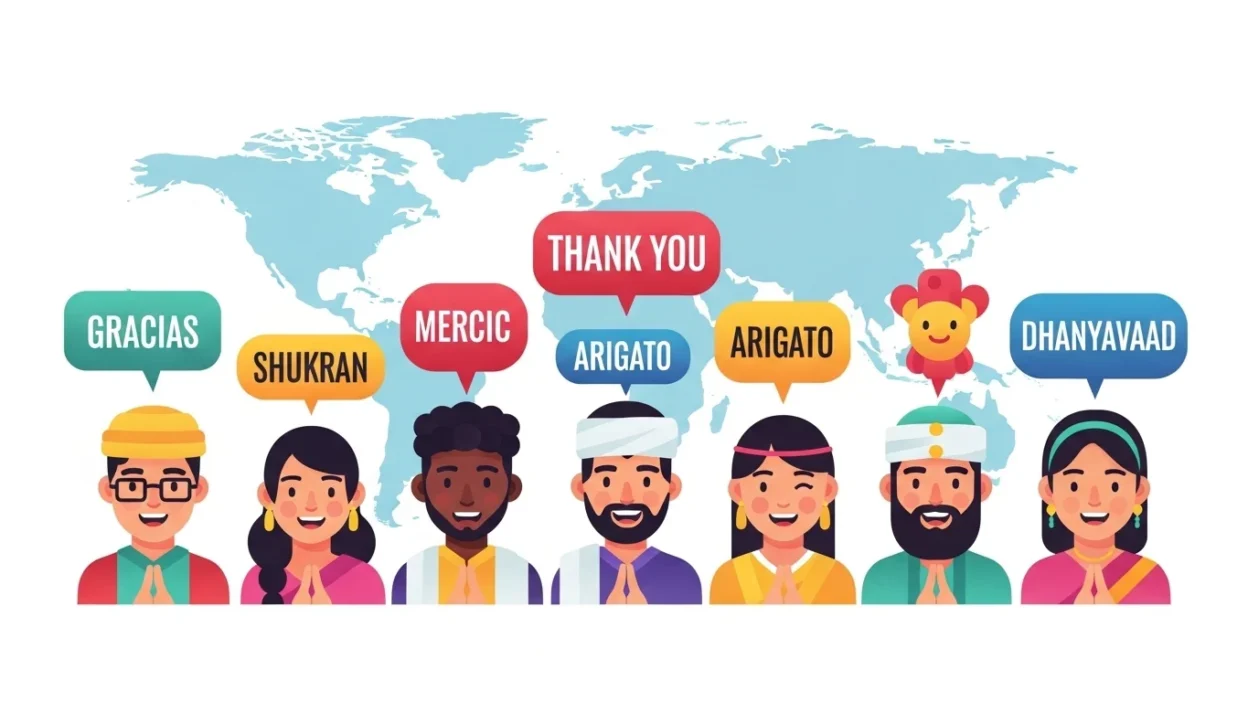
Gratitude is a universal language that connects people across cultures. Whether you’re traveling, learning a new language, or simply want to be more culturally aware, knowing how to say “thank you” can leave a lasting impression.
In this guide, you’ll discover 100+ thank you in different languages, with real-life examples to help you use them naturally in conversation.
Thank You in All Languages
| Language | Pronunciation | Example |
| English | Thank you | Thank you for your help. (Meaning: I appreciate your help.) |
| Spanish | Gracias | Gracias por tu ayuda. (Meaning: Thank you for your help.) |
| French | Merci | Merci pour ton aide. (Meaning: Thank you for your help.) |
| German | Danke | Danke für deine Hilfe. (Meaning: Thank you for your help.) |
| Italian | Grazie | Grazie per il tuo aiuto. (Meaning: Thank you for your help.) |
| Portuguese | Obrigado/Obrigada | Obrigado pela ajuda. (Meaning: Thank you for your help.) |
| Dutch | Dank je | Dank je voor je hulp. (Meaning: Thank you for your help.) |
| Russian | Spasibo | Spasibo za pomoshch. (Meaning: Thank you for your help.) |
| Chinese (Mandarin) | Xie xie | Xie xie ni de bangzhu. (Meaning: Thank you for your help.) |
| Japanese | Arigatou | Arigatou gozaimasu. (Meaning: Thank you very much.) |
| Korean | Gamsahamnida | Gamsahamnida for your help. (Meaning: Thank you for your help.) |
| Arabic | Shukran | Shukran lak. (Meaning: Thank you.) |
| Hindi | Dhanyavaad | Dhanyavaad aapki madad ke liye. (Meaning: Thank you for your help.) |
| Urdu | Shukriya | Shukriya aap ki madad ke liye. (Meaning: Thank you for your help.) |
| Turkish | Tesekkür ederim | Tesekkür ederim for your help. (Meaning: Thank you for your help.) |
| Greek | Efharisto | Efharisto poli. (Meaning: Thank you very much.) |
| Polish | Dziekuje | Dziekuje za pomoc. (Meaning: Thank you for your help.) |
| Swedish | Tack | Tack for hjälpen. (Meaning: Thank you for the help.) |
| Norwegian | Takk | Takk for hjelpen. (Meaning: Thank you for the help.) |
| Danish | Tak | Tak for hjælpen. (Meaning: Thank you for the help.) |
| Finnish | Kiitos | Kiitos avusta. (Meaning: Thank you for the help.) |
| Czech | Dekuji | Dekuji za pomoc. (Meaning: Thank you for the help.) |
| Slovak | Dakujem | Dakujem za pomoc. (Meaning: Thank you for the help.) |
| Hungarian | Koszonom | Koszonom a segitseget. (Meaning: Thank you for the help.) |
| Romanian | Multumesc | Multumesc pentru ajutor. (Meaning: Thank you for the help.) |
| Bulgarian | Blagodarya | Blagodarya za pomosht. (Meaning: Thank you for the help.) |
| Croatian | Hvala | Hvala za pomoc. (Meaning: Thank you for the help.) |
| Serbian | Hvala | Hvala za pomoc. (Meaning: Thank you for the help.) |
| Slovenian | Hvala | Hvala za pomoc. (Meaning: Thank you for the help.) |
| Ukrainian | Diakuyu | Diakuyu za dopomohu. (Meaning: Thank you for the help.) |
| Hebrew | Toda | Toda raba. (Meaning: Thank you very much.) |
| Persian | Mamnoon | Mamnoon az komaket. (Meaning: Thank you for your help.) |
| Thai | Khob khun | Khob khun mak. (Meaning: Thank you very much.) |
| Vietnamese | Cam on | Cam on ban. (Meaning: Thank you.) |
| Indonesian | Terima kasih | Terima kasih banyak. (Meaning: Thank you very much.) |
| Malay | Terima kasih | Terima kasih atas bantuan. (Meaning: Thank you for your help.) |
| Filipino | Salamat | Salamat po. (Meaning: Thank you.) |
| Swahili | Asante | Asante sana. (Meaning: Thank you very much.) |
| Zulu | Ngiyabonga | Ngiyabonga kakhulu. (Meaning: Thank you very much.) |
| Afrikaans | Dankie | Dankie vir jou hulp. (Meaning: Thank you for your help.) |
| Amharic | Ameseginalehu | Ameseginalehu. (Meaning: Thank you.) |
| Somali | Mahadsanid | Mahadsanid. (Meaning: Thank you.) |
| Hausa | Na gode | Na gode sosai. (Meaning: Thank you very much.) |
| Yoruba | E se | E se pupo. (Meaning: Thank you very much.) |
| Igbo | Daalụ | Daalụ nke ukwuu. (Meaning: Thank you very much.) |
| Malagasy | Misaotra | Misaotra betsaka. (Meaning: Thank you very much.) |
| Icelandic | Takk | Takk fyrir hjálpina. (Meaning: Thank you for the help.) |
| Estonian | Aitäh | Aitäh abi eest. (Meaning: Thank you for the help.) |
| Latvian | Paldies | Paldies par palīdzību. (Meaning: Thank you for the help.) |
| Lithuanian | Aciu | Aciu už pagalbą. (Meaning: Thank you for the help.) |
| Albanian | Faleminderit | Faleminderit për ndihmën. (Meaning: Thank you for the help.) |
| Macedonian | Blagodaram | Blagodaram za pomoshta. (Meaning: Thank you for the help.) |
| Georgian | Madloba | Madloba. (Meaning: Thank you.) |
| Armenian | Shnorhakalutyun | Shnorhakalutyun. (Meaning: Thank you.) |
| Nepali | Dhanyabad | Dhanyabad tapaiko sahayog ko lagi. (Meaning: Thank you for your help.) |
| Sinhala | Istuti | Istuti. (Meaning: Thank you.) |
| Burmese | Ce zu tin ba de | Ce zu tin ba de. (Meaning: Thank you.) |
| Khmer | Orkun | Orkun chran. (Meaning: Thank you very much.) |
| Lao | Khop chai | Khop chai lai lai. (Meaning: Thank you very much.) |
| Mongolian | Bayarlalaa | Bayarlalaa. (Meaning: Thank you.) |
| Kazakh | Rakhmet | Rakhmet sizge. (Meaning: Thank you.) |
| Uzbek | Rahmat | Rahmat katta. (Meaning: Thank you very much.) |
| Tajik | Tashakkur | Tashakkur. (Meaning: Thank you.) |
| Pashto | Manana | Manana staaso na. (Meaning: Thank you.) |
| Kurdish | Spas | Spas dikim. (Meaning: Thank you.) |
| Maori | Kia ora | Kia ora for your help. (Meaning: Thank you for your help.) |
| Hawaiian | Mahalo | Mahalo nui loa. (Meaning: Thank you very much.) |
Why Learning “Thank You” in Different Languages Matters
Knowing thank you in all languages shows respect, builds trust, and creates positive connections. Even a simple word can make interactions more meaningful, especially when traveling or communicating internationally.
It also enhances cultural awareness and helps you stand out as polite and thoughtful in any situation.
How to Say Thank You in Different Languages Easily
If you want to remember these phrases:
- Start with the most common languages you encounter
- Practice pronunciation out loud
- Use them in real conversations or daily life
- Group similar-sounding languages together
Consistency is key when learning thank you translations around the world.
Common Situations to Use “Thank You” Around the World
You can use these phrases in many everyday situations:
- When someone helps you
- After receiving a gift
- In customer service interactions
- While traveling abroad
- In professional or business settings
Using the local language adds warmth and authenticity to your gratitude.
Conclusion
Learning 100+ thank you in different languages is a simple yet powerful skill. It helps you connect with people, show respect, and communicate appreciation across cultures.
Whether you’re traveling or expanding your language knowledge, these phrases will always come in handy.
FAQs
1. How do you say thank you in different languages?
You can say thank you in different languages like “Gracias” (Spanish), “Merci” (French), and “Shukran” (Arabic), depending on the country and culture.
2. What is the most common way to say thank you worldwide?
“Thank you” in English is widely understood globally, but local expressions like “Gracias” and “Merci” are also very common.
3. Why is it important to learn thank you in all languages?
It shows respect, improves communication, and helps build better relationships across cultures.
4. How can I remember thank you translations easily?
Practice daily, use flashcards, and apply them in real conversations to improve memory.
5. Are thank you phrases the same in every culture?
No, they vary in pronunciation, formality, and usage depending on cultural norms.

Marak Robort is a content writer and researcher with a strong interest in language, meanings, and digital information. His work focuses on presenting clear, easy-to-understand explanations that help readers quickly grasp complex ideas.