
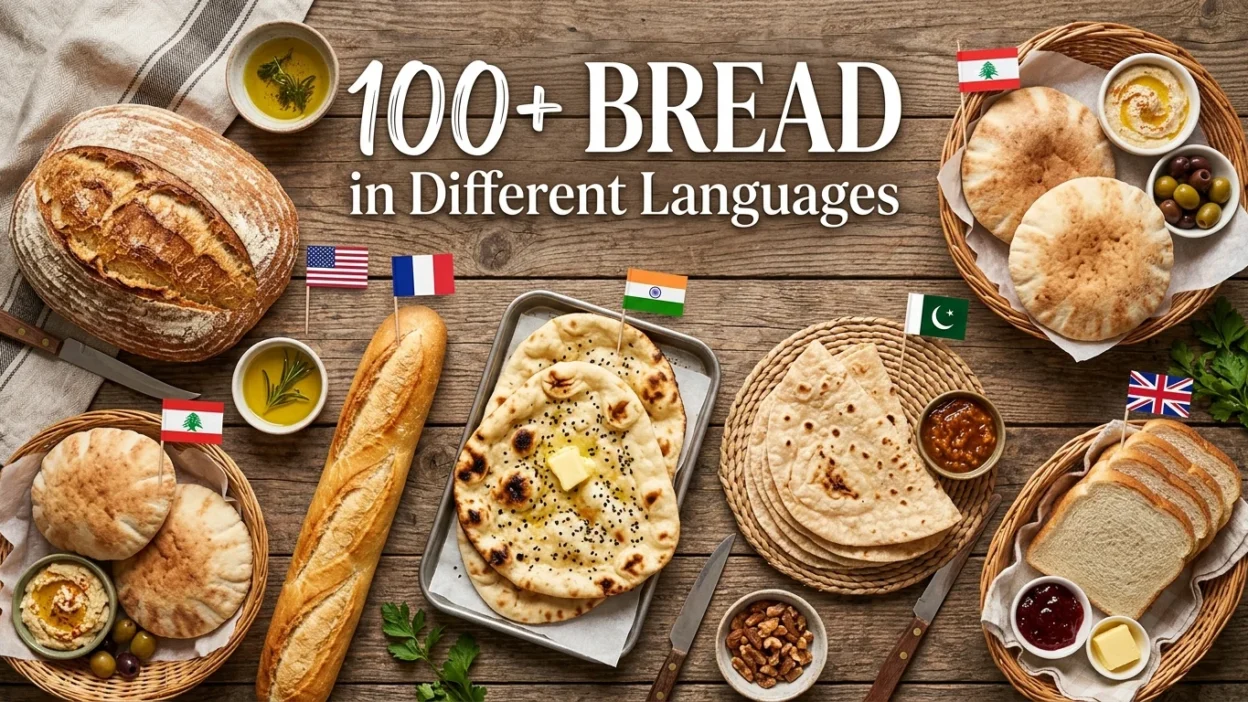
Bread is one of the most universal foods on earth. No matter where you go, every culture has its own version of bread and its own word for it.
If you’ve ever wondered how to say “bread” in different languages or wanted to explore bread translations around the world, this guide is exactly what you need.
Learning these words is useful for travel, language learning, and cultural understanding. Below, you’ll find a carefully curated list of languages with pronunciation and real life example sentences to help you actually use the word in context.
Bread in Different Languages
| Language | Pronunciation | Example |
| English | bred | I bought fresh bread today. (Meaning: I bought fresh bread today.) |
| Spanish | pan | Compré pan fresco. (Meaning: I bought fresh bread.) |
| French | pain | J’aime le pain chaud. (Meaning: I like warm bread.) |
| German | brot | Ich esse Brot. (Meaning: I eat bread.) |
| Italian | pane | Mangio pane ogni giorno. (Meaning: I eat bread every day.) |
| Portuguese | pão | Eu comprei pão. (Meaning: I bought bread.) |
| Dutch | brood | Ik eet brood. (Meaning: I eat bread.) |
| Russian | khleb | Ya lyublyu khleb. (Meaning: I love bread.) |
| Arabic | khubz | Ana akul khubz. (Meaning: I eat bread.) |
| Turkish | ekmek | Ekmek aldım. (Meaning: I bought bread.) |
| Hindi | roti | Main roti khata hoon. (Meaning: I eat bread.) |
| Urdu | roti | Main roti khata hoon. (Meaning: I eat bread.) |
| Chinese (Mandarin) | mianbao | Wo mai le mianbao. (Meaning: I bought bread.) |
| Japanese | pan | Pan o tabemasu. (Meaning: I eat bread.) |
| Korean | ppang | Ppang meogeoyo. (Meaning: I eat bread.) |
| Greek | psomi | Trogó psomi. (Meaning: I eat bread.) |
| Polish | chleb | Jem chleb. (Meaning: I eat bread.) |
| Swedish | bröd | Jag äter bröd. (Meaning: I eat bread.) |
| Norwegian | brød | Jeg spiser brød. (Meaning: I eat bread.) |
| Danish | brød | Jeg spiser brød. (Meaning: I eat bread.) |
| Finnish | leipä | Syön leipää. (Meaning: I eat bread.) |
| Hungarian | kenyér | Eszem kenyeret. (Meaning: I eat bread.) |
| Czech | chléb | Jím chléb. (Meaning: I eat bread.) |
| Slovak | chlieb | Jem chlieb. (Meaning: I eat bread.) |
| Romanian | pâine | Mănânc pâine. (Meaning: I eat bread.) |
| Bulgarian | hlyab | Yam hlyab. (Meaning: I eat bread.) |
| Serbian | hleb | Jedem hleb. (Meaning: I eat bread.) |
| Croatian | kruh | Jedem kruh. (Meaning: I eat bread.) |
| Ukrainian | khlib | Ya yem khlib. (Meaning: I eat bread.) |
| Hebrew | lechem | Ani ochel lechem. (Meaning: I eat bread.) |
| Persian | nan | Man nan mikhoram. (Meaning: I eat bread.) |
| Pashto | dodai | Za dodai khwaram. (Meaning: I eat bread.) |
| Bengali | ruti | Ami ruti khai. (Meaning: I eat bread.) |
| Tamil | rotti | Naan rotti saapiduven. (Meaning: I eat bread.) |
| Telugu | roti | Nenu roti tinanu. (Meaning: I eat bread.) |
| Marathi | bhakri | Mi bhakri khato. (Meaning: I eat bread.) |
| Gujarati | rotli | Hu rotli khau chu. (Meaning: I eat bread.) |
| Punjabi | roti | Main roti khanda haan. (Meaning: I eat bread.) |
| Malay | roti | Saya makan roti. (Meaning: I eat bread.) |
| Indonesian | roti | Saya makan roti. (Meaning: I eat bread.) |
| Thai | khanom pang | Chan kin khanom pang. (Meaning: I eat bread.) |
| Vietnamese | bánh mì | Tôi ăn bánh mì. (Meaning: I eat bread.) |
| Filipino | tinapay | Kumakain ako ng tinapay. (Meaning: I eat bread.) |
| Swahili | mkate | Ninakula mkate. (Meaning: I eat bread.) |
| Zulu | isinkwa | Ngidla isinkwa. (Meaning: I eat bread.) |
| Afrikaans | brood | Ek eet brood. (Meaning: I eat bread.) |
| Icelandic | brauð | Ég borða brauð. (Meaning: I eat bread.) |
| Irish | arán | Ithim arán. (Meaning: I eat bread.) |
| Welsh | bara | Rwy’n bwyta bara. (Meaning: I eat bread.) |
| Albanian | bukë | Ha bukë. (Meaning: I eat bread.) |
| Latvian | maize | Es ēdu maizi. (Meaning: I eat bread.) |
| Lithuanian | duona | Aš valgau duoną. (Meaning: I eat bread.) |
| Estonian | leib | Ma söön leiba. (Meaning: I eat bread.) |
| Maltese | ħobż | Nieħu ħobż. (Meaning: I eat bread.) |
| Georgian | puri | Me puri vcham. (Meaning: I eat bread.) |
| Armenian | hats | Yes hats em utum. (Meaning: I eat bread.) |
| Mongolian | talh | Bi talh иднэ. (Meaning: I eat bread.) |
| Nepali | roti | Ma roti khanchu. (Meaning: I eat bread.) |
| Sinhala | paan | Mama paan kanawa. (Meaning: I eat bread.) |
| Khmer | nom pang | Khnhom nyam nom pang. (Meaning: I eat bread.) |
| Lao | khao chi | Khoy kin khao chi. (Meaning: I eat bread.) |
| Burmese | paung moun | Nga paung moun sar de. (Meaning: I eat bread.) |
| Haitian Creole | pen | Mwen manje pen. (Meaning: I eat bread.) |
| Somali | rooti | Waxaan cunaa rooti. (Meaning: I eat bread.) |
| Amharic | dabo | Ene dabo belalhu. (Meaning: I eat bread.) |
| Tigrinya | hmbasha | Ane hmbasha belu. (Meaning: I eat bread.) |
| Malagasy | mofo | Mihinana mofo aho. (Meaning: I eat bread.) |
| Maori | parāoa | Kei te kai au i te parāoa. (Meaning: I eat bread.) |
| Samoan | falaoa | Ou te ai falaoa. (Meaning: I eat bread.) |
How to Say Bread in Different Languages
If you’re learning languages or traveling, knowing how to say “bread” can be surprisingly useful. From ordering food to understanding menus, this simple word appears everywhere. As shown above, “bread in all languages” varies widely, but many cultures share similar roots especially across Europe and Asia.
Bread Translations Around the World
Bread translations reflect cultural diversity. For example:
- European languages often use variations like brot, pain, or pan
- South Asian languages commonly use roti
- Middle Eastern regions prefer khubz or nan
These differences highlight how deeply food is tied to language and tradition.
Why Learning Food Words Matters
Understanding basic food vocabulary like bread helps you:
- Travel more confidently
- Connect with locals
- Improve language retention
- Understand culture faster
“Bread around the world” is more than a translation it’s a glimpse into daily life across cultures.
Conclusion
Bread is a universal staple, but its name changes beautifully across languages. Whether you’re learning, traveling, or just curious, knowing how to say “bread in different languages” opens the door to better communication and cultural appreciation.
FAQs
1. How do you say bread in most languages?
Most languages have unique words, such as pan (Spanish), brot (German), and roti (Hindi).
2. What is the most common word for bread worldwide?
There is no single global word, but “roti” and “bread-like terms” are widely used across regions.
3. How to remember bread in different languages easily?
Practice with example sentences and group languages by region or similarity.
4. Why are bread translations so different?
Languages evolved separately, and food names reflect local culture and history.
5. Is bread the same in every culture?
No, each culture has its own type of bread, from flatbreads to loaves.