
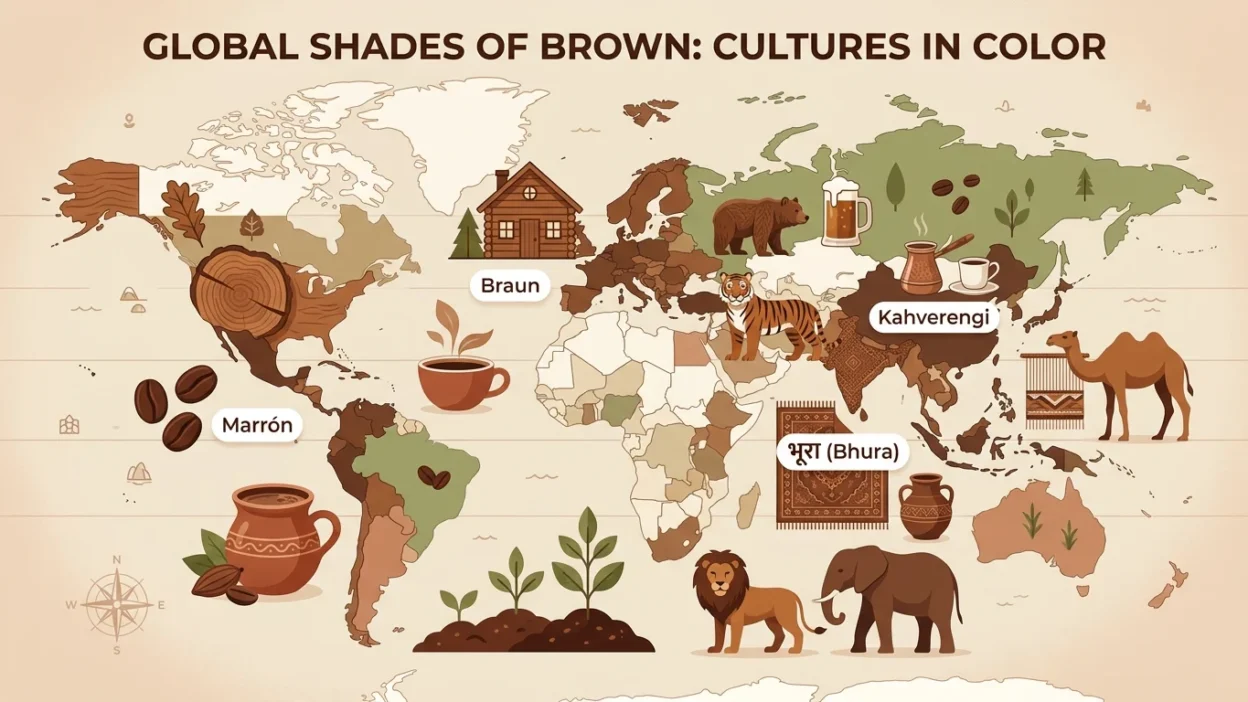
Colors are a universal part of human expression, and learning how to say brown in different languages can be both fun and useful.
Whether you’re traveling, learning a new language, or improving your vocabulary, knowing how to describe colors helps you communicate better in everyday life.
In this guide, you’ll discover how to say brown in all languages, along with pronunciation and real life examples. This makes it easier to understand brown translations and how the word is used around the world.
Brown in Different Languages (With Pronunciation & Examples)
| Language | Pronunciation | Example |
| English | braun | The dog is brown. (The dog is brown.) |
| Spanish | marrón | El perro es marrón. (The dog is brown.) |
| French | ma-ron | Le chien est marron. (The dog is brown.) |
| German | braun | Der Hund ist braun. (The dog is brown.) |
| Italian | mar-rone | Il cane è marrone. (The dog is brown.) |
| Portuguese | ma-hon | O cachorro é marrom. (The dog is brown.) |
| Dutch | brown | De hond is bruin. (The dog is brown.) |
| Russian | kori-ch-ne-viy | Собака коричневая. (The dog is brown.) |
| Chinese (Mandarin) | ka-fei-se | 狗是咖啡色的。 (The dog is brown.) |
| Japanese | cha-iro | 犬は茶色です。 (The dog is brown.) |
| Korean | gal-saek | 개는 갈색입니다. (The dog is brown.) |
| Arabic | bun-ni | الكلب بني. (The dog is brown.) |
| Hindi | bhura | कुत्ता भूरा है। (The dog is brown.) |
| Urdu | bhoora | کتا بھورا ہے۔ (The dog is brown.) |
| Turkish | kah-ve-ren-gi | Köpek kahverengi. (The dog is brown.) |
| Greek | ka-fe | Ο σκύλος είναι καφέ. (The dog is brown.) |
| Polish | bron-zo-wy | Pies jest brązowy. (The dog is brown.) |
| Swedish | brun | Hunden är brun. (The dog is brown.) |
| Danish | brun | Hunden er brun. (The dog is brown.) |
| Norwegian | brun | Hunden er brun. (The dog is brown.) |
| Finnish | rus-ke-a | Koira on ruskea. (The dog is brown.) |
| Czech | hne-dy | Pes je hnědý. (The dog is brown.) |
| Hungarian | bar-na | A kutya barna. (The dog is brown.) |
| Romanian | ma-ro | Câinele este maro. (The dog is brown.) |
| Bulgarian | ka-fe-ya-v | Кучето е кафяво. (The dog is brown.) |
| Thai | nam-tan | สุนัขเป็นสีน้ำตาล (The dog is brown.) |
| Vietnamese | nau | Con chó màu nâu. (The dog is brown.) |
| Indonesian | co-klat | Anjing itu coklat. (The dog is brown.) |
| Malay | co-klat | Anjing itu coklat. (The dog is brown.) |
| Filipino | kayumanggi | Ang aso ay kayumanggi. (The dog is brown.) |
| Swahili | kahawia | Mbwa ni kahawia. (The dog is brown.) |
| Zulu | nsun-du | Inja insundu. (The dog is brown.) |
| Afrikaans | bruin | Die hond is bruin. (The dog is brown.) |
| Hebrew | ka-hum | הכלב חום. (The dog is brown.) |
| Persian | qah-vei | سگ قهوهای است. (The dog is brown.) |
| Bengali | badami | কুকুরটি বাদামী। (The dog is brown.) |
| Tamil | pa-zhup-pu | நாய் பழுப்பு நிறம். (The dog is brown.) |
| Telugu | go-du-ma | కుక్క గోధుమ రంగులో ఉంది. (The dog is brown.) |
| Marathi | tap-ki-ri | कुत्रा तपकिरी आहे. (The dog is brown.) |
| Gujarati | bho-ro | કૂતરો ભૂરા રંગનો છે. (The dog is brown.) |
| Punjabi | bhoora | ਕੁੱਤਾ ਭੂਰਾ ਹੈ। (The dog is brown.) |
| Sinhala | dum-pat | බල්ලා දුඹුරුයි. (The dog is brown.) |
| Nepali | kha-iro | कुकुर खैरो छ। (The dog is brown.) |
| Khmer | tnaot | ឆ្កែមានពណ៌ត្នោត។ (The dog is brown.) |
| Lao | nam-tan | ຫມາແມ່ນສີນ້ໍາຕານ. (The dog is brown.) |
| Burmese | nyaung | ခွေးက အညိုရောင်ပါ။ (The dog is brown.) |
| Mongolian | bor | Нохой бор өнгөтэй. (The dog is brown.) |
| Kazakh | qongyr | Ит қоңыр. (The dog is brown.) |
| Uzbek | jigarrang | It jigarrang. (The dog is brown.) |
| Ukrainian | ko-rych-ne-vyy | Собака коричнева. (The dog is brown.) |
| Serbian | bra-on | Пас је браон. (The dog is brown.) |
| Croatian | sme-dji | Pas je smeđi. (The dog is brown.) |
| Slovak | hne-dy | Pes je hnedý. (The dog is brown.) |
| Slovenian | rjav | Pes je rjav. (The dog is brown.) |
| Estonian | pruun | Koer on pruun. (The dog is brown.) |
| Latvian | brauns | Suns ir brūns. (The dog is brown.) |
| Lithuanian | rudas | Šuo yra rudas. (The dog is brown.) |
| Icelandic | brun | Hundurinn er brúnn. (The dog is brown.) |
| Irish | don | Tá an madra donn. (The dog is brown.) |
| Welsh | brown | Mae’r ci yn frown. (The dog is brown.) |
| Albanian | kaf | Qeni është kaf. (The dog is brown.) |
| Macedonian | kafe-av | Кучето е кафеаво. (The dog is brown.) |
| Georgian | peri | ძაღლი ყავისფერია. (The dog is brown.) |
| Armenian | shok-ola-giyn | Շունը շոկոլագույն է։ (The dog is brown.) |
| Azerbaijani | qeh-ve-yi | İt qəhvəyi rəngdədir. (The dog is brown.) |
| Basque | marroi | Txakurra marroia da. (The dog is brown.) |
| Catalan | mar-ro | El gos és marró. (The dog is brown.) |
| Galician | ma-rron | O can é marrón. (The dog is brown.) |
How to Say Brown in Different Languages
Learning how to say brown in different languages helps you describe objects, clothing, animals, and more in daily conversations. It’s especially useful when traveling or learning new cultures.
You’ll notice that some languages use similar words (like marrón in Spanish and marrone in Italian), while others have completely unique terms.
Brown Translations Around the World
The word brown often relates to nature earth, wood, soil, and animals. Across cultures, it symbolizes stability, warmth, and simplicity. These meanings influence how the word is used in different languages.
Understanding brown translations can also improve your language skills and help you recognize patterns between related languages.
Why Learn Colors in All Languages?
Knowing colors like brown in all languages is one of the easiest ways to build vocabulary. It helps with:
- Basic communication
- Travel conversations
- Language learning foundations
- Cultural understanding
Colors are among the first words taught in any language, making them essential for beginners.
Conclusion
Now you know how to say brown in different languages, along with pronunciation and real-life examples. This knowledge can help you communicate more effectively and understand languages better across cultures.
Whether you’re learning for travel, study, or curiosity, mastering simple words like colors is a powerful first step.
FAQs
1. How do you say brown in different languages?
Brown is said as marrón in Spanish, braun in German, kahverengi in Turkish, and bhura in Hindi.
2. What is the most common translation of brown worldwide?
Many European languages use variations of “marron” or “braun,” making them among the most common.
3. Why is learning colors important in languages?
Colors are basic vocabulary used in daily conversations, helping learners describe objects easily.
4. Is brown the same word in all languages?
No, each language has its own unique word, though some may sound similar due to shared origins.
5. How can I remember brown in multiple languages?
Practice with examples, repetition, and associating the word with real objects like a brown dog or tree.

Marak Robort is a content writer and researcher with a strong interest in language, meanings, and digital information. His work focuses on presenting clear, easy-to-understand explanations that help readers quickly grasp complex ideas.