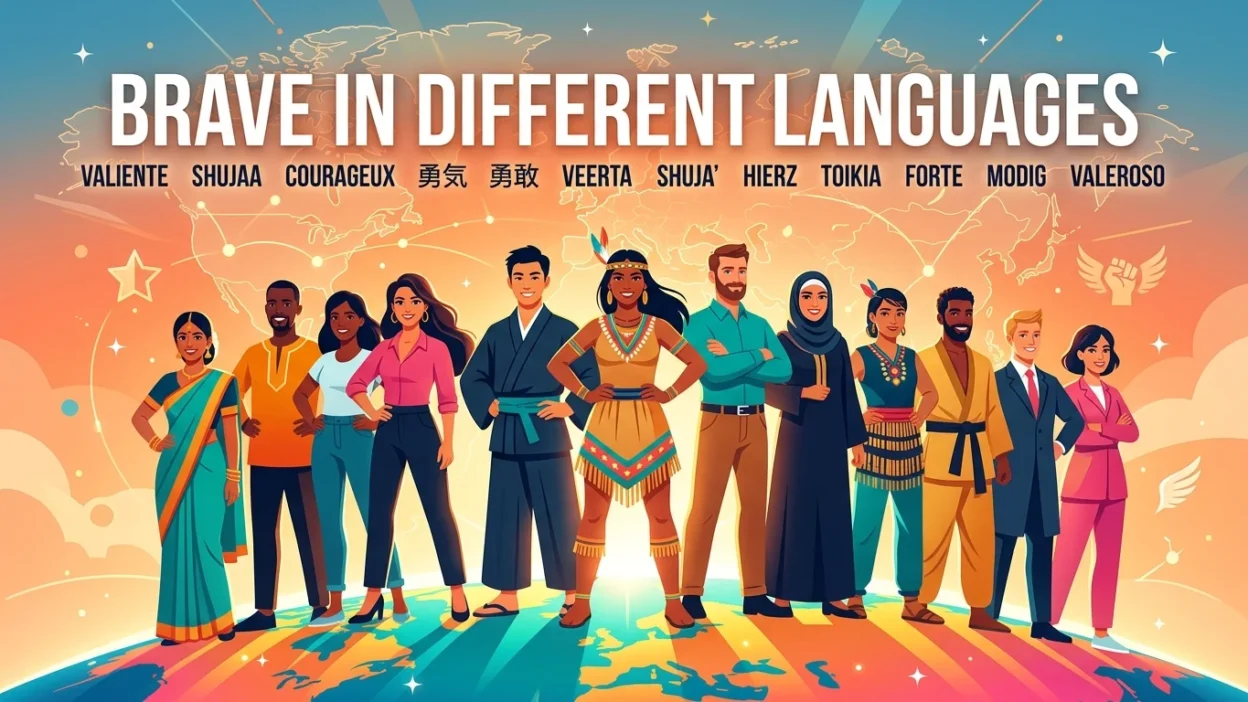
Being brave is a universal human quality admired in every culture. Whether it’s facing fears, standing up for others, or trying something new, the idea of courage connects people globally. In this article, you’ll discover how to say “brave” in different languages, along with pronunciation and real life examples. This helps you understand brave translations, explore brave around the world, and learn how to express courage across cultures.
How to Say “Brave” in Different Languages
| Language | Pronunciation | Example |
| English | breyv | She is brave in difficult times. (Meaning: She shows courage in hard situations.) |
| Spanish | brah-veh | Ella es valiente. (Meaning: She is brave.) |
| French | vahl-yahnt | Il est courageux. (Meaning: He is brave.) |
| German | koo-rah-gee | Er ist mutig. (Meaning: He is brave.) |
| Italian | koo-rah-joh-so | Lei è coraggiosa. (Meaning: She is brave.) |
| Portuguese | koh-rah-zhoh-so | Ele é corajoso. (Meaning: He is brave.) |
| Dutch | moo-tikh | Hij is moedig. (Meaning: He is brave.) |
| Russian | khrah-bry | Ona khrabraya. (Meaning: She is brave.) |
| Chinese (Mandarin) | yong-gan | 她很勇敢。 (Meaning: She is very brave.) |
| Japanese | yuu-kan | 彼は勇敢です。 (Meaning: He is brave.) |
| Korean | yong-gam-han | 그는 용감하다. (Meaning: He is brave.) |
| Arabic | shujaa | هو شجاع. (Meaning: He is brave.) |
| Hindi | sah-see | वह साहसी है। (Meaning: He/She is brave.) |
| Urdu | bahadur | وہ بہادر ہے۔ (Meaning: He/She is brave.) |
| Bengali | shah-shi | সে সাহসী। (Meaning: He/She is brave.) |
| Turkish | je-soor | O cesur. (Meaning: He/She is brave.) |
| Greek | thah-rra-leh-os | Είναι θαρραλέος. (Meaning: He is brave.) |
| Polish | moozh-nee | On jest odważny. (Meaning: He is brave.) |
| Swedish | moo-deeg | Han är modig. (Meaning: He is brave.) |
| Danish | mo-dee | Han er modig. (Meaning: He is brave.) |
| Norwegian | moo-dee | Han er modig. (Meaning: He is brave.) |
| Finnish | roh-keh-ah | Hän on rohkea. (Meaning: He/She is brave.) |
| Czech | od-vahzh-nee | On je odvážný. (Meaning: He is brave.) |
| Slovak | od-vahzh-nee | On je odvážny. (Meaning: He is brave.) |
| Hungarian | bah-tor | Ő bátor. (Meaning: He/She is brave.) |
| Romanian | koo-rah-jos | El este curajos. (Meaning: He is brave.) |
| Bulgarian | smeh-lo | Той е смел. (Meaning: He is brave.) |
| Serbian | hra-bar | On je hrabar. (Meaning: He is brave.) |
| Croatian | hra-bar | On je hrabar. (Meaning: He is brave.) |
| Ukrainian | khorob-ree | Він хоробрий. (Meaning: He is brave.) |
| Hebrew | a-meetz | הוא אמיץ. (Meaning: He is brave.) |
| Persian | shee-jaa | او شجاع است. (Meaning: He/She is brave.) |
| Thai | kla-han | เขากล้าหาญ (Meaning: He is brave.) |
| Vietnamese | dung-cam | Anh ấy dũng cảm. (Meaning: He is brave.) |
| Indonesian | be-rah-nee | Dia berani. (Meaning: He/She is brave.) |
| Malay | be-rah-nee | Dia berani. (Meaning: He/She is brave.) |
| Filipino | ma-ta-pang | Siya ay matapang. (Meaning: He/She is brave.) |
| Swahili | sha-ja-ah | Yeye ni shujaa. (Meaning: He/She is brave.) |
| Zulu | ne-si-bin-dee | Unesibindi. (Meaning: He/She is brave.) |
| Afrikaans | moo-deeg | Hy is moedig. (Meaning: He is brave.) |
| Amharic | deh-na | እሱ ደፍሮአል (Meaning: He is brave.) |
| Somali | gee-si | Waa geesi. (Meaning: He is brave.) |
| Icelandic | moot-ur | Hann er hugrakkur. (Meaning: He is brave.) |
| Irish | kroh-gah | Tá sé cróga. (Meaning: He is brave.) |
| Scottish Gaelic | kroh-gah | Tha e treun. (Meaning: He is brave.) |
| Welsh | dew-rook | Mae e’n ddewr. (Meaning: He is brave.) |
| Albanian | goo-xim-tar | Ai është guximtar. (Meaning: He is brave.) |
| Macedonian | hra-bar | Тој е храбар. (Meaning: He is brave.) |
| Latvian | droh-shs | Viņš ir drosmīgs. (Meaning: He is brave.) |
| Lithuanian | dras-soos | Jis yra drąsus. (Meaning: He is brave.) |
| Estonian | jul-ge | Ta on julge. (Meaning: He/She is brave.) |
| Slovenian | po-gum-en | On je pogumen. (Meaning: He is brave.) |
| Catalan | kuh-rah-jos | Ell és coratjós. (Meaning: He is brave.) |
| Basque | au-sart | Bera ausarta da. (Meaning: He/She is brave.) |
| Galician | koh-rah-sho-so | El é valente. (Meaning: He is brave.) |
| Maltese | kor-ah-goos | Huwa kuraġġuż. (Meaning: He is brave.) |
| Armenian | kah-ja | Նա քաջ է. (Meaning: He/She is brave.) |
| Georgian | mam-a-tsi | ის მამაცი არის. (Meaning: He/She is brave.) |
| Mongolian | zorigt | Тэр зоригтой. (Meaning: He/She is brave.) |
| Nepali | sah-see | ऊ साहसी छ। (Meaning: He/She is brave.) |
| Sinhala | vi-ra | ඔහු වීරයෙක්. (Meaning: He is brave.) |
| Khmer | kla-han | គាត់ក្លាហាន (Meaning: He is brave.) |
| Lao | kla-han | ລາວກ້າຫານ (Meaning: He is brave.) |
| Burmese | thout-kaung | သူရဲကောင်း (Meaning: He is brave.) |
| Kazakh | batyr | Ол батыр. (Meaning: He is brave.) |
| Uzbek | jasur | U jasur. (Meaning: He is brave.) |
| Tajik | sho-jo | Ӯ шуҷоъ аст. (Meaning: He/She is brave.) |
| Kyrgyz | ba-tyr | Ал баатыр. (Meaning: He is brave.) |
Why Learning “Brave” in All Languages Matters
Understanding how to say brave in all languages helps you connect with people globally. It’s useful for travelers, students, and language learners who want to express admiration and encouragement across cultures.
Brave Around the World
The concept of bravery exists everywhere, but each culture expresses it differently. Some emphasize physical courage, while others highlight emotional strength or moral integrity. Learning these differences deepens cultural awareness.
Tips to Remember Brave Translations
- Practice pronunciation daily
- Use the word in simple sentences
- Associate each translation with a real life situation
- Focus on commonly used languages first
Conclusion
Learning how to say brave in different languages is more than vocabulary it’s a way to understand courage across cultures. These translations help you communicate admiration and strength wherever you go.
FAQs
1. How to say brave in different languages easily?
Start with common languages like Spanish, French, and German, then expand gradually.
2. What is the most common translation of brave?
Words like “valiente,” “courageux,” and “mutig” are widely used.
3. Why learn brave in all languages?
It helps in communication, travel, and cultural understanding.
4. Is the meaning of brave the same everywhere?
The core meaning is similar, but cultural context may vary.
5. Which language has the simplest word for brave?
Languages like Indonesian (“berani”) and Malay are simple and easy to learn.

Ely Joseph is a language researcher, writer, and contributor who specializes in words, meanings, and multilingual communication. With a strong interest in how language shapes understanding across cultures, Ely focuses on creating clear, accurate, and reader-friendly content for a global audience.