
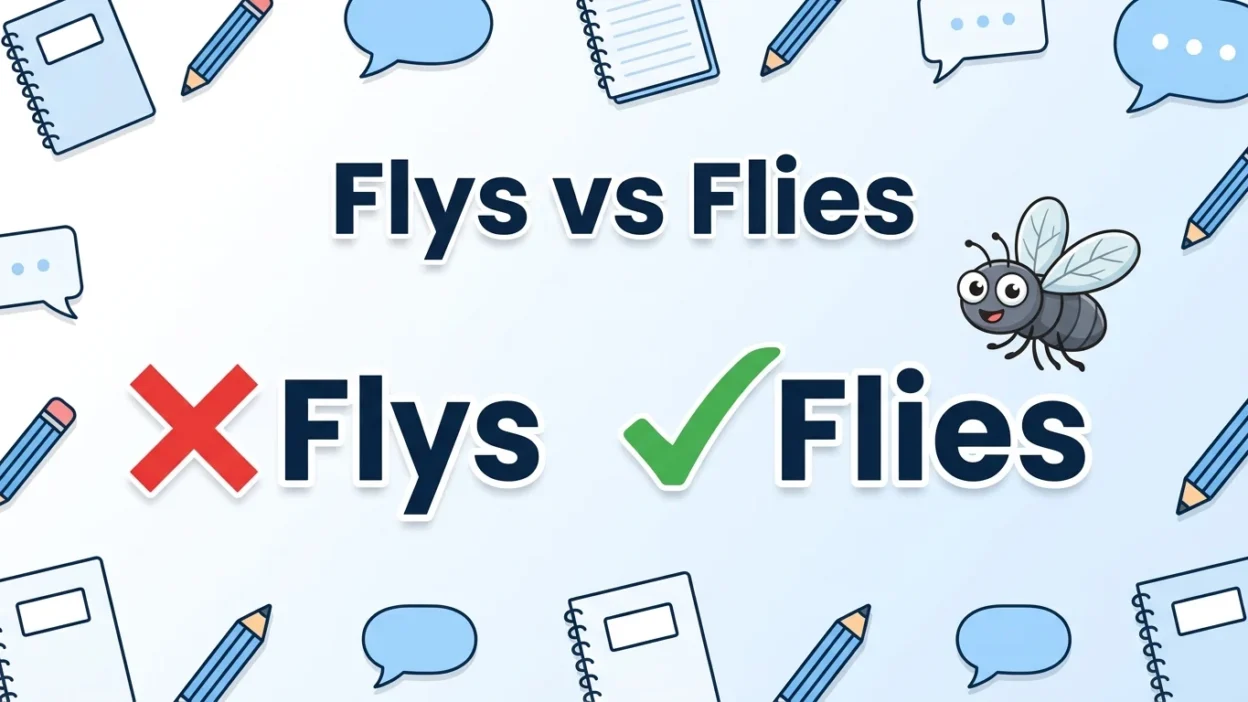
Many English learners get confused between “flys” and “flies.” The words look almost the same, and both come from the word “fly.” Because of this, many people are not sure which spelling is correct.
The good news is that the difference is actually very simple once you understand how English plural words and verb forms work.
In this guide, you will learn:
- What “flys” means
- What “flies” means
- Which spelling is correct in everyday English
- Common mistakes to avoid
- Easy examples from real life
By the end, the confusion between flys vs flies will be completely clear.
Quick Answer
Here is the short and simple answer:
- Flies is the correct spelling in most situations.
- Flys is very rare and usually considered incorrect in normal English writing.
Use “flies” when:
- Talking about more than one fly
- Example: There are flies in the kitchen.
- Talking about someone or something flying
- Example: The bird flies south in winter.
“Flys”:
- Is almost never used in modern everyday English
- May appear as a surname, company name, or old spelling
- Is usually a spelling mistake when people mean “flies”
Why Do People Get Confused?
People get confused because English changes many words ending in -y into -ies.
For example:
| Singular | Plural |
| baby | babies |
| city | cities |
| fly | flies |
So when learners try to write the plural of “fly,” they may wonder:
- Should it be flys?
- Or should it be flies?
The answer is simple:
When a word ends with a consonant + y, English usually changes the y to ies.
That is why:
- fly → flies
- NOT fly → flys
Simple Background of the Word
The word “fly” has been part of English for hundreds of years.
It can be used as:
A noun
Meaning:
- A small insect
Example:
- A fly landed on my food.
A verb
Meaning:
- To move through the air
Example:
- Birds fly in the sky.
When English changes this word into plural or third person form, the spelling becomes flies.
Examples:
- Many flies are near the trash.
- She flies to London every year.
The Main Difference Between Flys and Flies
The biggest difference is correctness and usage.
“Flies” is the standard English word
It is used for:
- The plural form of “fly”
- The third person singular form of the verb “fly”
Examples:
- Flies are annoying.
- He flies a plane.
“Flys” is not standard English
Most of the time, “flys” is simply a spelling mistake.
Incorrect:
- There are many flys here.
Correct:
- There are many flies here.
Incorrect:
- She flys to school every day.
Correct:
- She flies to school every day.
Flys vs Flies Comparison
| Feature | Flys | Flies |
| Common in modern English? | No | Yes |
| Correct plural of “fly”? | No | Yes |
| Correct verb form? | No | Yes |
| Used in everyday writing? | Rarely | Very often |
| Usually seen as a mistake? | Yes | No |
| Example | Incorrect: Two flys | Correct: Two flies |
Which One Should You Use?
In almost every situation, you should use flies.
Use “flies” for insects
Example:
- Flies are everywhere in summer.
Use “flies” for flying actions
Example:
- The airplane flies over the city.
Avoid using “flys”
Most teachers, dictionaries, and grammar experts consider it incorrect in normal writing.
Understanding the Grammar Rule
Here is the grammar rule in very simple English.
Words ending in consonant + y
When a word ends with:
- a consonant
- followed by the letter y
the y changes to ies.
Examples:
| Word | Correct Form |
| baby | babies |
| story | stories |
| fly | flies |
| party | parties |
So:
- NOT flys
- YES flies
Common Mistakes People Make
1. Writing “flys” as the plural
Incorrect:
- There were flys in the room.
Correct:
- There were flies in the room.
This is the most common mistake.
2. Using “flys” as a verb
Incorrect:
- My brother flys to Dubai often.
Correct:
- My brother flies to Dubai often.
Remember:
- he flies
- she flies
- it flies
3. Forgetting the spelling rule
Some learners simply add s to every word.
But English does not always work that way.
For words ending in consonant + y:
- change y to ies
Everyday Real Life Examples
Learning becomes easier when you see real examples from daily life.
In Emails
Correct:
- The company flies products to many countries.
Incorrect:
- The company flys products to many countries.
On Social Media
Correct:
- Time flies when you’re having fun.
Incorrect:
- Time flys when you’re having fun.
The phrase “Time flies” is very common in English.
In News Headlines
Correct:
- Airline flies hundreds of passengers safely.
Incorrect:
- Airline flys hundreds of passengers safely.
In Daily Conversation
Correct:
- Flies keep landing on the fruit.
Correct:
- She flies to work every week.
Easy Memory Trick
Here is a simple trick to remember the correct spelling.
Think about “baby → babies”
If:
- baby becomes babies
then:
- fly becomes flies
The spelling pattern is the same.
This small trick helps many students remember the correct form quickly.
Short Learning Section for Students and Beginners
Here is a simple study guide.
Step 1: Learn the base word
- fly
Step 2: Check the ending
The word ends with:
- consonant + y
Step 3: Apply the rule
Change:
- y → ies
Result:
- flies
Practice Sentences
Choose the correct word.
1.
There are many ___ near the window.
Correct answer:
- flies
2.
The bird ___ over the lake.
Correct answer:
- flies
3.
My uncle ___ to Turkey for work.
Correct answer:
- flies
4.
The kitchen has too many ___.
Correct answer:
- flies
Mini Quiz
Which sentence is correct?
- He flys a helicopter.
- He flies a helicopter.
Correct answer:
- He flies a helicopter.
Which spelling is correct?
- flys
- flies
Correct answer:
- flies
FAQ About Flys vs Flies
Is “flys” ever correct?
In normal modern English, “flys” is usually incorrect. It may appear in names or special titles, but not in standard grammar.
Why is “flies” spelled with “ies”?
Because “fly” ends with a consonant + y. English changes the y to ies in these cases.
Is “flies” a noun or a verb?
It can be both.
Noun:
- Flies are insects.
Verb:
- She flies every month.
What is the plural of “fly”?
The correct plural is:
- flies
Why do people write “flys”?
Many people simply add “s” to words automatically. They may not know the spelling rule for words ending in y.
Is “time flies” correct?
Yes.
“Time flies” is a very common English expression.
Meaning:
- Time passes quickly.
Do native English speakers make this mistake?
Sometimes yes, especially in casual typing or social media posts. But standard English uses “flies.”
How can I remember the correct spelling?
Remember this pattern:
- baby → babies
- fly → flies
That makes the rule easier to remember.
Conclusion
The difference between flys and flies is actually very simple.
- Flies is the correct spelling in modern English.
- Flys is usually a mistake.
Use flies when:
- talking about more than one fly
- describing someone or something that flies
The easiest way to remember the rule is this:
- consonant + y → ies
So:
- fly → flies
Once you learn this simple pattern, you will be able to use the correct spelling confidently in school, emails, social media, and everyday English.

David William is a language enthusiast, researcher, and content creator at Lingoveb. With a deep passion for words, meanings, and global communication, he focuses on making language simple, clear, and accessible for readers around the world.