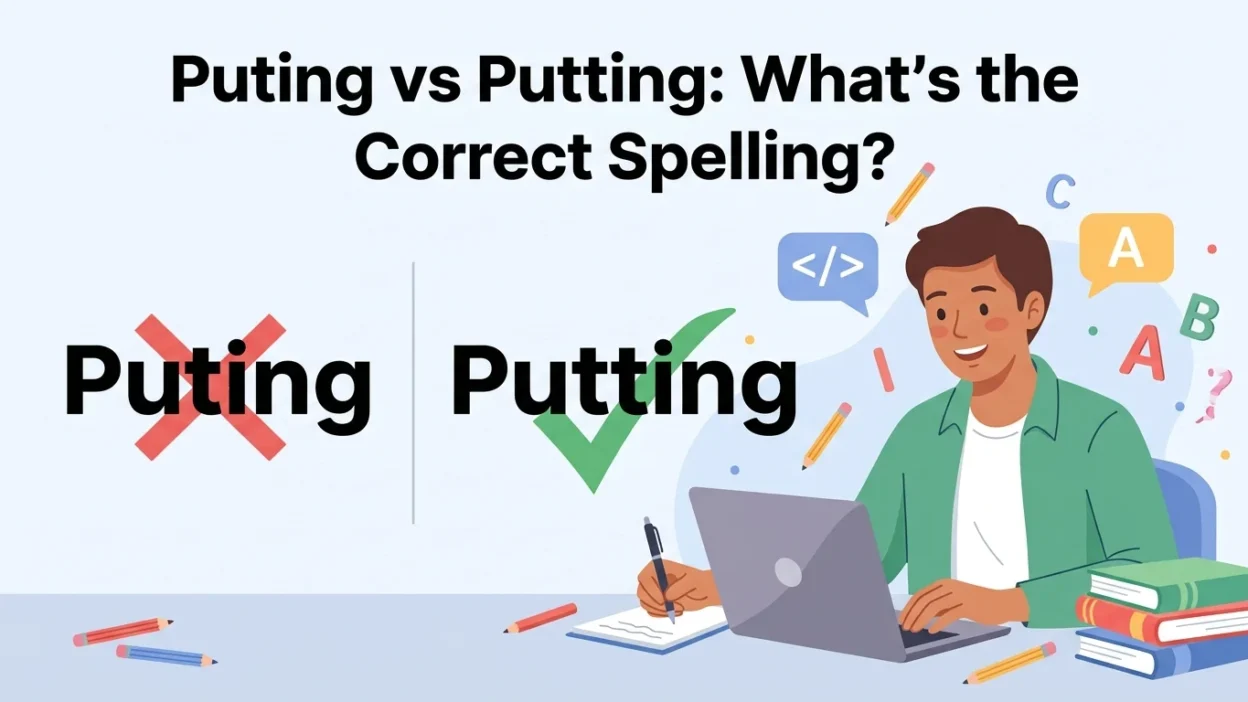
Many English learners get confused between “puting” and “putting.” The words look very similar, and both seem possible at first glance. But only one spelling is correct in standard English.
This confusion happens because English spelling rules are not always simple. Some verbs double the last letter before adding -ing, while others do not. If you are learning English, this can feel tricky.
The good news is that the difference is very easy once you understand the rule.
Quick Answer
- Putting is the correct spelling.
- Puting is incorrect in modern English.
- The verb is put.
- When adding -ing, the final t is doubled:
- put → putting
Correct Example
- I am putting my books on the table.
Incorrect Example
- I am puting my books on the table.
Simple Background of the Word
The word put is a very old English verb. It means:
- to place something somewhere
- to move something into a position
- to set something down
Examples:
- Put the cup on the desk.
- Put your shoes by the door.
- She put the keys in her bag.
When we want to talk about an action happening now, we often add -ing to the verb.
Examples:
- walk → walking
- read → reading
- put → putting
But with put, English doubles the last letter t before adding -ing.
That is why we write:
- put + ing = putting
Not:
- puting
Why “Putting” Is Correct
English has a spelling pattern for many short verbs.
When a verb:
- has one syllable,
- ends with one vowel + one consonant,
the last consonant is often doubled before adding -ing.
Examples
| Base Verb | Correct -ing Form |
| run | running |
| sit | sitting |
| get | getting |
| put | putting |
The word put follows this same pattern.
So:
- put → putting
This is the standard and accepted spelling in English.
Why “Puting” Is Wrong
“Puting” is considered a spelling mistake in English.
The problem is that the final t is missing. Without doubling the letter, the spelling does not follow the normal English rule for this verb.
You may sometimes see “puting”:
- in typing mistakes,
- on social media,
- in beginner writing,
- in informal online comments.
But in correct English grammar and spelling, you should always use putting.
Main Difference Between Puting and Putting
Here is the simplest way to understand it:
| Word | Correct or Incorrect? | Meaning |
| putting | Correct | placing or setting something |
| puting | Incorrect | spelling mistake |
Comparison Table
| Feature | Putting | Puting |
| Correct English spelling | Yes | No |
| Used in dictionaries | Yes | No |
| Common in formal writing | Yes | No |
| Accepted in school writing | Yes | No |
| Used in books and news | Yes | No |
| Grammar-safe choice | Yes | No |
Which One Should You Use?
You should always use putting.
Use “putting” when:
- talking about placing something,
- describing an action happening now,
- writing school work,
- sending emails,
- posting online,
- writing professionally.
Examples
- She is putting food on the table.
- They are putting new chairs in the room.
- I am putting my phone in my pocket.
Never use “puting” in formal or correct English writing.
Easy Rule to Remember
Here is a simple memory trick:
Short verb + vowel + consonant = double the last letter
Examples:
- run → running
- sit → sitting
- put → putting
So always remember:
“Put” needs two T’s before “-ing.”
Common Mistakes People Make
Many learners make similar mistakes with short verbs.
Mistake 1: Forgetting to Double the Letter
Incorrect:
- puting
- runing
- siting
Correct:
- putting
- running
- sitting
Mistake 2: Writing Too Fast
Sometimes people know the correct spelling but type too quickly.
Example:
- “I am puting the files online.”
This is still incorrect, even if it was accidental.
Mistake 3: Copying Incorrect Online Writing
Social media and comments often contain spelling errors. Beginners sometimes copy these mistakes without noticing.
Always check:
- dictionaries,
- grammar tools,
- school materials,
- trusted learning sources.
Everyday Real Life Examples
Seeing the word in daily situations helps learners remember it better.
In Emails
- I am putting the documents in the folder.
- We are putting your order together now.
In School
- The teacher is putting notes on the board.
- Students are putting their bags under the desk.
In News Writing
- The company is putting more money into education.
- The city is putting new lights on the roads.
On Social Media
- She is putting new photos online today.
- I’m putting my favorite songs into a playlist.
At Home
- Dad is putting the groceries away.
- Please stop putting wet towels on the bed.
“Putting” in Different Meanings
The word “putting” can be used in many situations.
1. Placing Something
- He is putting the plate on the table.
2. Adding Something
- She is putting sugar in her tea.
3. Causing Effort
- They are putting a lot of work into the project.
4. Organizing Something
- We are putting the books in order.
In all these meanings, the spelling stays the same:
- putting
Short Learning Section for Students and Beginners
If you are learning English, here are some simple study tips.
Learn the Base Verb First
The base verb is:
- put
Then learn its forms:
- put
- puts
- putting
Practice by Writing Sentences
Try making your own examples:
- I am putting my shoes away.
- Mom is putting dinner on the table.
- They are putting paint on the wall.
Writing helps memory.
Read the Word Out Loud
Say:
- put
- putting
Hearing the double t sound can help you remember the spelling.
Compare with Similar Words
| Verb | Correct Form |
| get | getting |
| run | running |
| sit | sitting |
| put | putting |
This pattern appears many times in English.
Practice Sentences
Choose the correct spelling.
- She is ___ books on the shelf.
- putting ✅
- puting ❌
- They are ___ new plants outside.
- putting ✅
- puting ❌
- I am ___ my phone in my bag.
- putting ✅
- puting ❌
FAQ
1. Is “puting” ever correct?
No. “Puting” is not correct English spelling.
2. Why does “putting” have two t’s?
Because short verbs like “put” usually double the final consonant before adding -ing.
3. Is “putting” used in American and British English?
Yes. Both American and British English use putting.
4. Can I use “puting” in casual texting?
You can type anything casually, but it is still considered a spelling mistake.
5. What is the base form of “putting”?
The base verb is:
- put
6. What does “putting” mean?
It usually means:
- placing,
- setting,
- moving something somewhere.
7. Is “putting” a verb?
Yes. It is the -ing form of the verb “put.”
8. How can I remember the correct spelling?
Remember this simple rule:
put + ing = putting
Double the t.
Conclusion
The difference between puting and putting is actually very simple once you know the spelling rule.
- Putting is the correct English word.
- Puting is incorrect.
The verb put doubles its final t before adding -ing, just like:
- run → running
- sit → sitting
So whenever you write about placing or moving something, always use:
- putting ✅
With practice and regular reading, the correct spelling will soon feel natural and easy to remember.

Ely Joseph is a language researcher, writer, and contributor who specializes in words, meanings, and multilingual communication. With a strong interest in how language shapes understanding across cultures, Ely focuses on creating clear, accurate, and reader-friendly content for a global audience.