Many people get confused about “more then” and “more than.” The reason is simple: the words then and than look almost the same. They sound similar too, especially when spoken quickly.
Because of this, students, English learners, and even native speakers sometimes type the wrong one without noticing.
The good news is that the difference is actually very easy. Once you understand what each word means, you will probably never mix them up again.
This guide explains everything in very simple English with clear examples you can use in real life.
Quick Answer
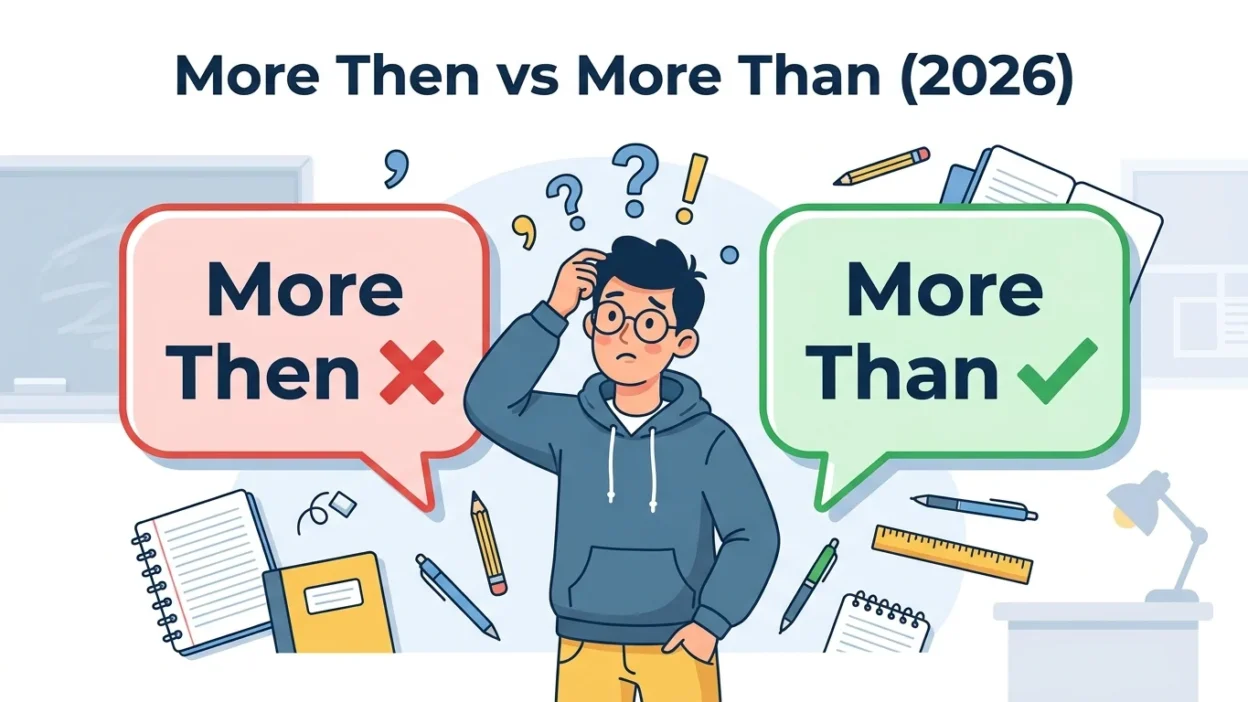
Here is the short and simple answer:
- More than = correct when comparing things or talking about amounts
- More then = usually incorrect in modern English
Correct Examples
- I have more than 10 books.
- She is more than happy to help.
- This phone costs more than mine.
Incorrect Examples
- I have more then 10 books.
- He earns more then his brother.
In almost every case, the correct phrase is more than.
Simple Background Explanation
To understand the difference, you first need to know the meaning of than and then.
What Does “Than” Mean?
Than is used for comparisons.
Examples:
- bigger than
- smaller than
- faster than
- more than
It helps compare two things.
Example:
- Tea is cheaper than coffee.
What Does “Then” Mean?
Then is usually connected to time or what happens next.
Examples:
- First we ate dinner, then we watched a movie.
- Finish your homework, then go outside.
It means:
- next
- after that
- at that time
Clear Explanation of the Difference
The confusion happens because people accidentally use then where they should use than.
Let’s make it very simple.
Use “More Than” for Comparison or Amount
Whenever you compare numbers, amounts, sizes, feelings, or actions, use more than.
Examples:
- More than 100 people came.
- She studies more than her brother.
- This bag weighs more than 5 kilos.
In all these sentences, something is being compared.
“More Then” Is Usually Wrong
The phrase more then normally does not fit English grammar.
Example:
❌ I have more then 20 dollars.
This is wrong because the sentence compares an amount.
Correct version:
✅ I have more than 20 dollars.
Comparison
| Phrase | Meaning | Correct? | Example |
| More than | Used for comparison or amount | Yes | She has more than 50 followers. |
| More then | Usually a mistake | No | ❌ I need more then one day. |
| Then | Used for time or next action | Yes | We ate, then we left. |
| Than | Used for comparison | Yes | He is taller than me. |
Which One to Use and When
Use “More Than” When Talking About Numbers
Examples:
- More than 30 students joined.
- The movie lasted more than two hours.
- I spent more than expected.
Use “More Than” for Comparisons
Examples:
- She likes cats more than dogs.
- This road is more dangerous than the other one.
- My phone is more expensive than yours.
Use “Then” Only for Time or Sequence
Examples:
- First read the question, then answer it.
- We went shopping, then had lunch.
- Finish this task, then start the next one.
Notice that then has nothing to do with comparison.
Common Mistakes People Make
1. Using “Then” Because It Sounds Similar
Many people type quickly and write:
❌ More then enough
Correct:
✅ More than enough
2. Mixing Up Time and Comparison
Incorrect:
❌ She is smarter then me.
Correct:
✅ She is smarter than me.
Why? Because you are comparing two people.
3. Auto Correct Problems
Sometimes phones or computers change words automatically.
You may type “than,” but the device changes it to “then.”
Always check your writing before sending messages or emails.
4. Learning by Sound Instead of Meaning
Some learners focus only on pronunciation. Since the words sound close, they guess the spelling.
A better way is to remember the meaning:
- Than = comparison
- Then = time
Easy Memory Trick
Here is a very simple trick:
“Than” Has the Letter A
Think of:
- compArison
- more thAn
Both have the letter A.
So when comparing things, use than.
“Then” Has the Letter E
Think of:
- nExt
- thEn
Both connect to time or sequence.
Everyday Real Life Examples
In Emails
Correct:
- We received more than 50 applications.
- The meeting lasted more than an hour.
Incorrect:
- We received more then 50 applications.
In Social Media Posts
Correct:
- More than 1 million views!
- I love this song more than the original version.
Incorrect:
- More then 1 million views!
In News Headlines
Correct:
- More than 200 people attended the event.
- Prices increased more than expected.
In Daily Conversations
Correct:
- I need more than five minutes.
- She works more than anyone else.
- This cake tastes better than the last one.
In School Writing
Correct:
- Water is more important than gold.
- More than half the class passed the test.
These examples show that more than is used everywhere in normal English.
Short Learning Section for Students and Beginners
If you are learning English, do not worry about this mistake. Many people confuse these words at first.
Here are three easy steps to remember the difference.
Step 1: Ask Yourself a Question
Are you comparing something?
If yes, use than.
Example:
- bigger than
- smaller than
- more than
Step 2: Think About Time
Are you talking about what happens next?
If yes, use then.
Example:
- Eat first, then sleep.
Step 3: Practice Small Sentences
Practice helps your brain remember naturally.
Try reading these aloud:
- I have more than enough money.
- She runs faster than me.
- We finished dinner, then watched TV.
After some practice, the correct choice will feel natural.
More Example Sentences
Correct Sentences With “More Than”
- He has more than three cars.
- The trip cost more than we planned.
- I enjoy reading more than watching TV.
- More than 500 people visited the museum.
- This test is harder than the last one.
Correct Sentences With “Then”
- I woke up, then I took a shower.
- Finish your work, then relax.
- We studied, then went home.
- She called me, then sent a message.
Incorrect Sentences
❌ I have more then enough food.
✅ I have more than enough food.
❌ He is taller then his father.
✅ He is taller than his father.
❌ More then 100 people came.
✅ More than 100 people came.
FAQ Section
Is “more then” ever correct?
Usually no. In modern English, people almost always mean more than.
Why do people confuse “then” and “than”?
Because the words look and sound similar.
Which phrase is correct: “more than enough” or “more then enough”?
The correct phrase is:
✅ more than enough
Is “than” used only for comparisons?
Mostly yes. It is commonly used when comparing things, people, numbers, or ideas.
Can “then” compare two things?
No. “Then” is mainly about time or sequence.
Example:
- First this happened, then that happened.
How can I remember the difference easily?
Remember this:
- Than = comparison
- Then = time
Is this mistake common among native English speakers?
Yes. Many native speakers make this mistake while typing quickly.
Should I worry if I make this mistake?
No. It is a very common error, and it becomes easy after practice.
Conclusion
The difference between more then and more than is actually very simple once you understand the meanings of then and than.
Use more than when comparing things or talking about amounts:
- more than 10 people
- more than enough
- better than before
Use then only when talking about time or what happens next:
- We ate, then we left.
In modern English, more then is almost always a mistake.
A simple rule can help you remember forever:
- Than = comparison
- Then = time
With a little practice, choosing the correct word becomes easy and natural.

Marak Robort is a content writer and researcher with a strong interest in language, meanings, and digital information. His work focuses on presenting clear, easy-to-understand explanations that help readers quickly grasp complex ideas.