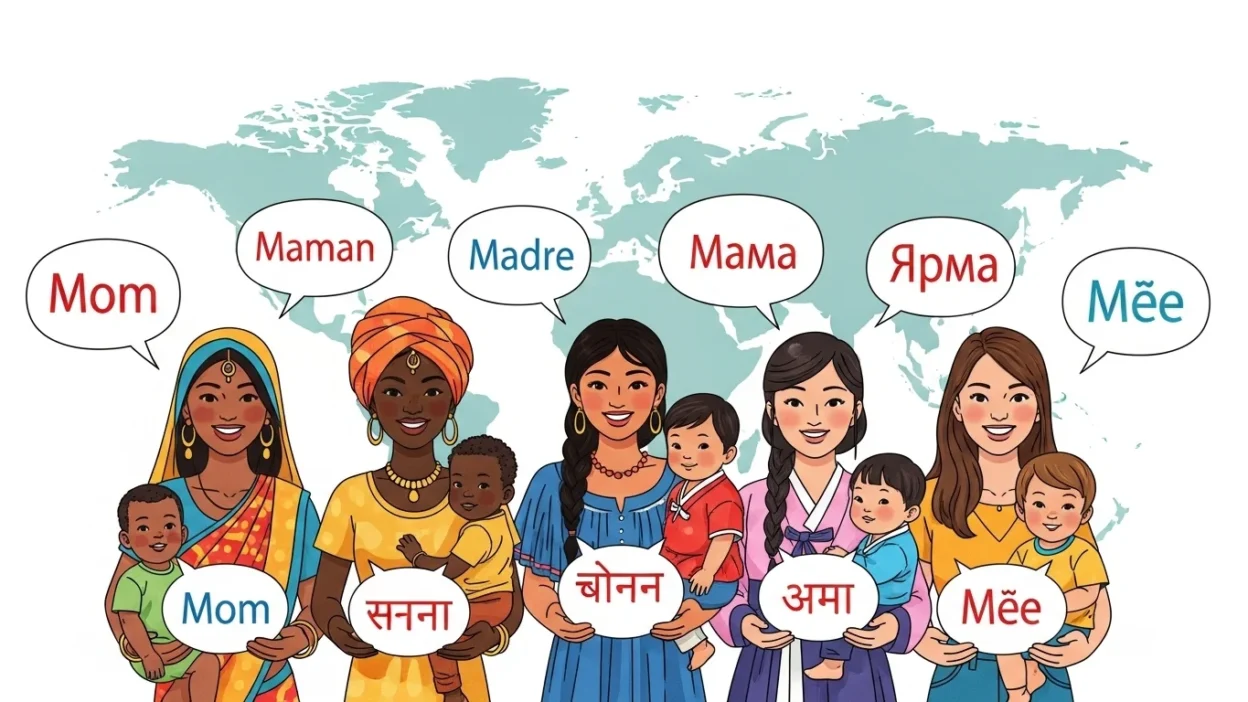
Have you ever wondered how to say “mom” in different languages? Whether you’re learning a new language, traveling, or simply curious about cultural expressions of love, understanding the word for “mom” in all languages gives you a glimpse into how families connect globally.
In this article, we’ll explore 70 languages, share pronunciation tips, and provide real life example sentences so you can confidently use mom in different languages in conversation.
Mom Translations: 70 Languages and Their Examples
| Language | Pronunciation | Example | English Meaning |
| Arabic | Umm | أحب أمي كثيراً | I love my mom very much |
| Spanish | Mamá | Mi mamá cocina muy bien | My mom cooks very well |
| French | Maman | Je parle avec ma maman | I am talking with my mom |
| German | Mama | Meine Mama ist Ärztin | My mom is a doctor |
| Italian | Mamma | La mia mamma è gentile | My mom is kind |
| Portuguese | Mãe | Minha mãe trabalha muito | My mom works a lot |
| Russian | Мама (Mama) | Мама готовит обед | Mom is cooking lunch |
| Chinese (Mandarin) | 妈妈 (Māma) | 我爱我的妈妈 | I love my mom |
| Japanese | お母さん (Okaasan) | お母さんは忙しいです | Mom is busy |
| Korean | 엄마 (Eomma) | 엄마가 웃어요 | Mom is smiling |
| Hindi | माँ (Maa) | मेरी माँ बहुत प्यारी है | My mom is very loving |
| Bengali | মা (Ma) | আমার মা ভালো রান্না করে | My mom cooks well |
| Punjabi | ਮਾਂ (Maan) | ਮੇਰੀ ਮਾਂ ਮੇਰੇ ਨਾਲ ਹੈ | My mom is with me |
| Urdu | ماں (Maan) | میری ماں پیاری ہے | My mom is lovely |
| Turkish | Anne | Annem evde | My mom is at home |
| Persian | مادر (Madar) | مادرم کتاب میخواند | My mom is reading a book |
| Greek | Μαμά (Mamá) | Η μαμά μου κοιμάται | My mom is sleeping |
| Dutch | Mama | Mijn mama werkt hier | My mom works here |
| Swedish | Mamma | Min mamma är läkare | My mom is a doctor |
| Norwegian | Mamma | Mamma lager middag | Mom is making dinner |
| Danish | Mor | Min mor elsker blomster | My mom loves flowers |
| Finnish | Äiti | Äitini on ystävällinen | My mom is kind |
| Polish | Mama | Moja mama śpiewa pięknie | My mom sings beautifully |
| Czech | Maminka | Moje maminka vaří skvěle | My mom cooks great |
| Slovak | Mama | Moja mama je doma | My mom is at home |
| Hungarian | Anya | Az anyám olvas egy könyvet | My mom is reading a book |
| Romanian | Mamă | Mama mea lucrează mult | My mom works a lot |
| Bulgarian | Мама (Mama) | Мама е вкъщи | Mom is at home |
| Serbian | Мама (Mama) | Моја мама је срећна | My mom is happy |
| Croatian | Mama | Moja mama pomaže meni | My mom helps me |
| Bosnian | Mama | Moja mama kuha dobro | My mom cooks well |
| Slovenian | Mama | Moja mama dela | My mom works |
| Albanian | Nënë | Nëna ime flet bukur | My mom speaks beautifully |
| Macedonian | Мајка (Majka) | Мајка ми спие | My mom is sleeping |
| Lithuanian | Mama | Mano mama juokiasi | My mom is laughing |
| Latvian | Māte | Mana māte lasa grāmatu | My mom is reading a book |
| Estonian | Ema | Minu ema laulab hästi | My mom sings well |
| Maltese | Omm | Omm tiegħi tħobbni | My mom loves me |
| Thai | แม่ (Mæ̂) | แม่กำลังทำอาหาร | Mom is cooking |
| Vietnamese | Mẹ | Mẹ tôi đang đọc sách | My mom is reading a book |
| Indonesian | Ibu | Ibu saya sedang tidur | My mom is sleeping |
| Malay | Ibu | Ibu saya memasak | My mom is cooking |
| Swahili | Mama | Mama yangu anacheka | My mom is laughing |
| Zulu | Umama | Umama wami uyapheka | My mom is cooking |
| Xhosa | Umama | Umama uyandithanda | Mom loves me |
| Yoruba | Iya | Iya mi n sùn | My mom is sleeping |
| Igbo | Nne | Nne m na-eri nri | My mom is eating |
| Hausa | Uwa | Uwa ta tana aiki | My mom is working |
| Somali | Hooyo | Hooyaday way qososhay | My mom laughed |
| Amharic | እናቱ (Enatu) | እናቱ ትምህርት ትሰጣለች | My mom gives lessons |
| Nepali | आमा (Ama) | आमा स्कूल जानुभयो | Mom went to school |
| Sinhala | අම්මා (Ammā) | අම්මා බඩගිනි | Mom is cooking |
| Georgian | დედა (Deda) | დედა სახლშია | Mom is at home |
| Armenian | Մայր (Mayr) | Մայրս երգում է | My mom is singing |
| Hebrew | אמא (Ima) | אמא שלי אוהבת אותי | My mom loves me |
| Kurdish | Dayik | Dayikê min tê xwarin | My mom is eating |
| Pashto | مور (Mor) | زما مور خوشحاله ده | My mom is happy |
| Kazakh | Ана (Ana) | Менің анам үйде | My mom is at home |
| Uzbek | Ona | Onam kitob o‘qiyapti | My mom is reading a book |
| Tajik | Модар (Modar) | Модарам механдад | My mom is laughing |
| Mongolian | Ээж (Eej) | Миний ээж ажиллаж байна | My mom is working |
| Tibetan | ཨ་མ་ (Ama) | ཨ་མ་ང་ལ་དགའ་ཡོད། | My mom loves me |
| Burmese | မေမေ (Mè mè) | မေမေစာအုပ်ဖတ်နေသည် | Mom is reading a book |
| Khmer | ម្តាយ (Mdai) | ម្តាយខ្ញុំចូលចិត្តច្រៀង | My mom likes singing |
| Lao | ແມ່ (Mae) | ແມ່ຂອງຂ້ອຍນອນ | My mom is sleeping |
Why Learning “Mom” in Different Languages Matters
Understanding the word for “mom” across cultures helps bridge language barriers and fosters empathy. It’s more than translation it’s a glimpse into family relationships worldwide. Using the correct term also shows respect and affection when visiting new countries or connecting with multicultural communities.
Tips for Remembering “Mom” Translations
- Focus on phonetics first; pronunciation is key for real conversation.
- Group languages by regions (e.g., European, Asian, African) for easier memorization.
- Practice with real-life examples like those in the table to reinforce learning.
Common Mistakes When Using “Mom” in Different Languages
- Confusing informal and formal terms (e.g., Japanese “Okaasan” vs. “Haha”).
- Overlooking accents and tones in tonal languages like Mandarin.
- Assuming the same spelling equals the same pronunciation.
Conclusion
Learning mom in different languages opens doors to better cultural understanding and heartfelt connections.
Whether for travel, study, or personal growth, knowing how to express love and respect for mothers globally enriches your communication and empathy.
FAQs
1. What is the easiest way to learn mom in multiple languages?
Start with phonetic pronunciation, then practice using short sentences like those in the table above.
2. Are there formal and informal ways to say mom?
Yes, languages like Japanese, Korean, and Arabic have both formal and casual terms for “mom.”
3. Can I use these translations in writing messages to my mom?
Absolutely! Using the native term adds a personal and cultural touch.
4. Which language has the shortest word for mom?
Many languages use simple words like “Ma” or “Maa,” especially in African and Asian languages.
5. Is “mom” universal across dialects?
No, dialects often have unique terms, even within the same country, so context matters.