Many English learners become confused about “weeped” and “wept” because both words seem like they could be the past form of the verb “weep.”
In English, regular verbs usually end in -ed in the past tense:
- walk → walked
- jump → jumped
- clean → cleaned
So, many people naturally think:
- weep → weeped
But English also has many irregular verbs. These verbs change in a different way. The verb “weep” is one of them.
That is why learners often wonder:
- Is “weeped” correct?
- Should I use “wept” instead?
- Do native speakers say both?
The good news is that the answer is actually simple once you understand the rule.
Quick Answer
- “Wept” is the correct past tense and past participle of “weep.”
- “Weeped” is generally considered incorrect in standard English.
- Use “weep” for the present.
- Use “wept” for the past.
Examples
- Present: She weeps quietly.
- Past: She wept after hearing the news.
- Past participle: He has wept many times.
Simple Rule
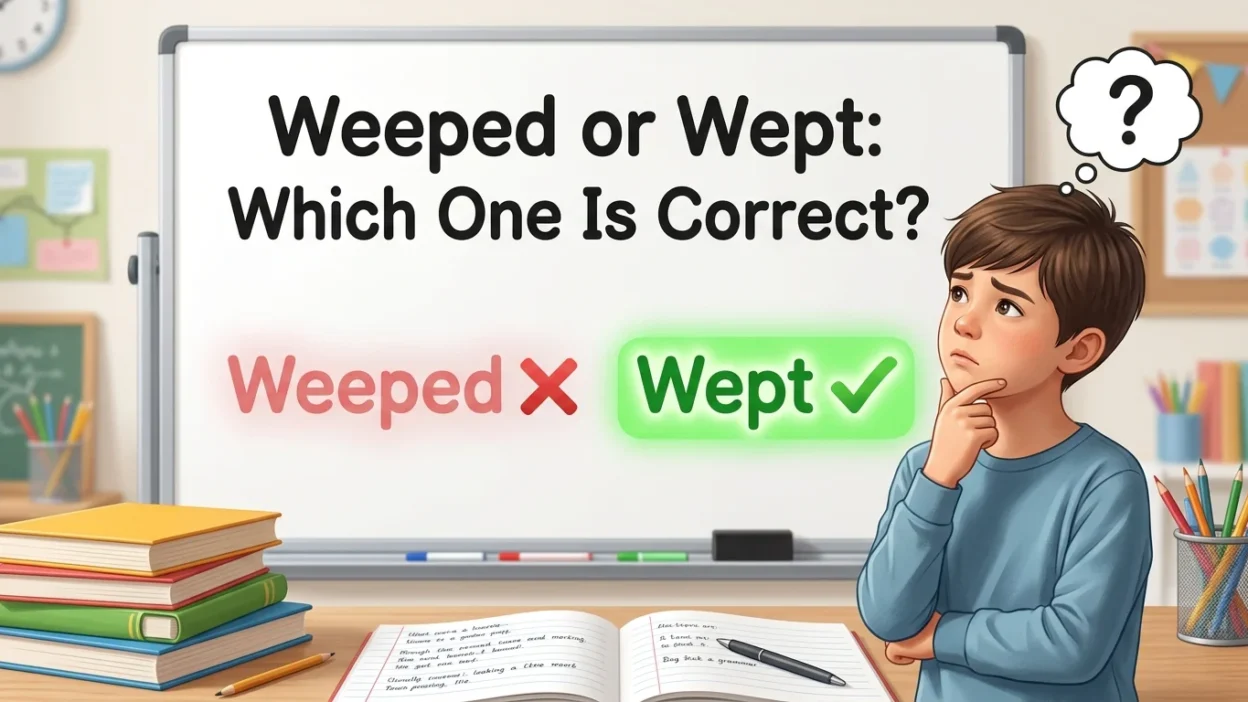
✅ Correct: wept
❌ Incorrect: weeped
Simple Origin or Background Explanation
The verb “weep” is an old English word. It has been used for hundreds of years to describe crying deeply or sadly.
Because it is an old verb, it follows an older grammar pattern instead of the normal -ed pattern.
This happens with many common English verbs:
| Present | Past |
| keep | kept |
| sleep | slept |
| weep | wept |
Notice something important:
- keep → kept
- sleep → slept
- weep → wept
The ending changes instead of adding -ed.
That is why native English speakers say “wept” and not “weeped.”
Clear Explanation of the Difference
The main difference is very simple:
“Wept” = Correct English
“Wept” is the proper past form of “weep.”
Example:
- The child wept loudly.
This sentence is grammatically correct.
“Weeped” = Usually Incorrect
“Weeped” is not normally used in modern standard English.
Example:
- The child weeped loudly. ❌
Most teachers, dictionaries, and native speakers consider this wrong.
Why Does “Weeped” Sound Possible?
Because English learners are taught this rule:
Add -ed to make the past tense.
That rule works for many verbs, but not all.
“Weep” belongs to the irregular group.
Comparison
| Word | Is It Correct? | Meaning | Example |
| weep | Yes | present tense | I weep when I watch sad movies. |
| wept | Yes | past tense/past participle | She wept all night. |
| weeped | No (usually) | considered incorrect in standard English | He weeped after the film. ❌ |
Another Quick Look
| Present | Past | Past Participle |
| weep | wept | wept |
Which One to Use and When
Use “Weep”
Use “weep” when talking about the present or future.
Examples
- Some people weep during emotional songs.
- I may weep if I hear that story again.
Use “Wept”
Use “wept” when talking about the past.
Examples
- She wept after losing her pet.
- They wept with happiness.
- He has wept before.
Do Not Use “Weeped”
Avoid using “weeped” in writing, school work, exams, emails, or formal speaking.
Even though some learners create this form naturally, it is not accepted as standard English.
Common Mistakes People Make
Mistake 1: Adding “-ed” Automatically
Many learners write:
- She weeped yesterday. ❌
Correct version:
- She wept yesterday. ✅
Mistake 2: Confusing “Weep” With “Cry”
“Weep” and “cry” are similar, but “weep” often sounds more emotional, literary, or serious.
Examples
- The baby cried.
- The mother wept quietly.
“Wept” often describes deep sadness or strong emotion.
Mistake 3: Using “Wepted”
Some beginners accidentally say:
- He wepted after the news. ❌
This is incorrect because “wept” is already the past form.
Correct:
- He wept after the news. ✅
Mistake 4: Using “Weep” Instead of “Wept”
Incorrect:
- Yesterday, she weep for hours. ❌
Correct:
- Yesterday, she wept for hours. ✅
Everyday Real Life Examples
Emails
- She wept after reading the emotional email.
- He wept when he received the goodbye message.
News
- Fans wept after the famous actor died.
- Families wept during the ceremony.
Social Media
- I wept while watching that video.
- People online said they wept at the ending.
Daily Use
- The child wept because he missed his mother.
- She wept quietly in her room.
- They wept tears of joy.
Books and Stories
“Wept” is very common in novels, poems, and emotional stories.
Example:
- The queen wept beside the river.
Short Learning Section for Students and Beginners
Here is an easy way to remember the correct form.
Memory Trick
Think about these word pairs:
| Present | Past |
| keep | kept |
| sleep | slept |
| weep | wept |
All three follow a similar pattern.
Mini Practice
Choose the correct word:
- She ___ after hearing the news.
- They have ___ many times before.
- I sometimes ___ during sad movies.
Answers
- wept
- wept
- weep
Easy Study Tip
When learning irregular verbs:
- Do not always depend on the -ed rule.
- Learn verbs in groups.
- Read simple English stories to see real examples.
FAQ
Is “weeped” a real word?
“Weeped” may appear sometimes in very old, rare, or nonstandard writing, but it is not accepted in normal modern English.
Which is correct: “weeped” or “wept”?
“Wept” is correct.
What is the past tense of “weep”?
The past tense of “weep” is “wept.”
Can I use “weeped” in school writing?
No. Use “wept” instead.
Is “wept” formal?
“Wept” is normal English, but it sounds more emotional or literary than “cried.”
What does “weep” mean?
“Weep” means to cry, usually because of strong emotion such as sadness, pain, or even happiness.
Is “wept” still used today?
Yes. People still use it in books, movies, news, and everyday speech.
What is the difference between “cried” and “wept”?
Both mean crying, but “wept” often sounds deeper, softer, or more emotional.
Conclusion
The confusion between “weeped” and “wept” happens because many English verbs use -ed in the past tense. However, “weep” is an irregular verb.
The correct past form is:
- weep → wept
Remember:
- ✅ She wept yesterday.
- ❌ She weeped yesterday.
Once you learn this simple rule, the confusion disappears. If you are unsure, always choose “wept” in standard English.

Ely Joseph is a language researcher, writer, and contributor who specializes in words, meanings, and multilingual communication. With a strong interest in how language shapes understanding across cultures, Ely focuses on creating clear, accurate, and reader-friendly content for a global audience.