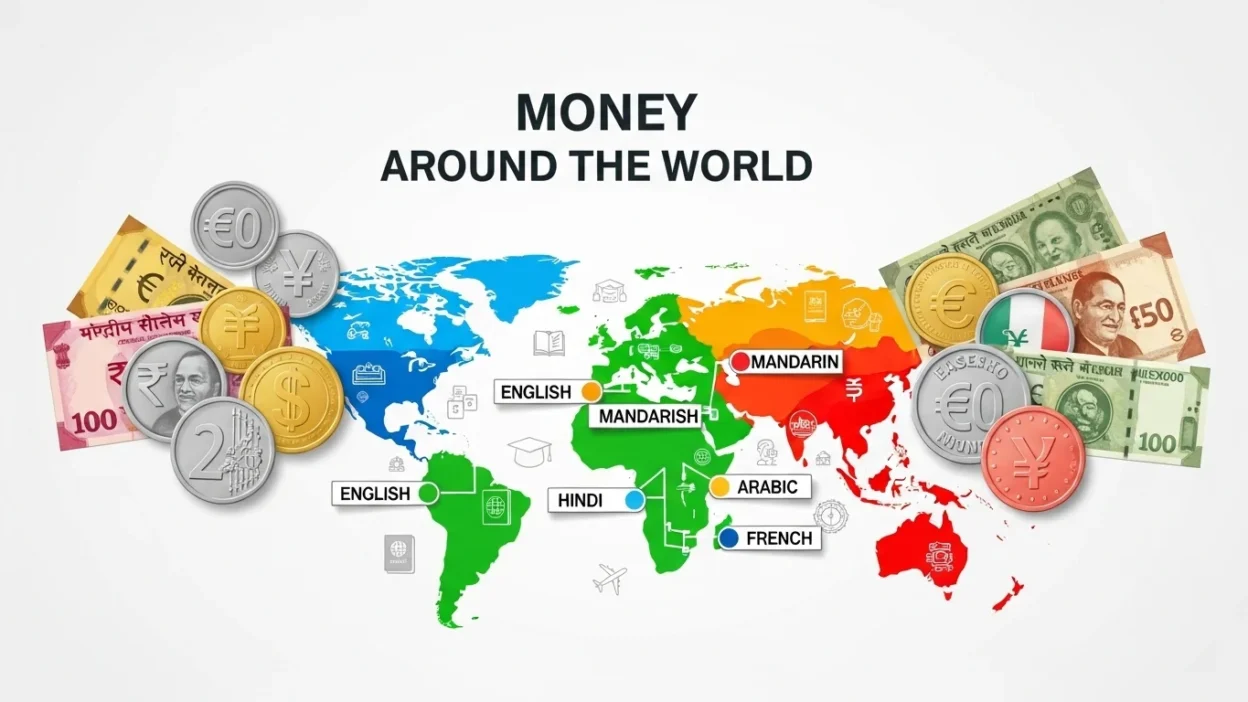
Understanding how to say money in different languages can be fascinating and useful. Whether you are traveling, learning a new language, or exploring cultures, knowing money translations helps you communicate better in financial conversations.
This guide will show you money in all languages with clear examples, pronunciation tips, and practical usage, making it easy to grasp the meaning and context in each culture.
Learning how to say money in different languages also reveals cultural nuances in finance and spending habits worldwide. Below, you’ll find a comprehensive table of money around the world in 70 languages.
Money in Different Languages: 70 Examples
| Language | Pronunciation | Example | English Meaning |
| Arabic | Nuqūd | أحتاج إلى بعض النقود | I need some money |
| Spanish | Dinero | No tengo dinero | I don’t have money |
| French | Argent | J’ai perdu mon argent | I lost my money |
| German | Geld | Ich habe kein Geld | I have no money |
| Italian | Soldi | Ho bisogno di soldi | I need money |
| Portuguese | Dinheiro | Ele tem muito dinheiro | He has a lot of money |
| Russian | Деньги (Dengi) | У меня нет денег | I have no money |
| Chinese (Mandarin) | 钱 (Qián) | 我没有钱 | I have no money |
| Japanese | お金 (Okane) | お金が必要です | I need money |
| Korean | 돈 (Don) | 나는 돈이 필요해요 | I need money |
| Hindi | पैसा (Paisa) | मुझे पैसे चाहिए | I need money |
| Bengali | টাকা (Taka) | আমার কাছে টাকা নেই | I don’t have money |
| Urdu | پیسہ (Paisa) | میرے پاس پیسہ نہیں ہے | I don’t have money |
| Turkish | Para | Param yok | I have no money |
| Vietnamese | Tiền | Tôi không có tiền | I have no money |
| Thai | เงิน (Ngern) | ฉันไม่มีเงิน | I have no money |
| Greek | Χρήματα (Chrímata) | Δεν έχω χρήματα | I have no money |
| Hebrew | כסף (Kesef) | אין לי כסף | I have no money |
| Polish | Pieniądze | Nie mam pieniędzy | I don’t have money |
| Dutch | Geld | Ik heb geen geld | I have no money |
| Swedish | Pengar | Jag har inga pengar | I have no money |
| Norwegian | Penger | Jeg har ikke penger | I don’t have money |
| Danish | Penge | Jeg har ingen penge | I have no money |
| Finnish | Raha | Minulla ei ole rahaa | I don’t have money |
| Hungarian | Pénz | Nincs pénzem | I have no money |
| Czech | Peníze | Nemám peníze | I don’t have money |
| Slovak | Peniaze | Nemám peniaze | I don’t have money |
| Romanian | Bani | Nu am bani | I don’t have money |
| Bulgarian | Пари (Pari) | Нямам пари | I have no money |
| Serbian | Новац (Novac) | Nemam novac | I have no money |
| Croatian | Novac | Nemam novac | I have no money |
| Bosnian | Novac | Nemam novac | I don’t have money |
| Slovenian | Denar | Nimam denarja | I don’t have money |
| Malay | Wang | Saya tiada wang | I have no money |
| Indonesian | Uang | Saya tidak punya uang | I don’t have money |
| Filipino | Pera | Wala akong pera | I don’t have money |
| Swahili | Pesa | Sina pesa | I don’t have money |
| Zulu | Imali | Anginayo imali | I don’t have money |
| Xhosa | Imali | Andinayo imali | I don’t have money |
| Somali | Lacag | Ma haysto lacag | I don’t have money |
| Amharic | ገንዘብ (Genzeb) | ገንዘብ የለኝም | I have no money |
| Nepali | पैसा (Paisa) | मसँग पैसा छैन | I don’t have money |
| Sinhala | මුදල් (Mudal) | මට මුදල් නැහැ | I have no money |
| Khmer | ប្រាក់ (Brak) | ខ្ញុំមិនមានប្រាក់ | I have no money |
| Lao | ເງິນ (Ngeun) | ຂ້ອຍບໍ່ມີເງິນ | I have no money |
| Mongolian | Мөнгө (Mung) | Намайг мөнгөгүй байна | I have no money |
| Kazakh | Ақша (Aqsha) | Маған ақша жоқ | I have no money |
| Uzbek | Pul | Menda pul yo‘q | I don’t have money |
| Tajik | Пул (Pul) | Ман пул надорам | I have no money |
| Kyrgyz | Акча (Akcha) | Менде акча жок | I have no money |
| Pashto | پیسې (Pisay) | زه پیسې نلرم | I have no money |
| Dari | پول (Pul) | من پول ندارم | I have no money |
| Maltese | Flus | Ma għandi l-ebda flus | I have no money |
| Irish | Airgead | Níl airgead agam | I have no money |
| Scottish Gaelic | Airgead | Chan eil airgead agam | I have no money |
| Welsh | Arian | Does gen i ddim arian | I have no money |
| Basque | Dirua | Dirurik ez dut | I have no money |
| Catalan | Diners | No tinc diners | I have no money |
| Galician | Diñeiro | Non teño diñeiro | I don’t have money |
| Icelandic | Peningar | Ég á engar peninga | I have no money |
| Latvian | Nauda | Man nav naudas | I have no money |
| Lithuanian | Pinigai | Neturiu pinigų | I have no money |
| Estonian | Raha | Mul pole raha | I have no money |
| Georgian | ფული (Puli) | მე ფული არ მაქვს | I have no money |
| Armenian | Գումար (Gumar) | Ես գումար չունեմ | I have no money |
| Azerbaijani | Pul | Mənim pulum yoxdur | I have no money |
| Thai (Northern) | เงิน (Ngoen) | ข้าพเจ้าไม่มีเงิน | I have no money |
Tips on Using Money Translations Around the World
Learning money in all languages is more than memorizing words it helps you understand local currency names, slang, and context.
For instance, some countries use specific words for coins vs. bills. When traveling, saying “I need money” correctly can make transactions smoother and more culturally appropriate.
Why Knowing Money Translations Matters
- Travel convenience: Avoid misunderstandings at banks, shops, and markets.
- Cultural insight: Language often reflects how societies value money.
- Learning efficiency: Associating words with practical examples reinforces memory.
By using this guide, you can confidently ask for or discuss money in 70 languages, bridging communication gaps effortlessly.
Conclusion
Knowing how to say money in different languages opens doors to better communication, cultural understanding, and travel efficiency.
From Arabic to Zulu, these money translations are practical, easy to learn, and universally useful.
Master these 70 translations, and you’ll never feel lost when discussing money around the world.
FAQs
1. What is the best way to remember money in different languages?
Use real life examples and repeat the phrases aloud. Associating the word with daily transactions helps retention.
2. Are there slang terms for money in other languages?
Yes, many languages have informal words for cash, like “bucks” in English or “plata” in Spanish.
3. How do I ask for money politely in another language?
Use phrases like “Could you please give me money?” and always include polite expressions.
4. Is the pronunciation important when learning money translations?
Absolutely. Correct pronunciation ensures you are understood and respected in local settings.
5. Can I use this guide for business purposes?
Yes, these money translations are suitable for both casual and professional communication globally.

Marak Robort is a content writer and researcher with a strong interest in language, meanings, and digital information. His work focuses on presenting clear, easy-to-understand explanations that help readers quickly grasp complex ideas.