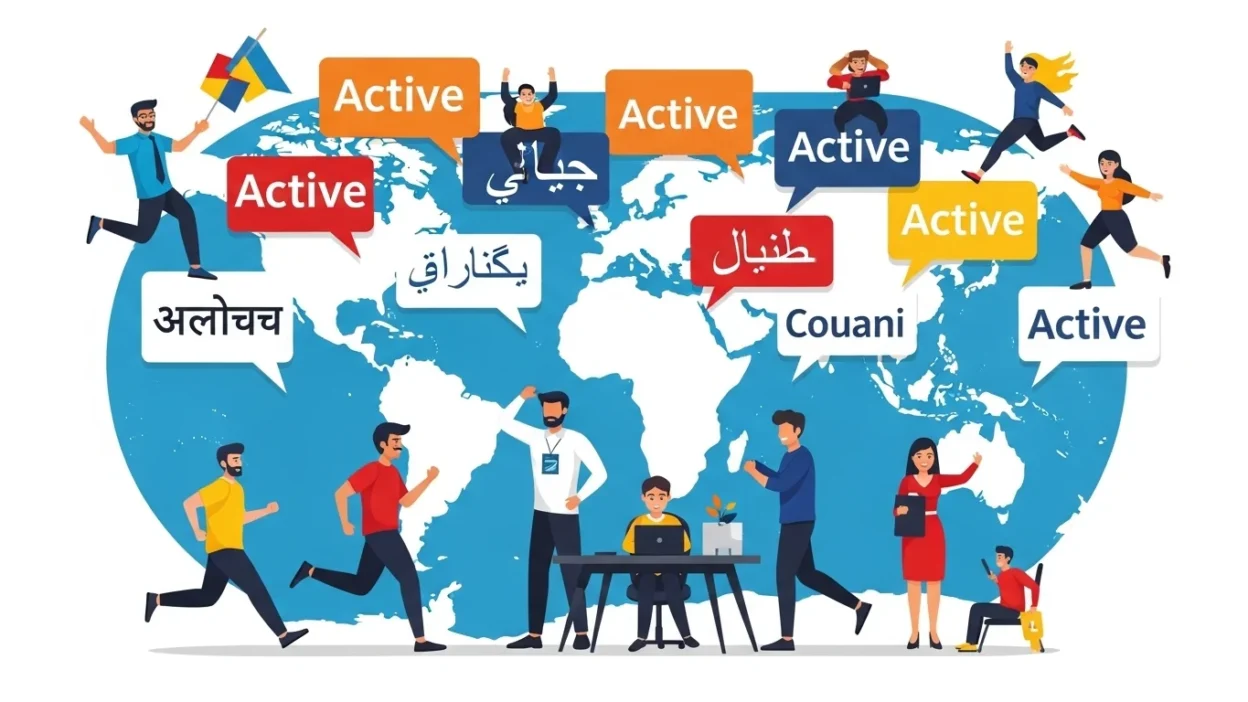
Understanding how to say “active” in different languages helps you communicate more effectively across cultures whether you’re traveling, learning a new language, or creating global content.
In this guide, you’ll discover “100+ active in different languages” presented in a clean, easy to read format with real life examples and meanings.
If you’ve ever searched for how to say active in different languages, this article gives you practical translations, pronunciation guidance, and usage examples you can actually use.
“Active” in All Languages:
| Language | Pronunciation | Example |
| English | ak-tiv | She is very active at work. (Meaning: She is energetic and involved.) |
| Spanish | ak-TEE-vo | Ella es muy activa. (Meaning: She is very active.) |
| French | ak-teev | Il est très actif. (Meaning: He is very active.) |
| German | AK-teef | Er ist sehr aktiv. (Meaning: He is very active.) |
| Italian | at-TEE-vo | Lei è molto attiva. (Meaning: She is very active.) |
| Portuguese | a-CHI-vo | Ele é muito ativo. (Meaning: He is very active.) |
| Dutch | ak-TEEF | Zij is actief. (Meaning: She is active.) |
| Russian | ak-TEEV-nyy | Он активный. (Meaning: He is active.) |
| Chinese (Mandarin) | huó yuè | 她很活跃。 (Meaning: She is very active.) |
| Japanese | ak-ti-bu | 彼はアクティブです。 (Meaning: He is active.) |
| Korean | hwal-bal-han | 그는 활발하다. (Meaning: He is active.) |
| Arabic | nashit | هو نشيط. (Meaning: He is active.) |
| Hindi | sakriya | वह सक्रिय है। (Meaning: He is active.) |
| Urdu | fa-aal | وہ فعال ہے۔ (Meaning: He is active.) |
| Turkish | ak-tif | O çok aktif. (Meaning: He is very active.) |
| Greek | ak-ti-vos | Είναι ενεργός. (Meaning: He is active.) |
| Polish | ak-TIV-ny | On jest aktywny. (Meaning: He is active.) |
| Swedish | AK-teev | Hon är aktiv. (Meaning: She is active.) |
| Norwegian | AK-teev | Han er aktiv. (Meaning: He is active.) |
| Danish | AK-teev | Hun er aktiv. (Meaning: She is active.) |
| Finnish | AK-tiiv-i-nen | Hän on aktiivinen. (Meaning: He/She is active.) |
| Czech | AK-tiv-nee | On je aktivní. (Meaning: He is active.) |
| Hungarian | ak-TEEV | Ő aktív. (Meaning: He/She is active.) |
| Romanian | ak-TEEV | El este activ. (Meaning: He is active.) |
| Bulgarian | ak-TEE-ven | Той е активен. (Meaning: He is active.) |
| Ukrainian | ak-TIV-nyy | Він активний. (Meaning: He is active.) |
| Hebrew | pa-eel | הוא פעיל. (Meaning: He is active.) |
| Thai | แอคทีฟ | เขาแอคทีฟ. (Meaning: He is active.) |
| Vietnamese | tích cực | Anh ấy rất tích cực. (Meaning: He is very active.) |
| Indonesian | ak-tif | Dia aktif. (Meaning: He/She is active.) |
| Malay | ak-tif | Dia sangat aktif. (Meaning: He/She is very active.) |
| Filipino | ak-tib | Siya ay aktibo. (Meaning: He/She is active.) |
| Swahili | hai | Yeye ni hai. (Meaning: He/She is active.) |
| Zulu | sebenza | Uyasebenza. (Meaning: He is active.) |
| Afrikaans | AK-teef | Hy is aktief. (Meaning: He is active.) |
| Persian | fa-al | او فعال است. (Meaning: He is active.) |
| Bengali | sokriyo | সে সক্রিয়। (Meaning: He is active.) |
| Tamil | seyalil | அவன் செயலிலிருக்கிறான். (Meaning: He is active.) |
| Telugu | sakriyam | అతను సక్రియంగా ఉన్నాడు. (Meaning: He is active.) |
| Marathi | sakriya | तो सक्रिय आहे. (Meaning: He is active.) |
| Gujarati | sakriya | તે સક્રિય છે. (Meaning: He is active.) |
| Punjabi | sargaram | ਉਹ ਸਰਗਰਮ ਹੈ। (Meaning: He is active.) |
| Sinhala | sakriya | ඔහු සක්රීයයි. (Meaning: He is active.) |
| Nepali | sakriya | ऊ सक्रिय छ। (Meaning: He is active.) |
| Khmer | sakam | គាត់សកម្ម។ (Meaning: He is active.) |
| Lao | sakam | ລາວສະກັມ. (Meaning: He is active.) |
| Burmese | sakriya | သူသည် လှုပ်ရှားသည်။ (Meaning: He is active.) |
| Mongolian | идэвхтэй | Тэр идэвхтэй. (Meaning: He is active.) |
| Icelandic | ak-tiv | Hann er virkur. (Meaning: He is active.) |
| Estonian | ak-TIIV-ne | Ta on aktiivne. (Meaning: He is active.) |
| Latvian | ak-TIIV-s | Viņš ir aktīvs. (Meaning: He is active.) |
| Lithuanian | ak-TIIV-us | Jis aktyvus. (Meaning: He is active.) |
| Slovak | ak-TIV-ny | On je aktívny. (Meaning: He is active.) |
| Slovenian | ak-TIV-en | On je aktiven. (Meaning: He is active.) |
| Croatian | ak-TIV-an | On je aktivan. (Meaning: He is active.) |
| Serbian | ak-TIV-an | Он је активан. (Meaning: He is active.) |
| Bosnian | ak-TIV-an | On je aktivan. (Meaning: He is active.) |
| Albanian | ak-TIV | Ai është aktiv. (Meaning: He is active.) |
| Macedonian | ak-TI-ven | Тој е активен. (Meaning: He is active.) |
| Armenian | ak-tiv | Նա ակտիվ է։ (Meaning: He is active.) |
| Georgian | ak-tiv | ის აქტიურია. (Meaning: He is active.) |
| Kazakh | bel-send-i | Ол белсенді. (Meaning: He is active.) |
| Uzbek | faol | U faol. (Meaning: He is active.) |
| Azerbaijani | ak-tiv | O aktivdir. (Meaning: He is active.) |
| Tajik | faol | Ӯ фаъол аст. (Meaning: He is active.) |
| Kurdish | çalak | Ew çalak e. (Meaning: He is active.) |
| Pashto | fa-al | هغه فعال دی. (Meaning: He is active.) |
| Somali | firfircoon | Wuxuu firfircoon yahay. (Meaning: He is active.) |
| Amharic | ne-kas | እሱ ንቁ ነው። (Meaning: He is active.) |
How to Say “Active” in Different Languages
The word “active” around the world often conveys energy, participation, and movement. In many languages, it directly translates to a form similar to “aktiv,” especially in European languages, while others use entirely different roots.
Learning these variations improves communication and helps in multilingual SEO, travel, and education.
Why Learn “Active” Translations?
Knowing “active” translations is useful in:
- Everyday conversations when traveling
- Language learning and vocabulary building
- Understanding cultural communication styles
It also helps when targeting keywords like “active in all languages” for international audiences.
Tips to Remember “Active” in Multiple Languages
- Many European languages use similar forms like aktiv or actif
- Asian languages often use unique native words
- Practice using short sentences for better retention
- Focus on pronunciation along with spelling
Conclusion
Learning 100+ active in different languages opens doors to better communication and global understanding. Whether you’re a traveler, student, or content creator, these translations make it easier to connect with people worldwide.
FAQs
1. What is “active” in most languages?
In many European languages, it appears as “aktiv” or a similar variation.
2. How do you say active in Asian languages?
In Chinese, it’s “huó yuè,” and in Japanese, “akutibu.”
3. Why are many translations similar?
Many languages share Latin or Greek roots, leading to similar words.
4. Is “active” used the same way globally?
Mostly yes, but context and tone can vary by culture.
5. How can I learn these translations faster?
Practice daily, use flashcards, and speak sentences out loud.

David William is a language enthusiast, researcher, and content creator at Lingoveb. With a deep passion for words, meanings, and global communication, he focuses on making language simple, clear, and accessible for readers around the world.