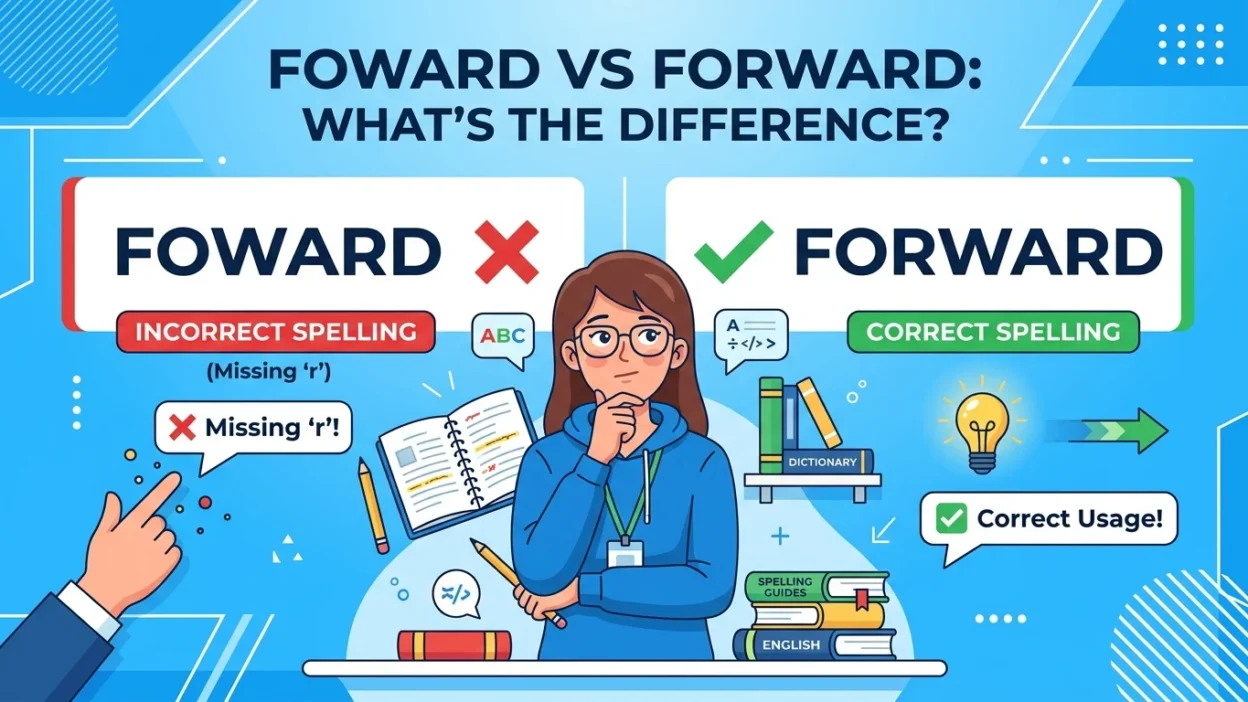
Many English learners and even native speakers sometimes write foward instead of forward. The two words look very similar, and when people type quickly, they often miss one letter.
The confusion usually happens because:
- The words sound almost the same when spoken quickly.
- People accidentally leave out the letter “r.”
- Some learners think both spellings are correct.
The good news is that the difference is very simple.
Only one spelling is correct in standard English: “forward.”
The word “foward” is a spelling mistake.
Once you understand this, you will never have to wonder which one to use again.
Quick Answer
- ✅ Forward = the correct English spelling.
- ❌ Foward = an incorrect spelling and should not be used.
- ✅ Use forward in writing, emails, school work, and everyday conversations.
- ❌ Avoid foward because dictionaries and grammar rules do not accept it.
Example:
✅ Please move forward.
❌ Please move foward.
Simple Origin and Background
The word forward has been part of English for hundreds of years. It comes from old forms of English that meant:
- toward the front
- ahead
- moving in the direction in front of you
Over time, the spelling became forward, and this spelling stayed the same.
The spelling foward did not develop as a real English word. It usually appears because someone accidentally forgets to type the second “r.”
So, from a language point of view:
- Forward = real English word.
- Foward = typing or spelling error.
Clear Explanation of the Difference
The difference is actually very easy.
Forward
Forward is a real English word. It can be:
- an adjective
- an adverb
- a verb
- a noun in some situations
It usually means:
- ahead
- toward the front
- making progress
- sending something to another person
Examples:
- We need to move forward.
- She stepped forward.
- Please forward this email to me.
Foward
Foward is not a standard English word.
People write it by mistake because they forget the second r.
Example:
❌ I look foward to meeting you.
Correct:
✅ I look forward to meeting you.
Comparison Table
| Feature | Forward | Foward |
| Correct spelling? | Yes | No |
| Found in dictionaries? | Yes | No |
| Used in formal writing? | Yes | No |
| Used in emails? | Yes | No |
| Means ahead or in front? | Yes | No |
| Should you use it? | Yes | No |
Which One to Use and When
You should use forward every time.
Use “forward” when talking about movement.
Examples:
- Walk forward.
- The car moved forward.
Use “forward” when talking about progress.
Examples:
- We are moving forward with our plans.
- The company is going forward with the project.
Use “forward” when sending something.
Examples:
- Please forward the message.
- I will forward the document tomorrow.
Never use “foward”
There is no situation in standard English where foward is the correct choice.
Common Mistakes People Make
Leaving out the second “r”
❌ Foward
✅ Forward
Writing too quickly
Many people type fast and do not notice the missing letter.
Not checking spelling
Spell checkers often find the mistake immediately, but some people ignore the warning.
Confusing pronunciation with spelling
Words do not always sound exactly like they are spelled in English. Even if foward sounds similar, it is still wrong.
Making mistakes in the phrase “look forward to”
This is one of the most common errors.
❌ I look foward to hearing from you.
✅ I look forward to hearing from you.
Everyday Real Life Examples
Emails
✅ I look forward to your reply.
✅ Please forward this email to the manager.
❌ I look foward to your reply.
News
✅ The country is moving forward with new plans.
✅ Leaders want to move the project forward.
Social Media
✅ Looking forward to the weekend!
✅ Can’t wait to move forward and start something new.
Daily Conversations
✅ Step forward, please.
✅ We need to move forward together.
✅ I look forward to seeing you tomorrow.
Short Learning Section for Students and Beginners
A simple trick can help you remember the correct spelling.
Remember this pattern:
For + ward = forward
Think of the word as having two parts:
- for
- ward
Together they make:
forward
Notice that there are two “r” letters.
Another memory trick:
If you move forward, you need the extra r to keep going.
Practice these sentences:
- I look forward to summer vacation.
- The teacher stepped forward.
- Please forward the message.
- We are moving forward with our plans.
Writing these sentences a few times can help you remember the correct spelling forever.
Frequently Asked Questions (FAQ)
Is “foward” a real English word?
No. It is a spelling mistake.
Is “forward” the correct spelling?
Yes. It is the only correct standard spelling.
Why do people write “foward”?
Most people accidentally forget the second r.
Can I use “foward” in school writing?
No. Teachers will usually mark it as a spelling error.
Is “foward” in the dictionary?
No. Standard dictionaries list forward, not foward.
Which spelling should I use in emails?
Always use forward.
Is “look foward to” correct?
No.
The correct phrase is:
look forward to
Can spell check fix this mistake?
Usually yes. Most spelling tools suggest changing foward to forward.
Conclusion
The difference between foward and forward is very simple.
- ✅ Forward is the correct English spelling.
- ❌ Foward is a spelling mistake.
Use forward when you mean:
- ahead
- toward the front
- making progress
- sending something to another person
If you ever feel unsure, remember this:
Forward has two “r” letters, and it is always the correct choice.
Once you remember that small detail, you will never confuse foward and forward again.

Ely Joseph is a language researcher, writer, and contributor who specializes in words, meanings, and multilingual communication. With a strong interest in how language shapes understanding across cultures, Ely focuses on creating clear, accurate, and reader-friendly content for a global audience.