Many English learners get confused by rehireable and rehirable because both words look correct. They both come from the verb rehire, which means to hire someone again after they have left a job.
When people add endings like -able or -ible to a word, the spelling can become confusing. Some words keep an extra letter, while others do not. Because of this, many people are not sure whether they should write rehireable or rehirable.
The good news is that the difference is simple once you understand it.
Quick Answer
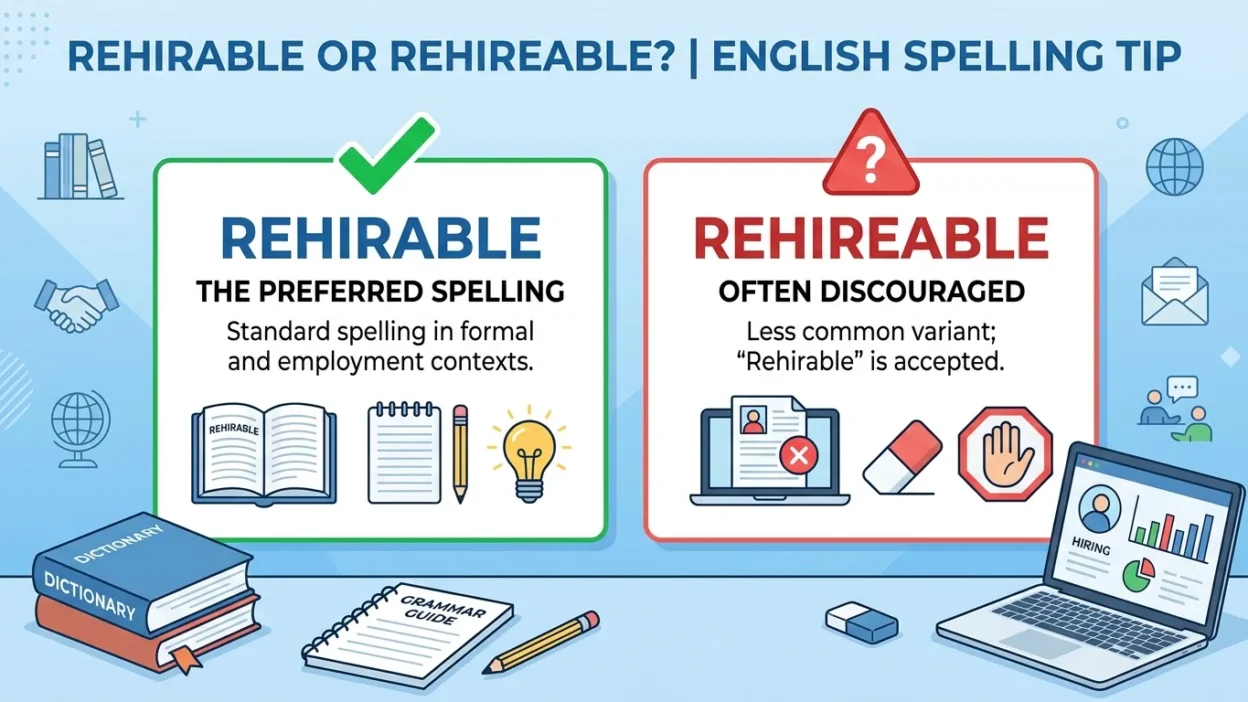
- ✅ Rehirable is the preferred and standard spelling.
- ❌ Rehireable is usually considered a less common or nonstandard spelling.
- Rehirable means that a former employee can be hired again.
- In professional writing, job records, and business documents, rehirable is the better choice.
Example:
- The employee left on good terms and is rehirable.
- The company marked her as rehirable after her contract ended.
Simple Origin and Background
The word rehirable comes from two parts:
- Rehire = to hire again
- -able = able to be
When we combine them, the meaning becomes:
Rehirable = able to be hired again.
English spelling often removes an extra e before adding -able.
For example:
- admire → admirable
- desire → desirable
- rehire → rehirable
This is why rehirable became the preferred spelling.
Some people still write rehireable because they keep the whole word rehire and simply add -able at the end. Although you may occasionally see this spelling, it is much less common.
Clear Explanation of the Difference
The meaning of both words is exactly the same.
Both mean:
A person can be hired again by the same company.
The real difference is only in the spelling.
Rehirable
- Standard spelling
- More widely accepted
- Better for professional writing
- Common in human resources and business documents
Rehireable
- Alternative spelling
- Less common
- May look incorrect to some readers
- Usually avoided in formal writing
Think of it this way:
The difference is about spelling, not meaning.
Comparison Table
| Feature | Rehirable | Rehireable |
| Meaning | Can be hired again | Can be hired again |
| Standard spelling | Yes | No, usually not |
| Used in business writing | Very common | Rare |
| Suitable for formal documents | Yes | Usually avoided |
| Easy for readers to recognize | Yes | Sometimes confusing |
Which One to Use and When
Use “Rehirable” in Professional Writing
Choose rehirable when writing:
- Job applications
- Company records
- Business emails
- Employee evaluations
- Human resources documents
- School assignments
Examples:
- The worker is marked as rehirable.
- She remains rehirable after leaving the company.
Should You Ever Use “Rehireable”?
You might see rehireable in:
- Informal writing
- Old documents
- Social media posts
- Personal notes
However, if you want to be safe and professional, choose rehirable.
Common Mistakes People Make
Mistake 1: Thinking They Have Different Meanings
Some people believe:
- rehirable = one meaning
- rehireable = another meaning
This is not true.
Both words mean the same thing.
Mistake 2: Using Rehireable in Formal Documents
Because rehireable looks natural, some people use it in resumes or reports.
It is better to use rehirable instead.
Mistake 3: Forgetting the Meaning
Some learners think rehirable means:
“Looking for a new job.”
This is incorrect.
It actually means:
“Allowed or suitable to be hired again.”
Mistake 4: Confusing It With “Rehired”
These words are different.
- Rehired = someone was hired again.
- Rehirable = someone can be hired again.
Example:
- She was rehired last month.
- She is rehirable if another position opens.
Everyday Real Life Examples
Emails
- The employee resigned politely and is considered rehirable.
- According to our records, he is rehirable.
News
- Several former workers are now rehirable after the company changed its policy.
- The business announced that many past employees are rehirable.
Social Media
- I left my old job on good terms, so I’m still rehirable.
- My manager said I am rehirable, which is great news.
Daily Conversations
- Is she rehirable?
- Yes, the company would hire her again.
Short Learning Section for Students and Beginners
A simple way to remember this word is:
Rehire + able = Rehirable
Even though the base word ends with e, English often removes that extra e before adding -able.
Easy Memory Trick
Think:
- desire → desirable
- admire → admirable
- rehire → rehirable
This pattern can help you remember the correct spelling.
Simple Sentence Practice
- My former company says I am rehirable.
- The manager marked him as rehirable.
- She remains rehirable after leaving the job.
- Many workers hope to stay rehirable.
Practicing these sentences will help you remember the word.
Frequently Asked Questions (FAQ)
Is rehireable a real word?
It appears in some places, but it is much less common than rehirable.
Which spelling is correct?
Rehirable is the preferred and standard spelling.
Do both words mean the same thing?
Yes. Both mean that someone can be hired again.
Which spelling should students use?
Students should use rehirable because it is more widely accepted.
Which spelling should I use in a resume?
Use rehirable.
Does rehirable mean someone already got their old job back?
No.
It only means the person can be hired again.
Can a person be rehirable after quitting?
Yes. Many employees who leave politely are still considered rehirable.
Is rehirable used only in business?
Mostly, yes. It is mainly used in employment and workplace situations.
Conclusion
The confusion between rehireable and rehirable comes from English spelling rules. The two words have the same meaning, but one spelling is preferred.
Remember these key points:
- ✅ Rehirable is the standard spelling.
- ✅ It means someone can be hired again.
- ❌ Rehireable is less common and usually avoided in formal writing.
- ✅ For school, business, and professional documents, choose rehirable.
If you remember one thing, remember this:
When talking about a person who can be hired again, “rehirable” is the spelling you should normally use.

David William is a language enthusiast, researcher, and content creator at Lingoveb. With a deep passion for words, meanings, and global communication, he focuses on making language simple, clear, and accessible for readers around the world.