
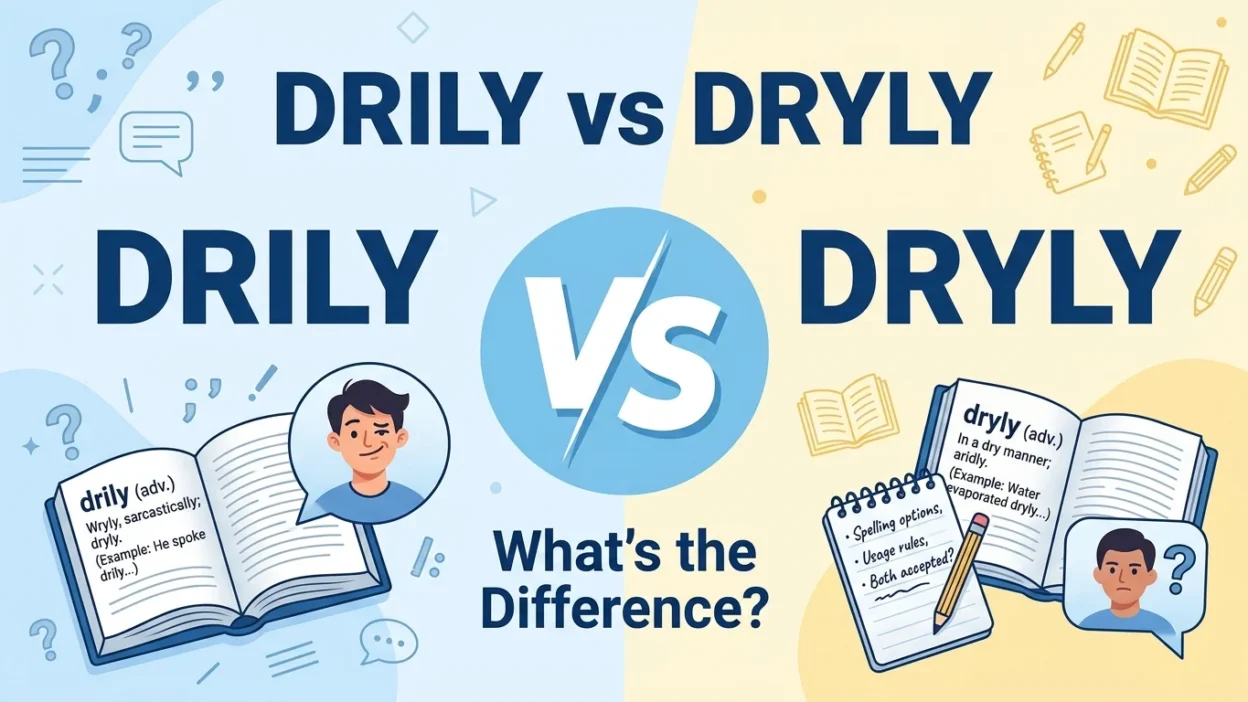
Many English learners become confused by drily and dryly because both words are correct and both have the same meaning. When people see two spellings for one word, they often wonder:
- Which one is right?
- Is one spelling old and the other new?
- Do they mean different things?
The good news is that there is no big difference in meaning. The confusion comes only from the spelling. Once you understand when and why each spelling is used, choosing the right one becomes easy.
Quick Answer
- Drily and dryly have the same meaning.
- Both words are adverbs that come from the adjective dry.
- Both can mean:
- In a way that is not wet.
- In a serious, unemotional, or slightly funny way.
- Dryly is more common in modern English.
- Drily is less common but still correct.
Simple answer: Use dryly in most situations because it is the spelling people see more often today.
The Simple Background of These Words
The adjective dry has been part of English for hundreds of years. It originally described something that had no water or moisture.
Later, English speakers began using dry in another way. A person could speak in a dry manner, meaning:
- serious
- calm
- showing little emotion
- quietly funny
When people wanted an adverb form of dry, two spellings appeared:
- drily
- dryly
Over time, both spellings became accepted. That is why dictionaries usually list both forms today.
What Is the Difference Between Drily and Dryly?
The biggest thing to remember is this:
There is no difference in meaning.
Both words can describe:
Something that is not wet
Example:
- The clothes were folded dryly after sitting in the sun.
- The clothes were folded drily after sitting in the sun.
Both sentences are correct, although this use is less common.
A way of speaking
Example:
- She dryly said, “That was a great idea,” after the plan failed.
- She drily said, “That was a great idea,” after the plan failed.
Again, both sentences mean the same thing.
In everyday English, people usually choose dryly because it looks more natural to many readers.
Drily vs Dryly Comparison Table
| Feature | Drily | Dryly |
| Correct spelling? | Yes | Yes |
| Meaning | Same as dryly | Same as drily |
| Used in modern English? | Yes, but less often | Yes, very often |
| Means “without emotion”? | Yes | Yes |
| Means “not wet”? | Yes | Yes |
| Best choice for learners? | Acceptable | Recommended |
Easy tip: If you are unsure, choose dryly.
Which One Should You Use and When?
Use “dryly” for everyday writing
Examples:
- She dryly thanked him.
- He dryly replied that everything was fine.
- The teacher dryly joked about the difficult test.
This spelling is common in:
- books
- newspapers
- blogs
- school writing
- business writing
Use “drily” if you prefer that style
Some writers simply like the look of drily. It is not wrong.
Examples:
- He drily remarked that the meeting was too long.
- She drily answered the question.
However, because dryly is more familiar to many readers, it is usually the safer choice.
Common Mistakes People Make
Mistake 1: Thinking one word is wrong
Many learners believe that only dryly is correct.
This is false.
Both spellings are accepted.
Mistake 2: Thinking the meanings are different
Some people think:
- drily means “not wet”
- dryly means “without emotion”
This is also false.
Both meanings belong to both spellings.
Mistake 3: Using both spellings in one piece of writing
For example:
- He dryly laughed.
- She drily answered.
This is not a grammar mistake, but it can make your writing look inconsistent.
Choose one spelling and stay with it.
Mistake 4: Confusing “dryly” with “dry”
Incorrect:
- She spoke dry.
Correct:
- She spoke dryly.
The adverb form needs -ly.
Everyday Real Life Examples
Emails
- She dryly thanked the team for another late meeting.
- He dryly wrote, “I look forward to receiving the report.”
News
- The mayor dryly commented that the traffic problem was “a little difficult.”
- The coach dryly admitted that the team had made mistakes.
Social Media
- She dryly posted, “Well, that went exactly as planned.”
- He dryly tweeted that his computer crashed five minutes before the deadline.
Daily Conversations
- Dad dryly said, “Wonderful weather,” while standing in heavy rain.
- My friend dryly replied, “That sounds like a fantastic idea,” when I suggested more homework.
Learning Section for Students and Beginners
A simple way to remember these words is:
Step 1
Ask yourself:
Do I need an adverb?
If yes, you need:
- dryly
- drily
Step 2
Ask yourself:
Do I want the most common spelling?
If yes, use:
dryly
Memory Trick
Think of this sentence:
Dryly is usually the easy choice.
This will help you remember which spelling is more common.
Practice Sentences
Fill in the blank:
- She ______ said that the meeting lasted forever.
- He ______ replied, “That’s wonderful.”
- The manager ______ joked about the mistake.
Possible answers:
- dryly
- drily
Both answers are correct.
Frequently Asked Questions
Is “drily” a real word?
Yes. It is a correct English word and appears in dictionaries.
Is “dryly” a real word?
Yes. It is also correct and is the more common spelling.
Do they mean different things?
No. They have the same meanings.
Which spelling should students use?
Most students should use dryly because readers see it more often.
Can I use “drily” in formal writing?
Yes. It is completely acceptable.
Which spelling is used more today?
Generally, dryly is used more often in modern writing.
Can both words describe someone’s sense of humor?
Yes.
Example:
- He dryly said that he loved waking up at 5 a.m.
- He drily said that he loved waking up at 5 a.m.
Both show a dry sense of humor.
Should I switch between the two spellings?
It is better to choose one spelling and use it consistently.
Conclusion
The difference between drily and dryly is much simpler than many people think. Both spellings are correct, and both have exactly the same meanings. They can describe something that is not wet or a way of speaking that is calm, serious, or quietly funny.
The only real difference is popularity. Dryly is the spelling most people use today, while drily appears less often.
If you are a student or an English learner, the easiest rule is:
- Dryly = recommended for everyday writing
- Drily = also correct but less common
Remember this simple idea, and you will never be confused by drily vs dryly again.

Ely Joseph is a language researcher, writer, and contributor who specializes in words, meanings, and multilingual communication. With a strong interest in how language shapes understanding across cultures, Ely focuses on creating clear, accurate, and reader-friendly content for a global audience.