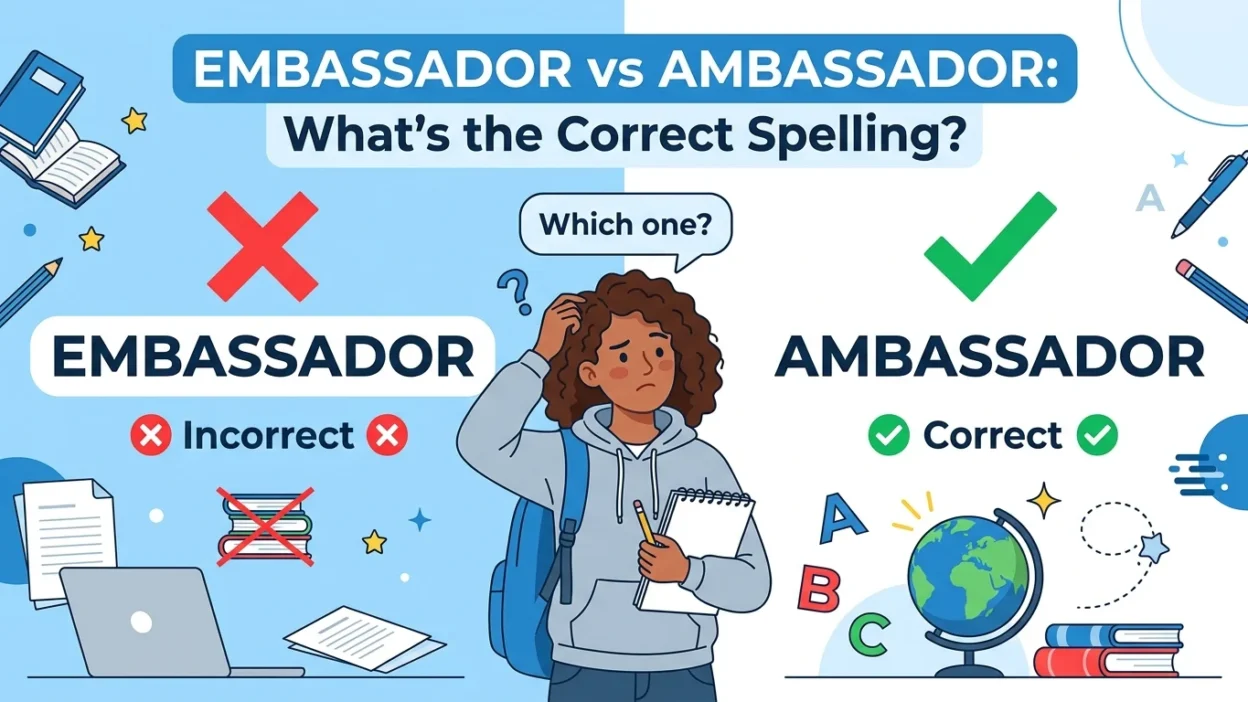
Many people become confused about embassador vs ambassador because both words look very similar. When we hear the word spoken, the pronunciation can also sound close, especially for English learners.
The truth is simple: one spelling is correct, and the other is usually a spelling mistake.
If you have ever wondered which one to use, this guide will explain everything in easy English.
Quick Answer
- Ambassador is the correct English word.
- Embassador is considered a misspelling in standard English.
- Use ambassador when talking about:
- A government representative
- A person who represents a company or organization
- A person who promotes a product, idea, or cause
- Avoid using embassador in writing, school assignments, emails, and professional documents.
Correct: She became an ambassador for the charity.
Incorrect: She became an embassador for the charity.
Simple Origin or Background Explanation
The word ambassador has been used in English for hundreds of years. It came from older European languages and has always been spelled with an “a” at the beginning.
Over time, some people started writing embassador because the word’s pronunciation can make the first sound seem like an “e.” However, dictionaries and grammar guides recognize only ambassador as the standard spelling.
So, although you may occasionally see embassador online or in casual writing, it is not considered correct English.
Clear Explanation of the Difference
The difference is very simple.
Ambassador
Ambassador is a real English word.
It refers to:
- An official representative of a country.
- A person who promotes a brand or organization.
- Someone who supports and represents a cause.
Examples:
- The ambassador met the president.
- She is a student ambassador at her university.
- He became a brand ambassador for a sports company.
Embassador
Embassador is generally a spelling error.
People may write it because:
- They are unsure of the correct spelling.
- They hear the word and guess the spelling.
- They confuse it with other words that start with “em.”
In standard English, you should avoid using this spelling.
Comparison Table
| Feature | Ambassador | Embassador |
| Is it a real English word? | Yes | No, usually a misspelling |
| Correct for school and work? | Yes | No |
| Used in dictionaries? | Yes | Not as a standard word |
| Meaning | A representative or promoter | Same intended meaning, but incorrect spelling |
| Should you use it? | Yes | No |
Which One to Use and When
Always use ambassador.
In Government
- The ambassador traveled to another country.
- The ambassador attended an important meeting.
In Business
- She became the company’s brand ambassador.
- The ambassador promoted the new product.
In Schools
- He is a student ambassador who helps new students.
In Charities
- The actor became an ambassador for children’s education.
No matter the situation, ambassador is the correct spelling.
Common Mistakes People Make
Adding an “E” at the Beginning
Many learners write:
Embassador
instead of:
Ambassador
This is the most common mistake.
Trusting Incorrect Spellings Online
Sometimes incorrect spellings appear on social media or in comments. Seeing a word many times does not make it correct.
Writing Too Quickly
Typing fast can lead to mistakes. Always check the spelling before sending an email or submitting homework.
Confusing Pronunciation with Spelling
English words are not always spelled exactly as they sound. Even if you hear something that sounds like “embassador,” the correct spelling remains ambassador.
Everyday Real Life Examples
Emails
Correct:
“Our school ambassador will contact you tomorrow.”
Incorrect:
“Our school embassador will contact you tomorrow.”
News
Correct:
“The ambassador spoke about international relations.”
Social Media
Correct:
“I am excited to be a brand ambassador for this company.”
Daily Use
Correct:
“My sister became a student ambassador at her college.”
At Work
Correct:
“The company chose him as its ambassador.”
Short Learning Section for Students and Beginners
A simple trick can help you remember the correct spelling.
Memory Tip
Think of the word:
A + mbassador
The word begins with the letter A, not E.
Easy Sentence to Remember
An Ambassador Always Starts with A.
The first letters of this sentence remind you that ambassador starts with A.
Practice Activity
Choose the correct word.
- She became a student ______.
- The country’s ______ visited the city.
- He is a brand ______.
Answers:
- ambassador
- ambassador
- ambassador
The answer is always ambassador.
Frequently Asked Questions (FAQ)
Is embassador a real word?
No. It is generally considered a misspelling of ambassador.
Which spelling is correct: ambassador or embassador?
Ambassador is the correct spelling.
Why do people write embassador?
People often spell it that way because of pronunciation or simple typing mistakes.
Can I use embassador in school writing?
No. Use ambassador in essays, homework, and exams.
Is embassador accepted in dictionaries?
Standard dictionaries recognize ambassador as the correct form.
What does ambassador mean?
An ambassador is a person who represents a country, company, school, or cause.
Can a student be an ambassador?
Yes. Many schools have student ambassadors who help other students and represent the school.
Can an ambassador represent a brand?
Yes. Many companies choose brand ambassadors to promote their products and services.
Conclusion
The confusion between embassador vs ambassador is actually easy to solve.
- Ambassador is the correct English word.
- Embassador is usually a spelling mistake.
- Use ambassador in every situation, including school, business, emails, and everyday writing.
The easiest way to remember it is this:
Ambassador always starts with the letter A.
If you remember that simple rule, you will never confuse these two spellings again.

Marak Robort is a content writer and researcher with a strong interest in language, meanings, and digital information. His work focuses on presenting clear, easy-to-understand explanations that help readers quickly grasp complex ideas.