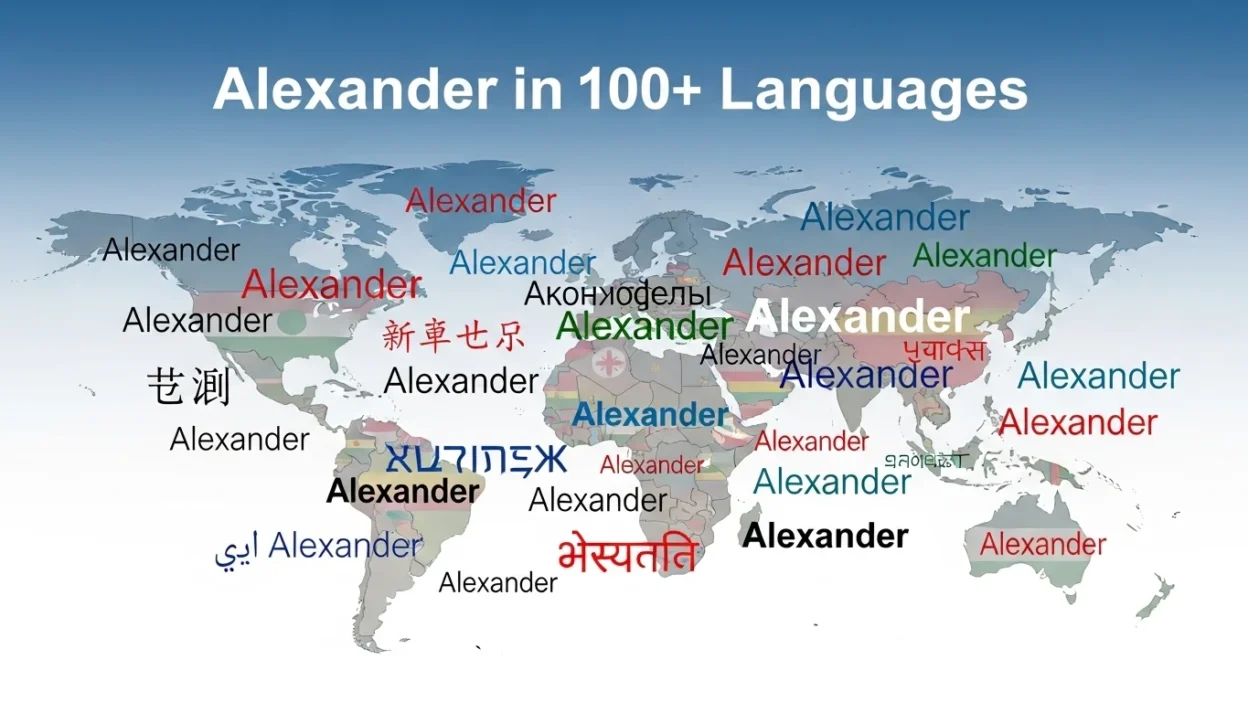
If you’re searching for “100+ Alexander in different languages”, you’re likely curious about how this classic name appears and sounds across cultures.
Whether for naming inspiration, language learning, or global curiosity, understanding Alexander in all languages gives you insight into history, pronunciation, and cultural variations of one of the world’s most widely used names.
In this guide, you’ll discover how to say Alexander in different languages, along with pronunciation tips and simple real life examples. This helps you understand not just the translation, but how the name is actually used in everyday conversation.
Alexander in Different Languages
| Language | Pronunciation | Example |
| English | al-ig-ZAN-der | My friend Alexander is visiting today. (Meaning: My friend Alexander is visiting today.) |
| Spanish | a-le-HAN-dro | Alejandro is my neighbor. (Meaning: Alejandro is my neighbor.) |
| French | a-lek-SAN-dr | Alexandre works here. (Meaning: Alexandre works here.) |
| German | a-LEK-san-der | Alexander is my teacher. (Meaning: Alexander is my teacher.) |
| Italian | a-les-SAN-dro | Alessandro plays football. (Meaning: Alessandro plays football.) |
| Portuguese | a-leh-SAN-dru | Alexandre is happy. (Meaning: Alexandre is happy.) |
| Dutch | a-lek-SAN-der | Alexander lives nearby. (Meaning: Alexander lives nearby.) |
| Russian | a-lyek-SAN-dr | Aleksandr is my brother. (Meaning: Aleksandr is my brother.) |
| Ukrainian | o-lek-SAN-dr | Oleksandr is strong. (Meaning: Oleksandr is strong.) |
| Polish | a-lek-SAN-der | Aleksander is here. (Meaning: Aleksander is here.) |
| Czech | a-lek-SAN-dr | Alexandr arrived early. (Meaning: Alexandr arrived early.) |
| Slovak | a-lek-SAN-der | Alexander is kind. (Meaning: Alexander is kind.) |
| Hungarian | a-lek-SAN-der | Sándor is my uncle. (Meaning: Sándor is my uncle.) |
| Romanian | a-lek-SAN-dru | Alexandru studies hard. (Meaning: Alexandru studies hard.) |
| Bulgarian | a-lek-SAN-dar | Aleksandar is tall. (Meaning: Aleksandar is tall.) |
| Serbian | a-lek-SAN-dar | Aleksandar is friendly. (Meaning: Aleksandar is friendly.) |
| Croatian | a-lek-SAN-dar | Aleksandar is my cousin. (Meaning: Aleksandar is my cousin.) |
| Greek | a-lek-SAN-dros | Alexandros is famous. (Meaning: Alexandros is famous.) |
| Turkish | a-lek-SAN-der | Alexander came late. (Meaning: Alexander came late.) |
| Arabic | a-lek-SAN-dar | Iskandar is a hero. (Meaning: Iskandar is a hero.) |
| Persian | es-kan-DAR | Eskandar is wise. (Meaning: Eskandar is wise.) |
| Hindi | a-lek-SAN-dar | Alexander is here. (Meaning: Alexander is here.) |
| Urdu | a-lek-SAN-dar | Alexander aya hai. (Meaning: Alexander has come.) |
| Bengali | a-lek-SAN-dar | Alexander amar bondhu. (Meaning: Alexander is my friend.) |
| Punjabi | a-lek-SAN-dar | Alexander mera dost hai. (Meaning: Alexander is my friend.) |
| Tamil | a-lek-SAN-dar | Alexander inge irukkar. (Meaning: Alexander is here.) |
| Telugu | a-lek-SAN-dar | Alexander vachadu. (Meaning: Alexander came.) |
| Kannada | a-lek-SAN-dar | Alexander illi iddare. (Meaning: Alexander is here.) |
| Malayalam | a-lek-SAN-dar | Alexander ivide undu. (Meaning: Alexander is here.) |
| Thai | a-lek-SAN-da | Alexander maa laew. (Meaning: Alexander has arrived.) |
| Vietnamese | a-lek-SAN-der | Alexander den roi. (Meaning: Alexander arrived.) |
| Indonesian | a-lek-SAN-der | Alexander datang. (Meaning: Alexander came.) |
| Malay | a-lek-SAN-der | Alexander ada di sini. (Meaning: Alexander is here.) |
| Filipino | a-lek-SAN-der | Alexander ay narito. (Meaning: Alexander is here.) |
| Chinese (Mandarin) | ah-lek-san-da | Alexander zai zheli. (Meaning: Alexander is here.) |
| Japanese | a-re-ku-san-da | Alexander ga kita. (Meaning: Alexander came.) |
| Korean | a-lek-san-deo | Alexander watda. (Meaning: Alexander came.) |
| Swahili | a-lek-SAN-der | Alexander yuko hapa. (Meaning: Alexander is here.) |
| Zulu | a-lek-SAN-da | Alexander ulapha. (Meaning: Alexander is here.) |
| Afrikaans | a-lek-SAN-der | Alexander is hier. (Meaning: Alexander is here.) |
| Hebrew | a-lek-SAN-der | Alexander po. (Meaning: Alexander is here.) |
| Finnish | a-lek-SAN-te-ri | Aleksanteri tuli. (Meaning: Aleksanteri came.) |
| Swedish | a-lek-SAN-der | Alexander är här. (Meaning: Alexander is here.) |
| Norwegian | a-lek-SAN-der | Alexander er her. (Meaning: Alexander is here.) |
| Danish | a-lek-SAN-der | Alexander er her. (Meaning: Alexander is here.) |
| Icelandic | a-lek-SAN-der | Alexander er hér. (Meaning: Alexander is here.) |
| Irish | a-lek-SAN-der | Alexander anseo. (Meaning: Alexander is here.) |
| Scottish Gaelic | a-lek-SAN-der | Alexander an seo. (Meaning: Alexander is here.) |
| Welsh | a-lek-SAN-der | Alexander yma. (Meaning: Alexander is here.) |
| Albanian | a-lek-SAN-der | Aleksandër është këtu. (Meaning: Alexander is here.) |
| Macedonian | a-lek-SAN-dar | Aleksandar e tuka. (Meaning: Alexander is here.) |
| Slovenian | a-lek-SAN-der | Aleksander je tukaj. (Meaning: Alexander is here.) |
| Estonian | a-lek-SAN-der | Aleksander on siin. (Meaning: Alexander is here.) |
| Latvian | a-lek-SAN-ders | Aleksandrs ir šeit. (Meaning: Alexander is here.) |
| Lithuanian | a-lek-SAN-dras | Aleksandras yra čia. (Meaning: Alexander is here.) |
| Maltese | a-lek-SAN-der | Alexander qiegħed hawn. (Meaning: Alexander is here.) |
| Basque | a-lek-SAN-der | Alexander hemen dago. (Meaning: Alexander is here.) |
| Catalan | a-lek-SAN-dre | Alexandre és aquí. (Meaning: Alexander is here.) |
| Galician | a-lek-SAN-dre | Alexandre está aquí. (Meaning: Alexander is here.) |
| Armenian | a-lek-SAN-der | Aleksandr e aystegh. (Meaning: Alexander is here.) |
| Georgian | a-lek-SAN-dre | Aleksandre aq aris. (Meaning: Alexander is here.) |
| Mongolian | a-lek-SAN-der | Alexander irsen. (Meaning: Alexander came.) |
| Khmer | a-lek-SAN-da | Alexander mok. (Meaning: Alexander came.) |
| Lao | a-lek-SAN-da | Alexander maa laew. (Meaning: Alexander arrived.) |
| Burmese | a-lek-SAN-da | Alexander yauk de. (Meaning: Alexander arrived.) |
| Nepali | a-lek-SAN-dar | Alexander ayo. (Meaning: Alexander came.) |
| Sinhala | a-lek-SAN-der | Alexander awa. (Meaning: Alexander came.) |
| Pashto | a-lek-SAN-dar | Alexander raghlay. (Meaning: Alexander came.) |
| Kazakh | a-lek-SAN-dr | Aleksandr keldi. (Meaning: Aleksandr came.) |
| Uzbek | a-lek-SAN-dr | Aleksandr keldi. (Meaning: Aleksandr came.) |
How to Say Alexander in Different Languages
The name Alexander changes slightly depending on pronunciation rules and alphabet systems. In Romance languages like Spanish and Italian, it becomes Alejandro or Alessandro, while Slavic languages prefer forms like Aleksandr.
Understanding these variations helps when learning Alexander translations or communicating globally.
Alexander Around the World
Alexander around the world reflects deep historical roots, especially from ancient Greece. Many countries adapted the name while keeping its original meaning: “defender of men.”
From Europe to Asia, the name remains widely recognized, making it one of the most universal names globally.
Conclusion
Exploring Alexander in all languages shows how one name can travel across cultures while keeping its identity. Whether you’re learning languages, choosing a name, or exploring global cultures, these translations give you a practical and fascinating perspective.
FAQs
1. What does the name Alexander mean?
Alexander means “defender of men” and has Greek origins.
2. How do you say Alexander in Spanish?
In Spanish, Alexander is commonly translated as Alejandro.
3. Is Alexander the same in all languages?
No, it changes slightly depending on pronunciation and cultural adaptation.
4. What is the most common variation of Alexander?
Alejandro, Alessandro, and Aleksandr are among the most common variations worldwide.
5. Why is Alexander popular globally?
Its historical significance and strong meaning make it popular across many cultures.

Ely Joseph is a language researcher, writer, and contributor who specializes in words, meanings, and multilingual communication. With a strong interest in how language shapes understanding across cultures, Ely focuses on creating clear, accurate, and reader-friendly content for a global audience.